 Add to Chrome
 Add to Firefox
 Add to Edge
Adaptive Action Chunking via Multi-Chunk Q Value Estimation
May 11, 2026
Action chunking emerged as a pivotal technique in imitation learning, enabling policies to predict cohesive action sequences rather than single actions. Recently, this approach has expanded to reinforcement learning (RL), enhancing behavioral consistency and reducing bootstrapping errors in value function estimation. However, existing methods rely on a fixed chunk length, creating a performance bottleneck as the optimal length varies across states and tasks. In this paper, we propose Adaptive Action CHunking (ACH), a novel offline-to-online RL algorithm that dynamically modulates chunk length during both training and inference. To find the optimal chunk length for a dynamically varying current state, we simultaneously estimate action-values for all candidate chunk lengths in a single forward pass, using a Transformer-based architecture. Our mechanism allows the agent to select the most effective chunk length adaptively based on the current state. Evaluated on 34 challenging tasks, ACH consistently outperforms fixed-length baselines, demonstrating superior generalization and learning efficiency in complex environments.

Sample-Efficient and Safe Deep Reinforcement Learning via Reset Deep Ensemble Agents
Oct 31, 2023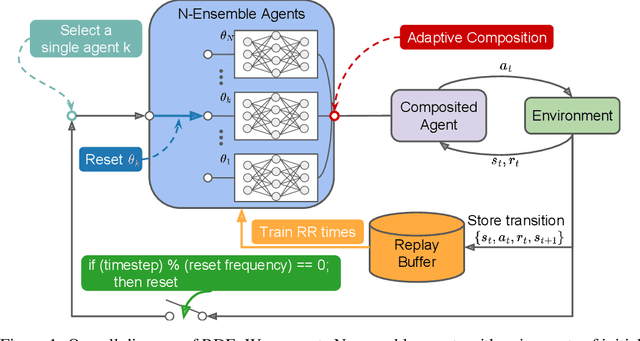
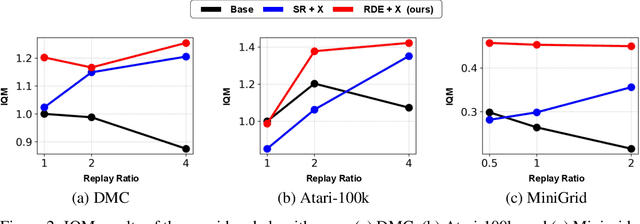
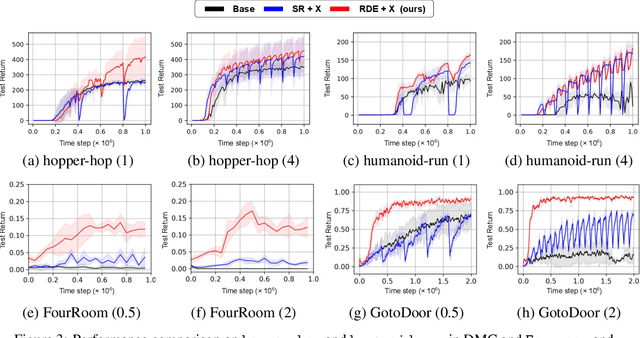
Deep reinforcement learning (RL) has achieved remarkable success in solving complex tasks through its integration with deep neural networks (DNNs) as function approximators. However, the reliance on DNNs has introduced a new challenge called primacy bias, whereby these function approximators tend to prioritize early experiences, leading to overfitting. To mitigate this primacy bias, a reset method has been proposed, which performs periodic resets of a portion or the entirety of a deep RL agent while preserving the replay buffer. However, the use of the reset method can result in performance collapses after executing the reset, which can be detrimental from the perspective of safe RL and regret minimization. In this paper, we propose a new reset-based method that leverages deep ensemble learning to address the limitations of the vanilla reset method and enhance sample efficiency. The proposed method is evaluated through various experiments including those in the domain of safe RL. Numerical results show its effectiveness in high sample efficiency and safety considerations.