 Add to Chrome
 Add to Firefox
 Add to Edge
Understanding and Improving Hyperbolic Deep Reinforcement Learning
Dec 16, 2025
The performance of reinforcement learning (RL) agents depends critically on the quality of the underlying feature representations. Hyperbolic feature spaces are well-suited for this purpose, as they naturally capture hierarchical and relational structure often present in complex RL environments. However, leveraging these spaces commonly faces optimization challenges due to the nonstationarity of RL. In this work, we identify key factors that determine the success and failure of training hyperbolic deep RL agents. By analyzing the gradients of core operations in the Poincaré Ball and Hyperboloid models of hyperbolic geometry, we show that large-norm embeddings destabilize gradient-based training, leading to trust-region violations in proximal policy optimization (PPO). Based on these insights, we introduce Hyper++, a new hyperbolic PPO agent that consists of three components: (i) stable critic training through a categorical value loss instead of regression; (ii) feature regularization guaranteeing bounded norms while avoiding the curse of dimensionality from clipping; and (iii) using a more optimization-friendly formulation of hyperbolic network layers. In experiments on ProcGen, we show that Hyper++ guarantees stable learning, outperforms prior hyperbolic agents, and reduces wall-clock time by approximately 30%. On Atari-5 with Double DQN, Hyper++ strongly outperforms Euclidean and hyperbolic baselines. We release our code at https://github.com/Probabilistic-and-Interactive-ML/hyper-rl .

Spectral Clustering of Attributed Multi-relational Graphs
Nov 03, 2023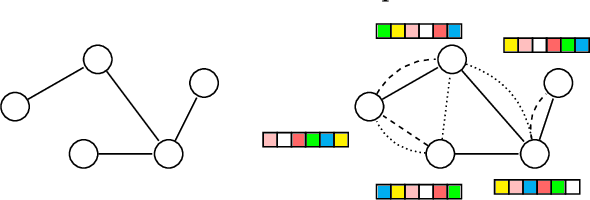

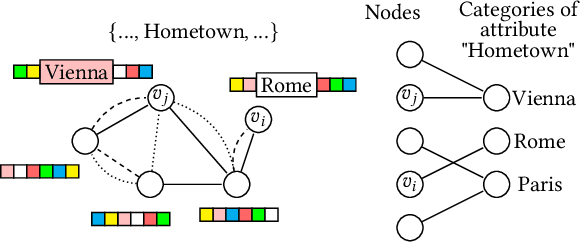

Graph clustering aims at discovering a natural grouping of the nodes such that similar nodes are assigned to a common cluster. Many different algorithms have been proposed in the literature: for simple graphs, for graphs with attributes associated to nodes, and for graphs where edges represent different types of relations among nodes. However, complex data in many domains can be represented as both attributed and multi-relational networks. In this paper, we propose SpectralMix, a joint dimensionality reduction technique for multi-relational graphs with categorical node attributes. SpectralMix integrates all information available from the attributes, the different types of relations, and the graph structure to enable a sound interpretation of the clustering results. Moreover, it generalizes existing techniques: it reduces to spectral embedding and clustering when only applied to a single graph and to homogeneity analysis when applied to categorical data. Experiments conducted on several real-world datasets enable us to detect dependencies between graph structure and categorical attributes, moreover, they exhibit the superiority of SpectralMix over existing methods.