 Add to Chrome
 Add to Firefox
 Add to Edge
Unveiling Complex Collective Behaviors from Simple Rewards
Jul 14, 2026
Multi-agent Reinforcement Learning (MARL) holds great potential for robot swarms, but the black-box nature of neural policies complicates strategic analysis, limiting multi-robot applications. Furthermore, complex swarm behaviors can surprisingly emerge from simple rewards without explicit aggregation incentives. Unveiling the mechanisms behind this emergence is critical, but the disconnection between simple rewards and collective behaviors exacerbates interpretability challenges. This paper aims to reveal the hidden mechanisms in this process. We propose a two-stage EEC (\LinkIII) explanatory framework. This includes a novel analytical tool called the Agent Response Map (ARM), which reveals agents' decision-making patterns across space and identifies regions of aggregation and avoidance. ARM reveals that the robots implicitly learn the geometric fields of the environment and utilize these structures as desired targets for coordinated movement. We validate this finding across two distinct tasks: a cooperative multi-robot shape assembly and a competitive predator-prey pursuit-evasion. 1) In the cooperative task, ARM identifies the unoccupied target interior as the desired destination for robot navigation. As the center becomes occupied, this target region automatically shifts toward the boundary, demonstrating the robots' capacity to autonomously explore unoccupied areas. 2) In the competitive task, ARM surprisingly identifies the boundary of the predators' Voronoi diagram as the convergence destination for prey agents. Together, these two tasks demonstrate the capability of ARM to discover the hidden geometric structures underlying MARL policies in robot swarms.

Vision-Based Cooperative MAV-Capturing-MAV
Mar 09, 2025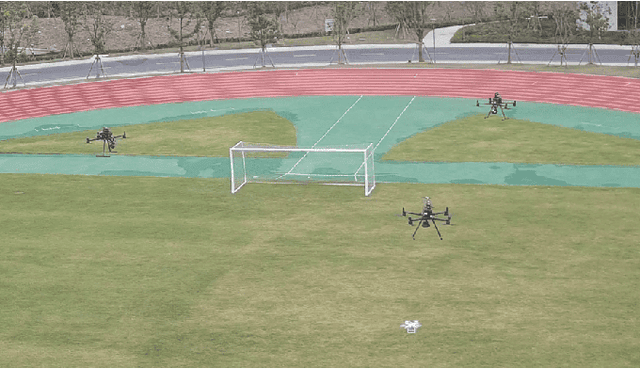
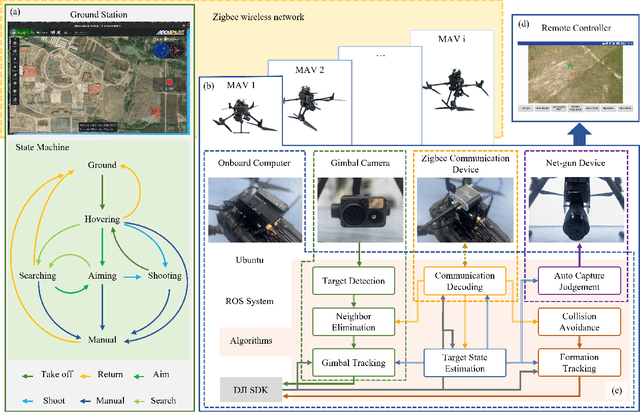
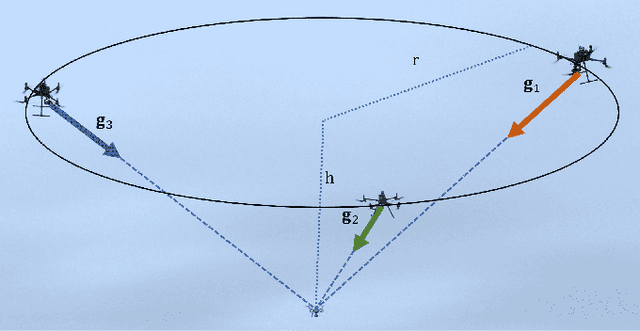
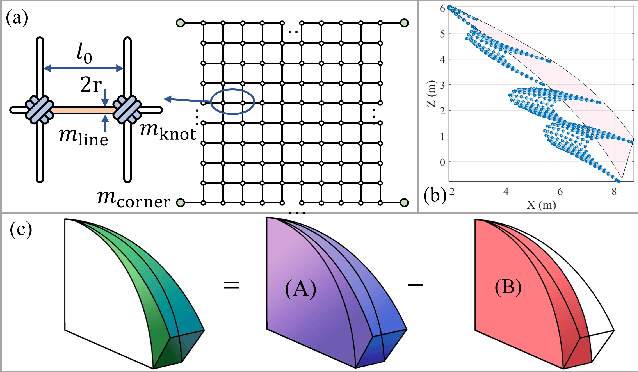
MAV-capturing-MAV (MCM) is one of the few effective methods for physically countering misused or malicious MAVs.This paper presents a vision-based cooperative MCM system, where multiple pursuer MAVs equipped with onboard vision systems detect, localize, and pursue a target MAV. To enhance robustness, a distributed state estimation and control framework enables the pursuer MAVs to autonomously coordinate their actions. Pursuer trajectories are optimized using Model Predictive Control (MPC) and executed via a low-level SO(3) controller, ensuring smooth and stable pursuit. Once the capture conditions are satisfied, the pursuer MAVs automatically deploy a flying net to intercept the target. These capture conditions are determined based on the predicted motion of the net. To enable real-time decision-making, we propose a lightweight computational method to approximate the net motion, avoiding the prohibitive cost of solving the full net dynamics. The effectiveness of the proposed system is validated through simulations and real-world experiments. In real-world tests, our approach successfully captures a moving target traveling at 4 meters per second with an acceleration of 1 meter per square second, achieving a success rate of 64.7 percent.
Optimal Spatial-Temporal Triangulation for Bearing-Only Cooperative Motion Estimation
Oct 29, 2023Vision-based cooperative motion estimation is an important problem for many multi-robot systems such as cooperative aerial target pursuit. This problem can be formulated as bearing-only cooperative motion estimation, where the visual measurement is modeled as a bearing vector pointing from the camera to the target. The conventional approaches for bearing-only cooperative estimation are mainly based on the framework distributed Kalman filtering (DKF). In this paper, we propose a new optimal bearing-only cooperative estimation algorithm, named spatial-temporal triangulation, based on the method of distributed recursive least squares, which provides a more flexible framework for designing distributed estimators than DKF. The design of the algorithm fully incorporates all the available information and the specific triangulation geometric constraint. As a result, the algorithm has superior estimation performance than the state-of-the-art DKF algorithms in terms of both accuracy and convergence speed as verified by numerical simulation. We rigorously prove the exponential convergence of the proposed algorithm. Moreover, to verify the effectiveness of the proposed algorithm under practical challenging conditions, we develop a vision-based cooperative aerial target pursuit system, which is the first of such fully autonomous systems so far to the best of our knowledge.