 Add to Chrome
 Add to Firefox
 Add to Edge
Coral: Cost-Efficient Multi-LLM Serving over Heterogeneous Cloud GPUs
May 05, 2026
The usage of large language models (LLMs) has grown increasingly fragmented, with no single model dominating. Meanwhile, cloud providers offer a wide range of mid-tier and older-generation GPUs that enjoy better availability and deliver comparable performance per dollar to top-tier hardware. To efficiently harness these heterogeneous resources for serving multiple LLMs concurrently, we introduce Coral, an adaptive heterogeneity-aware multi-LLM serving system. The key idea behind Coral is to jointly optimize resource allocation and the serving strategy of each model replica across all models. To keep pace with shifting throughput demand and resource availability, Coral applies a lossless two-stage decomposition that preserves joint optimality while cutting online solve time from hours to tens of seconds. Our evaluation across 6 models and 20 GPU configurations shows that Coral reduces serving cost by up to 2.79$\times$ over the best baseline, and delivers up to 2.39$\times$ higher goodput under scarce resource availability.

Helix: Distributed Serving of Large Language Models via Max-Flow on Heterogeneous GPUs
Jun 03, 2024


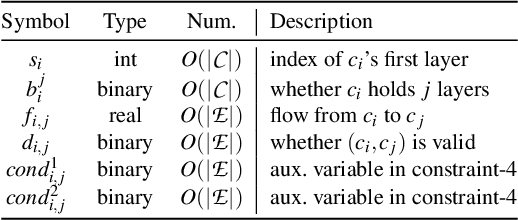
This paper introduces Helix, a distributed system for high-throughput, low-latency large language model (LLM) serving on heterogeneous GPU clusters. A key idea behind Helix is to formulate inference computation of LLMs over heterogeneous GPUs and network connections as a max-flow problem for a directed, weighted graph, whose nodes represent GPU instances and edges capture both GPU and network heterogeneity through their capacities. Helix then uses a mixed integer linear programming (MILP) algorithm to discover highly optimized strategies to serve LLMs. This approach allows Helix to jointly optimize model placement and request scheduling, two highly entangled tasks in heterogeneous LLM serving. Our evaluation on several heterogeneous cluster settings ranging from 24 to 42 GPU nodes shows that Helix improves serving throughput by up to 2.7$\times$ and reduces prompting and decoding latency by up to 2.8$\times$ and 1.3$\times$, respectively, compared to best existing approaches.
Quarl: A Learning-Based Quantum Circuit Optimizer
Jul 17, 2023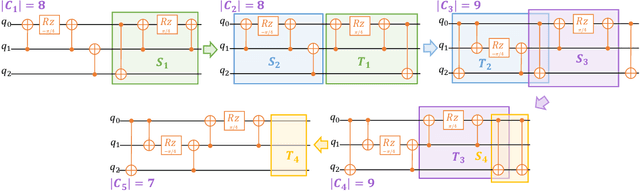
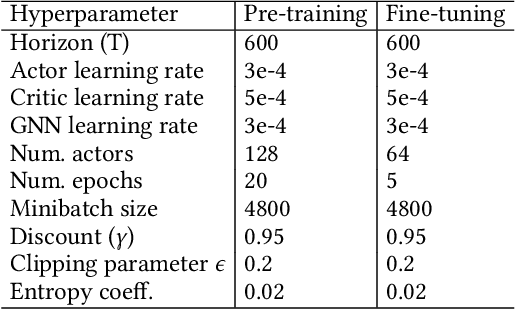
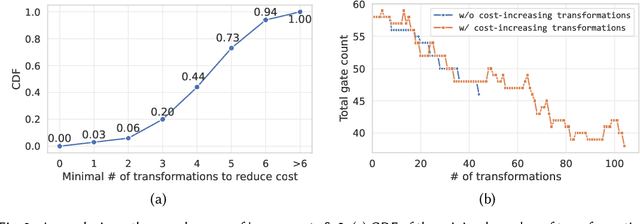
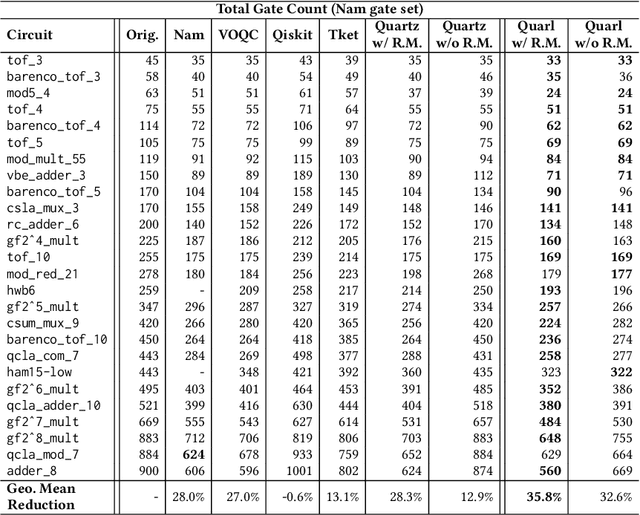
Optimizing quantum circuits is challenging due to the very large search space of functionally equivalent circuits and the necessity of applying transformations that temporarily decrease performance to achieve a final performance improvement. This paper presents Quarl, a learning-based quantum circuit optimizer. Applying reinforcement learning (RL) to quantum circuit optimization raises two main challenges: the large and varying action space and the non-uniform state representation. Quarl addresses these issues with a novel neural architecture and RL-training procedure. Our neural architecture decomposes the action space into two parts and leverages graph neural networks in its state representation, both of which are guided by the intuition that optimization decisions can be mostly guided by local reasoning while allowing global circuit-wide reasoning. Our evaluation shows that Quarl significantly outperforms existing circuit optimizers on almost all benchmark circuits. Surprisingly, Quarl can learn to perform rotation merging, a complex, non-local circuit optimization implemented as a separate pass in existing optimizers.