 Add to Chrome
 Add to Firefox
 Add to Edge
Adding Thermal Awareness to Visual Systems in Real-Time via Distilled Diffusion Models
May 07, 2026
Purely RGB-based vision models often fail to provide reliable cues in challenging scenarios such as nighttime and fog, leading to degraded performance and safety risks. Infrared imaging captures heat-emitting sources and provides critical complementary information, but existing high-fidelity fusion methods suffer from prohibitive latency, rendering them impractical for real-time edge deployment. To address this, we propose FusionProxy, a real-time image fusion module designed as a fully independent, plug-and-play component with diffusion level quality. FusionProxy exploits two complementary statistics of a teacher sample ensemble: per-pixel variance in raw image space, used to weight pixel-level supervision, and per-pixel variance inside frozen foundation backbones, used to route feature-level alignment spatially. Once trained, FusionProxy can be directly integrated into any visual perception system without joint optimization. Extensive experiments demonstrate that our method achieves superior performance on static recognition tasks and significantly enhances robustness in dynamic tasks, including closed-loop autonomous driving. Crucially, FusionProxy achieves real-time inference speeds on diverse platforms, from high-end GPUs to commodity hardware, providing a flexible and generalizable solution for all-day perception.

Competitive and Penalized Clustering Auto-encoder
Mar 12, 2017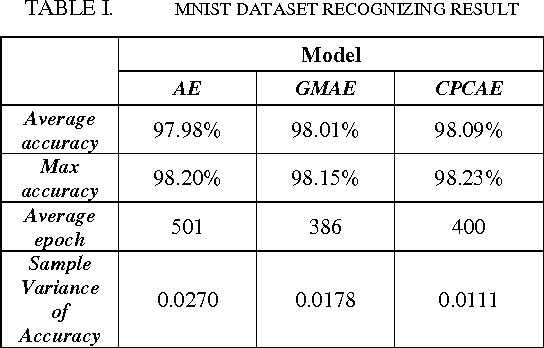
The paper has been withdrawn since more effective experiments should be completed. Auto-encoders (AE) has been widely applied in different fields of machine learning. However, as a deep model, there are a large amount of learnable parameters in the AE, which would cause over-fitting and slow learning speed in practice. Many researchers have been study the intrinsic structure of AE and showed different useful methods to regularize those parameters. In this paper, we present a novel regularization method based on a clustering algorithm which is able to classify the parameters into different groups. With this regularization, parameters in a given group have approximate equivalent values and over-fitting problem could be alleviated. Moreover, due to the competitive behavior of clustering algorithm, this model also overcomes some intrinsic problems of clustering algorithms like the determination of number of clusters. Experiments on handwritten digits recognition verify the effectiveness of our novel model.