 Add to Chrome
 Add to Firefox
 Add to Edge
FAS-R1: A Unified Multi-Task MLLM for Reasoning Face Anti-Spoofing
Jul 29, 2026
Face anti-spoofing (FAS) is increasingly expected to provide not only bona fide/spoof decisions, but also attack semantics and image-grounded evidence for human inspection. Existing discriminative FAS models remain largely label-centric, while recent MLLM-based methods offer structured outputs but still rely mainly on supervised fine-tuning, often producing template-like rationales and weak optimization for difficult attacks. We propose FAS-R1, a two-stage reasoning-oriented MLLM framework for unified FAS prediction, covering authenticity classification, attack-type recognition and spoof-region localization. FAS-R1 first uses FAS-R1-23K, a high-quality long-CoT dataset, for cold-start supervised fine-tuning, and then performs FAS-specific GRPO post-training. Degradation-Simulated Augmentation (DSA) encourages stable spoof-cue reasoning across visual-quality shifts, while Difficulty-Aware GRPO (DA-GRPO) mitigates easy-sample dominance that may leave difficult task--attack groups under-optimized, especially for subtle or ambiguous attacks such as makeup and mask attacks. The main 3B FAS-R1 model achieves 98.75\% authenticity accuracy, 93.33\% attack-type accuracy, and 96.30/94.73\% AP@40/AP@50 in-domain. It also outperforms the compared systems in cross-domain authenticity generalization and answer-and-rationale quality. Experiments with different base models further show favorable scaling behavior. The code will be released soon.

AMSNet: Netlist Dataset for AMS Circuits
May 15, 2024
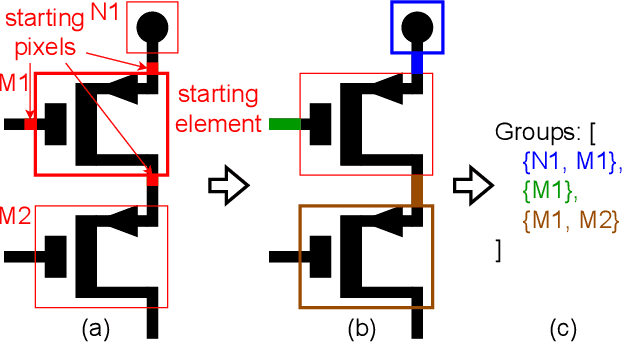
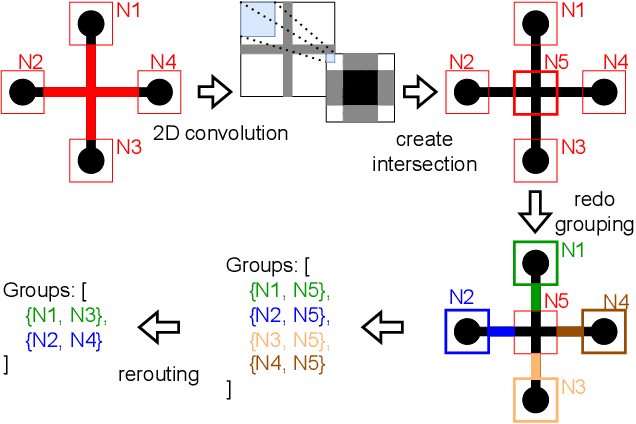
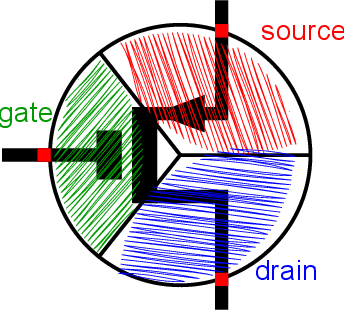
Today's analog/mixed-signal (AMS) integrated circuit (IC) designs demand substantial manual intervention. The advent of multimodal large language models (MLLMs) has unveiled significant potential across various fields, suggesting their applicability in streamlining large-scale AMS IC design as well. A bottleneck in employing MLLMs for automatic AMS circuit generation is the absence of a comprehensive dataset delineating the schematic-netlist relationship. We therefore design an automatic technique for converting schematics into netlists, and create dataset AMSNet, encompassing transistor-level schematics and corresponding SPICE format netlists. With a growing size, AMSNet can significantly facilitate exploration of MLLM applications in AMS circuit design. We have made an initial set of netlists public, and will make both our netlist generation tool and the full dataset available upon publishing of this paper.