 Add to Chrome
 Add to Firefox
 Add to Edge
A Posterior-Predictive Variance Decomposition for Epistemic and Aleatoric Uncertainty in Wind Power Forecasting
May 21, 2026
Accurate wind power forecasting requires reliable uncertainty quantification, yet most existing methods report a single predictive uncertainty that conflates epistemic and aleatoric sources. This paper applies the law of total variance to the joint setting of heteroscedastic neural network regression and Bayesian posterior approximation, deriving an explicit decomposition of total uncertainty (TU) into aleatoric (AU) and epistemic (EU) components. The resulting estimators are compatible with standard posterior-approximation methods and with $β$-NLL training to regulate the mean--variance learning trade-off. A wind power--specific evaluation framework is proposed to validate disentanglement without access to ground-truth uncertainty labels, comprising three modules: controlled synthetic experiments to verify responses to heteroscedastic noise and distribution shift; data-property--driven validation on a real-world wind turbine SCADA dataset; and dataset-size scaling experiments to examine the predicted asymptotic behavior of EU. Across synthetic and real-world experiments, the decomposed AU and EU components respond in theoretically consistent directions to noise structure, distributional shift, and training-scale variation, supporting the theoretical consistency and operational utility of the proposed decomposition and evaluation protocol.

A Unified Framework for Uncertainty-Aware Explainable Artificial Intelligence: A Case Study in Power Quality Disturbance Classification
May 20, 2026Post-hoc explainable AI (XAI) methods typically produce deterministic attribution maps, whereas Bayesian neural networks (BNNs) induce a distribution over explanations. Capturing the variability of this distribution is important for uncertainty-aware decision-making. This paper formalises the \emph{explanation distribution} as the push-forward measure of the BNN posterior through any Lipschitz-continuous attribution operator. It further proposes the uncertainty-aware relevance attribution operator (UA-RAO), a general family of operators that summarises the explanation distribution using the mean, variance, coefficient of variation, quantiles, and set-theoretic aggregation measures. Theoretical support is provided through Monte Carlo accessibility and Wasserstein approximation bounds. The framework is evaluated on a 15-class power quality disturbance (PQD) classification benchmark, comparing three BNN approximations paired with three attribution operators using relevance mass accuracy and intersection-over-union as localisation metrics. Results show that deep ensembles with the mean UA-RAO improve localisation over the deterministic baseline, while other UA-RAO summaries reveal uncertainty patterns absent from point-estimate attributions. Qualitative results on measured signals further suggest that these patterns generalise beyond the synthetic training distribution. The framework is domain-agnostic and can be applied to any BNN paired with a Lipschitz-continuous attribution operator.
A Bayesian Framework for Uncertainty-Aware Explanations in Power Quality Disturbance Classification
Apr 15, 2026Advanced deep learning methods have shown remarkable success in power quality disturbance (PQD) classification. To enhance model transparency, explainable AI (XAI) techniques have been developed to provide instance-specific interpretations of classifier decisions. However, conventional XAI methods yield deterministic explanations, overlooking uncertainty and limiting reliability in safety-critical applications. This paper proposes a Bayesian explanation framework that models explanation uncertainty by generating a relevance attribution distribution for each instance. This method allows experts to select explanations based on confidence percentiles, thereby tailoring interpretability according to specific disturbance types. Extensive experiments on synthetic and real-world power quality datasets demonstrate that the proposed framework improves the transparency and reliability of PQD classifiers through uncertainty-aware explanations.
Dynamic Residual Safe Reinforcement Learning for Multi-Agent Safety-Critical Scenarios Decision-Making
Apr 09, 2025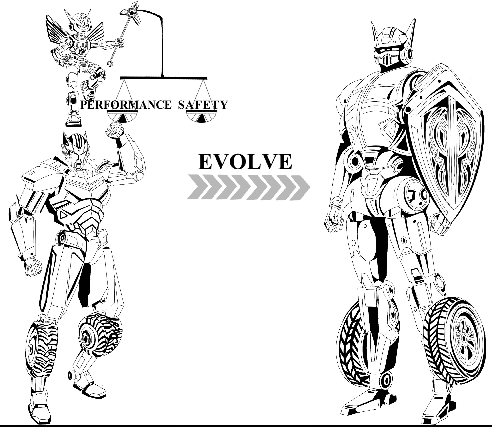
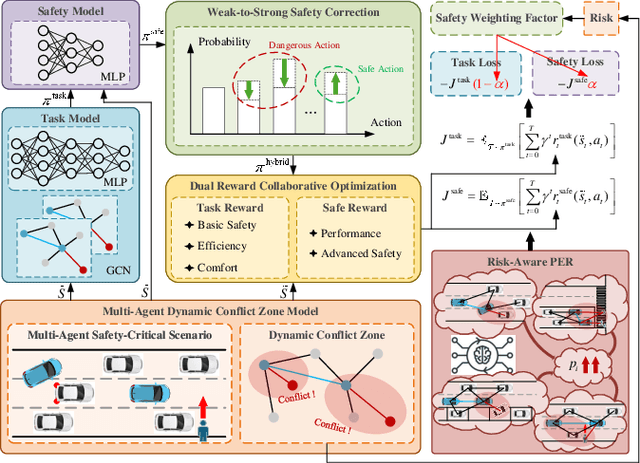
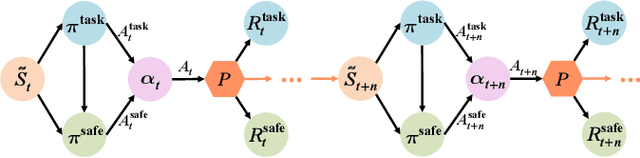
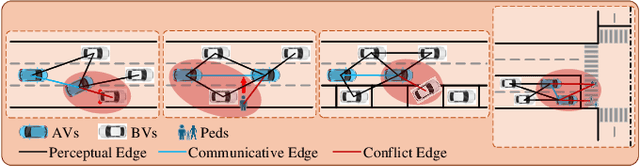
In multi-agent safety-critical scenarios, traditional autonomous driving frameworks face significant challenges in balancing safety constraints and task performance. These frameworks struggle to quantify dynamic interaction risks in real-time and depend heavily on manual rules, resulting in low computational efficiency and conservative strategies. To address these limitations, we propose a Dynamic Residual Safe Reinforcement Learning (DRS-RL) framework grounded in a safety-enhanced networked Markov decision process. It's the first time that the weak-to-strong theory is introduced into multi-agent decision-making, enabling lightweight dynamic calibration of safety boundaries via a weak-to-strong safety correction paradigm. Based on the multi-agent dynamic conflict zone model, our framework accurately captures spatiotemporal coupling risks among heterogeneous traffic participants and surpasses the static constraints of conventional geometric rules. Moreover, a risk-aware prioritized experience replay mechanism mitigates data distribution bias by mapping risk to sampling probability. Experimental results reveal that the proposed method significantly outperforms traditional RL algorithms in safety, efficiency, and comfort. Specifically, it reduces the collision rate by up to 92.17%, while the safety model accounts for merely 27% of the main model's parameters.
Generalized Laplace Approximation
May 22, 2024
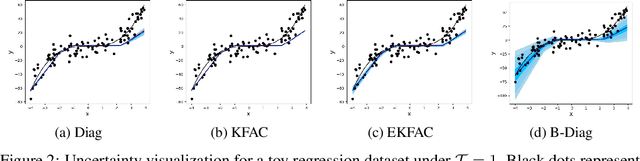
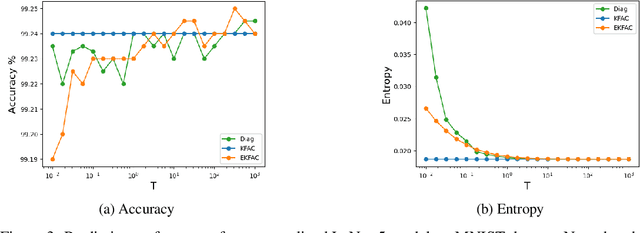
In recent years, the inconsistency in Bayesian deep learning has garnered increasing attention. Tempered or generalized posterior distributions often offer a direct and effective solution to this issue. However, understanding the underlying causes and evaluating the effectiveness of generalized posteriors remain active areas of research. In this study, we introduce a unified theoretical framework to attribute Bayesian inconsistency to model misspecification and inadequate priors. We interpret the generalization of the posterior with a temperature factor as a correction for misspecified models through adjustments to the joint probability model, and the recalibration of priors by redistributing probability mass on models within the hypothesis space using data samples. Additionally, we highlight a distinctive feature of Laplace approximation, which ensures that the generalized normalizing constant can be treated as invariant, unlike the typical scenario in general Bayesian learning where this constant varies with model parameters post-generalization. Building on this insight, we propose the generalized Laplace approximation, which involves a simple adjustment to the computation of the Hessian matrix of the regularized loss function. This method offers a flexible and scalable framework for obtaining high-quality posterior distributions. We assess the performance and properties of the generalized Laplace approximation on state-of-the-art neural networks and real-world datasets.