 Add to Chrome
 Add to Firefox
 Add to Edge
Bridging Diffusion Pruning and Step Distillation with Teacher-Aligned Repair
Jul 07, 2026
Diffusion models generate high-quality images, but their inference cost comes from two sources: large denoising networks and repeated denoising steps. Existing compression pipelines usually attack these costs separately. Pruning reduces the network, but most pruning methods still rely on a long post-pruning retraining stage to recover a many-step sampler. Step distillation reduces the number of denoising steps, but it usually assumes a student that can already follow the teacher well enough to receive useful distillation gradients. This paper asks whether post-pruning retraining can be replaced by step distillation. We find that the direct replacement fails: after pruning an EDM2-XS teacher, starting SiDA from the pruned checkpoint produces unusable samples. We introduce a short teacher-alignment repair stage as a bridge between pruning and step distillation. The bridge matches the pruned generator to the teacher on noisy real-image latents, then hands the repaired checkpoint to one-step distillation. On ImageNet-512, the original EDM2-XS baseline uses 124.713M parameters and 63 network evaluations, reaching an FID of 3.53. With a suitable distillation objective, our 20% pruned one-step generator uses 98.826M parameters and one network evaluation, reaching an FID of 3.12. With 30% pruning, the model uses 88.029M parameters and one network evaluation, with an FID of 4.26.

Efficient Diffusion Distillation via Embedding Loss
Apr 24, 2026Recent advances in distilling expensive diffusion models into efficient few-step generators show significant promise. However, these methods typically demand substantial computational resources and extended training periods, limiting accessibility for resource-constrained researchers, and existing supplementary loss functions have notable limitations. Regression loss requires pre-generating large datasets before training and limits the student model to the teacher's performance, while GAN-based losses suffer from training instability and require careful tuning. In this paper, we propose Embedding Loss (EL), a novel supplementary loss function that complements existing diffusion distillation methods to enhance generation quality and accelerate training with smaller batch sizes. Leveraging feature embeddings from a diverse set of randomly initialized networks, EL effectively aligns the feature distributions between the distilled few-step generator and the original data. By computing Maximum Mean Discrepancy (MMD) in the embedded feature space, EL ensures robust distribution matching, thereby preserving sample fidelity and diversity during distillation. Within distribution matching distillation frameworks, EL demonstrates strong empirical performance for one-step generators. On the CIFAR-10 dataset, our approach achieves state-of-the-art FID values of 1.475 for unconditional generation and 1.380 for conditional generation. Beyond CIFAR-10, we further validate EL across multiple benchmarks and distillation methods, including ImageNet, AFHQ-v2, and FFHQ datasets, using DMD, DI, and CM distillation frameworks, demonstrating consistent improvements over existing one-step distillation methods. Our method also reduces training iterations by up to 80%, offering a more practical and scalable solution for deploying diffusion-based generative models in resource-constrained environments.
VMID: A Multimodal Fusion LLM Framework for Detecting and Identifying Misinformation of Short Videos
Nov 15, 2024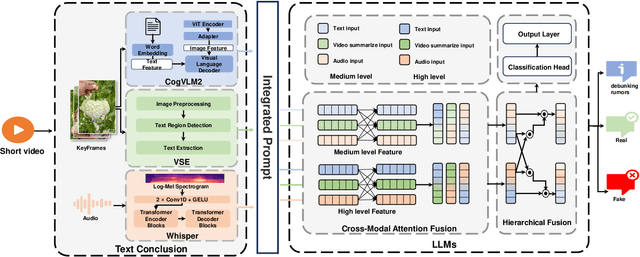
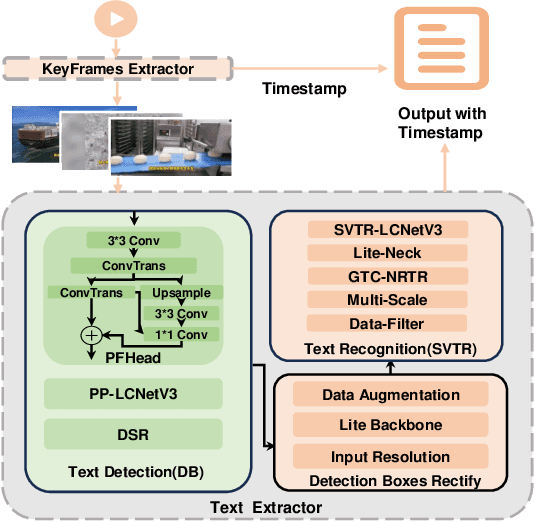

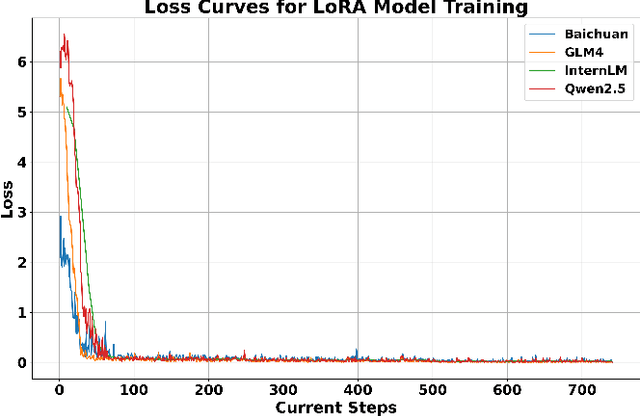
Short video platforms have become important channels for news dissemination, offering a highly engaging and immediate way for users to access current events and share information. However, these platforms have also emerged as significant conduits for the rapid spread of misinformation, as fake news and rumors can leverage the visual appeal and wide reach of short videos to circulate extensively among audiences. Existing fake news detection methods mainly rely on single-modal information, such as text or images, or apply only basic fusion techniques, limiting their ability to handle the complex, multi-layered information inherent in short videos. To address these limitations, this paper presents a novel fake news detection method based on multimodal information, designed to identify misinformation through a multi-level analysis of video content. This approach effectively utilizes different modal representations to generate a unified textual description, which is then fed into a large language model for comprehensive evaluation. The proposed framework successfully integrates multimodal features within videos, significantly enhancing the accuracy and reliability of fake news detection. Experimental results demonstrate that the proposed approach outperforms existing models in terms of accuracy, robustness, and utilization of multimodal information, achieving an accuracy of 90.93%, which is significantly higher than the best baseline model (SV-FEND) at 81.05%. Furthermore, case studies provide additional evidence of the effectiveness of the approach in accurately distinguishing between fake news, debunking content, and real incidents, highlighting its reliability and robustness in real-world applications.
Multi-View Pre-Trained Model for Code Vulnerability Identification
Aug 10, 2022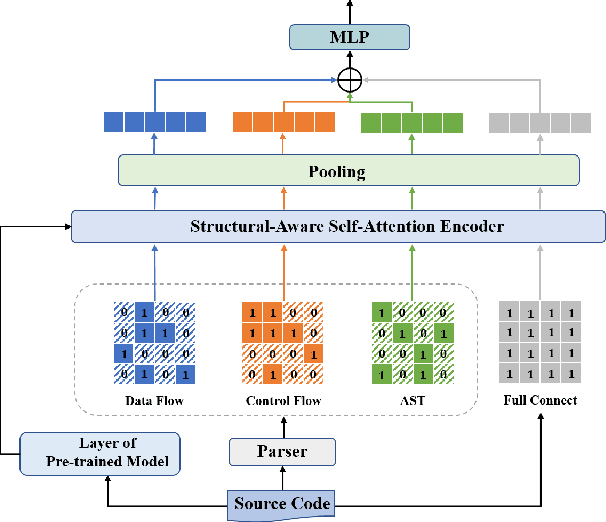
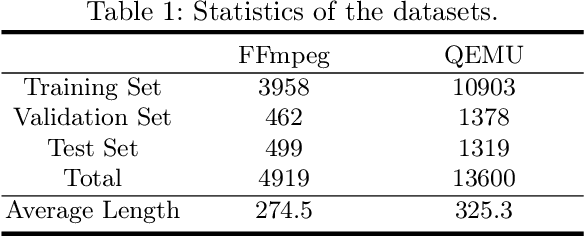
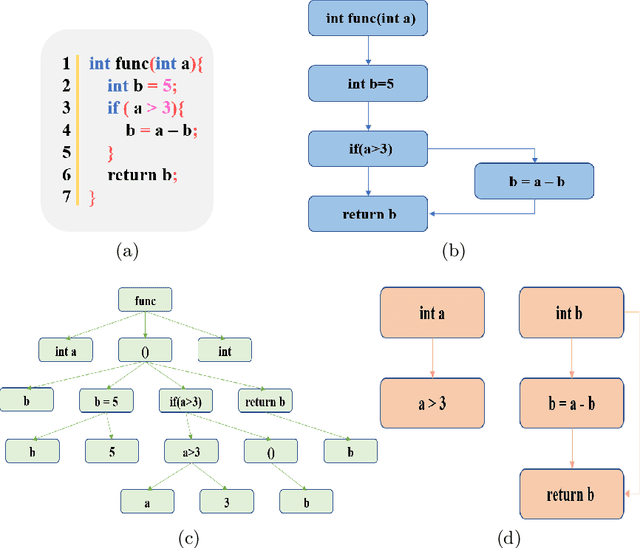
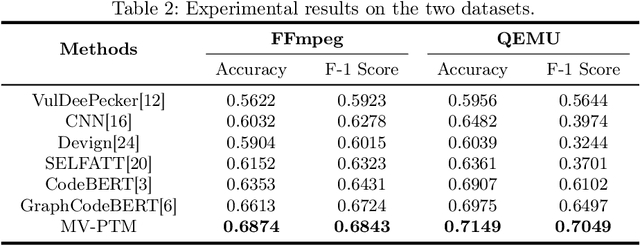
Vulnerability identification is crucial for cyber security in the software-related industry. Early identification methods require significant manual efforts in crafting features or annotating vulnerable code. Although the recent pre-trained models alleviate this issue, they overlook the multiple rich structural information contained in the code itself. In this paper, we propose a novel Multi-View Pre-Trained Model (MV-PTM) that encodes both sequential and multi-type structural information of the source code and uses contrastive learning to enhance code representations. The experiments conducted on two public datasets demonstrate the superiority of MV-PTM. In particular, MV-PTM improves GraphCodeBERT by 3.36\% on average in terms of F1 score.