 Add to Chrome
 Add to Firefox
 Add to Edge
Self-Consistent Generative Paths via Admissible Random Variational Transport
Jun 08, 2026
Modern generative models often define an entire probability path from a simple prior to the data law, rather than only an endpoint map. Diffusion models follow stochastic denoising paths, flow matching learns transport fields, consistency and distillation methods compress paths into one or a few steps, adversarial models match terminal distributions, and VAEs generate through latent kernels. Existing unifying views mainly describe how such paths are constructed. We study a complementary question: when is a generated probability path self-consistent? We define a self-consistent generative path as a random fixed point of admissible local variational transport corrections. In this framework, a local correction is specified by a random variational transport operator combining a divergence or geometry term, an energy term, and a structural constraint. The framework contains random regularized optimal-transport proximal steps as a structured instance, while also allowing non-OT divergences, latent kernels, adversarial constraints, causal discrete kernels, and terminal one-step maps. The theory yields a random fixed-point path residual (R-FPR), which measures the gap between the actual generated path and an admissible local correction. We prove well-posedness, random fixed-point existence and attraction, non-contractive existence, residual-to-generation error bounds, empirical residual concentration, proxy perturbation bounds, continuous-time limits, and operator-level generalization with model-specific corollaries. The resulting theory turns endpoint matching into path self-consistency testing and provides a residual-control principle for diagnosing failures, regularizing training, and guiding adaptive sampling across diffusion, flow, one-step, VAE, GAN/WGAN, and autoregressive generators.

ERDDCI: Exact Reversible Diffusion via Dual-Chain Inversion for High-Quality Image Editing
Oct 18, 2024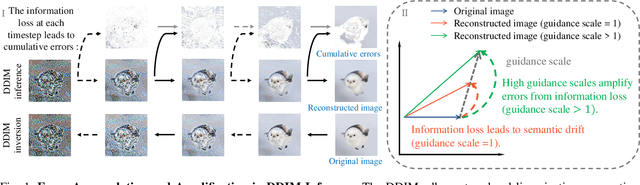

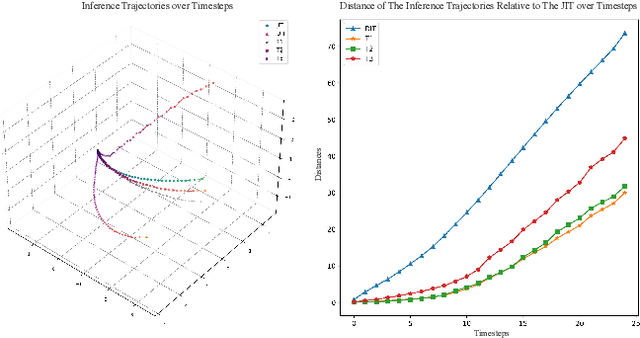
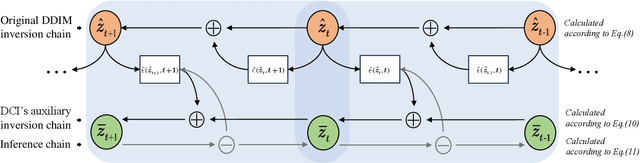
Diffusion models (DMs) have been successfully applied to real image editing. These models typically invert images into latent noise vectors used to reconstruct the original images (known as inversion), and then edit them during the inference process. However, recent popular DMs often rely on the assumption of local linearization, where the noise injected during the inversion process is expected to approximate the noise removed during the inference process. While DM efficiently generates images under this assumption, it can also accumulate errors during the diffusion process due to the assumption, ultimately negatively impacting the quality of real image reconstruction and editing. To address this issue, we propose a novel method, referred to as ERDDCI (Exact Reversible Diffusion via Dual-Chain Inversion). ERDDCI uses the new Dual-Chain Inversion (DCI) for joint inference to derive an exact reversible diffusion process. By using DCI, our method effectively avoids the cumbersome optimization process in existing inversion approaches and achieves high-quality image editing. Additionally, to accommodate image operations under high guidance scales, we introduce a dynamic control strategy that enables more refined image reconstruction and editing. Our experiments demonstrate that ERDDCI significantly outperforms state-of-the-art methods in a 50-step diffusion process. It achieves rapid and precise image reconstruction with an SSIM of 0.999 and an LPIPS of 0.001, and also delivers competitive results in image editing.