 Add to Chrome
 Add to Firefox
 Add to Edge
Disentangling Visuo-Tactile Foresight: Oracle-Guided Interface Discovery for World Action Models
Aug 01, 2026
Contact-rich manipulation remains challenging because successful control depends on physical interaction cues that are often weakly observable from vision alone. Recent tactile world action models jointly model future visual observations and tactile signals to guide action generation, but how such futures should be structured for effective use by the action expert remains underexplored. Directly studying this question with learned world action models is difficult because end-to-end behavior entangles physically invalid visual futures, unreliable predictions, inaccurate or cross-modally inconsistent tactile forecasts, and an unreadable future-to-action interface. To make this interface independently studyable, we introduce Oracle Visuo-Tactile Foresight (OVTF), a controlled framework that supplies paired RGB and tactile futures from successful trajectories verified in simulation. By fixing the future provider, OVTF isolates the interface and asks a cleaner question: if the future is successful and physically executable, what representation allows the action expert to absorb its benefit? Within OVTF, we propose Asymmetric Phase-Local Future Memory (AFM), in which visual memory reads future vision, each tactile memory jointly attends to its own tactile stream and phase-aligned future vision, and cross-tactile access is blocked. We compare AFM with Modality-Isolated Future Memory (IFM), which removes visual-to-tactile access and processes each future modality independently. Across seven tasks on the UniVTAC simulation benchmark, AFM achieves 32.0% average success, compared with 23.7% for IFM and 14.9% for UniVTAC-ACT. This controlled comparison shows that selective phase-aligned visual-tactile routing provides a more actionable future-to-action bridge than complete modality isolation.

LibMOON: A Gradient-based MultiObjective OptimizatioN Library in PyTorch
Sep 04, 2024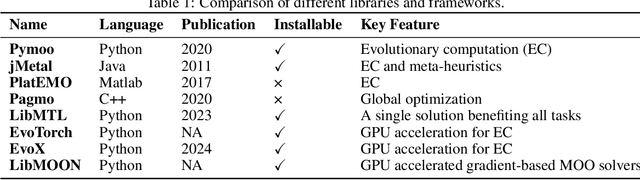
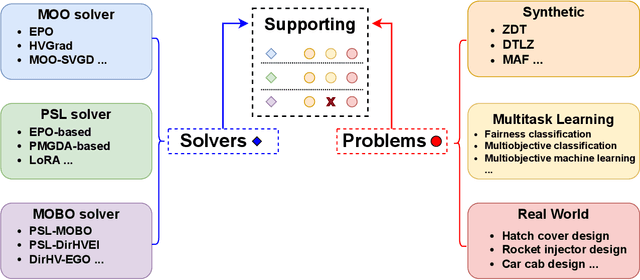
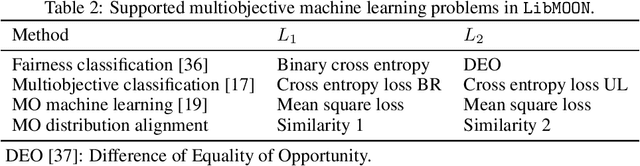
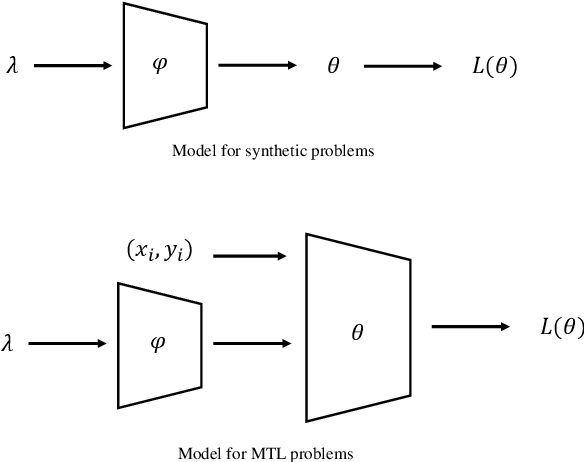
Multiobjective optimization problems (MOPs) are prevalent in machine learning, with applications in multi-task learning, learning under fairness or robustness constraints, etc. Instead of reducing multiple objective functions into a scalar objective, MOPs aim to optimize for the so-called Pareto optimality or Pareto set learning, which involves optimizing more than one objective function simultaneously, over models with millions of parameters. Existing benchmark libraries for MOPs mainly focus on evolutionary algorithms, most of which are zeroth-order methods that do not effectively utilize higher-order information from objectives and cannot scale to large-scale models with millions of parameters. In light of the above gap, this paper introduces LibMOON, the first multiobjective optimization library that supports state-of-the-art gradient-based methods, provides a fair benchmark, and is open-sourced for the community.