 Add to Chrome
 Add to Firefox
 Add to Edge
Surrogate Fidelity: When Can Open LLMs Explain Closed Ones?
Jun 30, 2026
Mechanistic interpretability (MI) requires full access to model internals, yet the APIs for most widely deployed language models at best expose log-probabilities over output tokens. This creates a surrogate problem: when do measurements made on open models allow us to make claims about a closed model? We evaluate surrogate fidelity at the prediction, attribution, and representation levels. For binary classification tasks, log-odds provide an API-compatible scalar readout of the model's representation space, and leave-one-out attributions provide insight into model behavior. Across eleven models spanning four families (Llama, Qwen, GPT, and Gemini), we find that prediction fidelity substantially overstates attribution fidelity: models that agree on what the answer is often disagree on why. We document an access-validity inversion: white-box signals like attention patterns and perturbation magnitudes are highly stable across models but only weakly predictive of causal attributions, which black-box input ablations capture by design. Mechanistic insight does not automatically transfer to closed targets, and prediction-level agreement is insufficient to warrant such transfer. Code and results are available at https://github.com/facebookresearch/surrogate.

Active Preference Elicitation via Adjustable Robust Optimization
Mar 04, 2020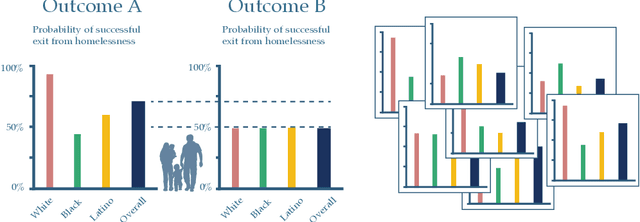
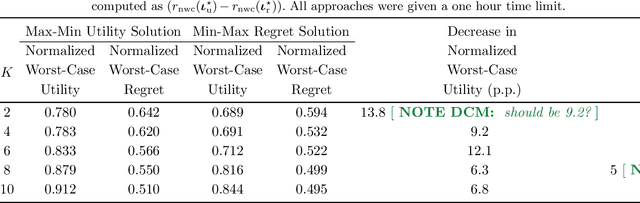
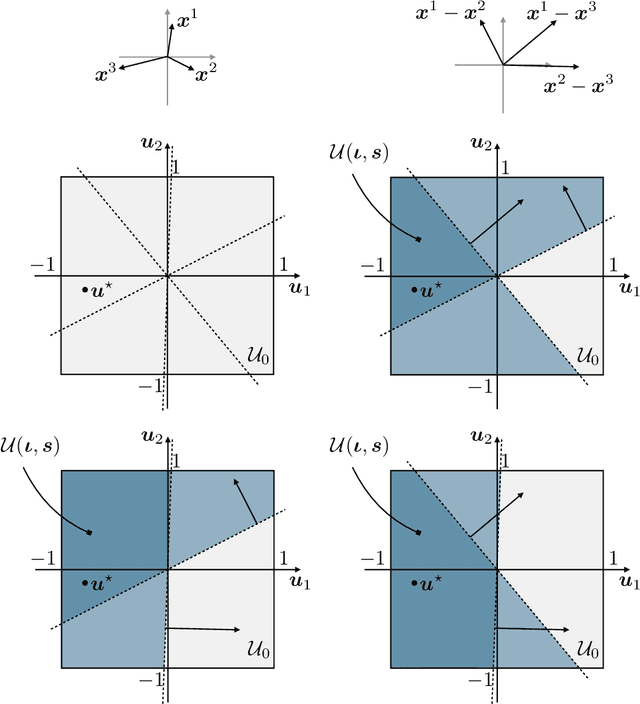
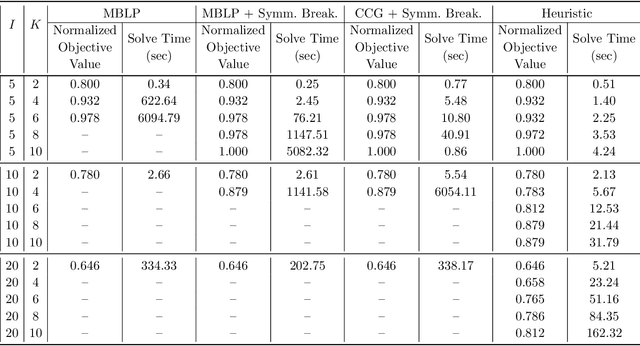
We consider the problem faced by a recommender system which seeks to offer a user with unknown preferences an item. Before making a recommendation, the system has the opportunity to elicit the user's preferences by making queries. Each query corresponds to a pairwise comparison between items. We take the point of view of either a risk averse or regret averse recommender system which only possess set-based information on the user utility function. We investigate: a) an offline elicitation setting, where all queries are made at once, and b) an online elicitation setting, where queries are selected sequentially over time. We propose exact robust optimization formulations of these problems which integrate the elicitation and recommendation phases and study the complexity of these problems. For the offline case, where the problem takes the form of a two-stage robust optimization problem with decision-dependent information discovery, we provide an enumeration-based algorithm and also an equivalent reformulation in the form of a mixed-binary linear program which we solve via column-and-constraint generation. For the online setting, where the problem takes the form of a multi-stage robust optimization problem with decision-dependent information discovery, we propose a conservative solution approach. We evaluate the performance of our methods on both synthetic data and real data from the Homeless Management Information System. We simulate elicitation of the preferences of policy-makers in terms of characteristics of housing allocation policies to better match individuals experiencing homelessness to scarce housing resources. Our framework is shown to outperform the state-of-the-art techniques from the literature.