 Add to Chrome
 Add to Firefox
 Add to Edge
Decentralized Opinion-Integrated Decision making at Unsignalized Intersections via Signed Networks
Apr 10, 2026
In this letter, we consider the problem of decentralized decision making among connected autonomous vehicles at unsignalized intersections, where existing centralized approaches do not scale gracefully under mixed maneuver intentions and coordinator failure. We propose a closed-loop opinion-dynamic decision model for intersection coordination, where vehicles exchange intent through dual signed networks: a conflict topology based communication network and a commitment-driven belief network that enable cooperation without a centralized coordinator. Continuous opinion states modulate velocity optimizer weights prior to commitment; a closed-form predictive feasibility gate then freezes each vehicle's decision into a GO or YIELD commitment, which propagates back through the belief network to pre-condition neighbor behavior ahead of physical conflicts. Crossing order emerges from geometric feasibility and arrival priority without the use of joint optimization or a solver. The approach is validated across three scenarios spanning fully competitive, merge, and mixed conflict topologies. The results demonstrate collision-free coordination and lower last-vehicle exit times compared to first come first served (FCFS) in all conflict non-trivial configurations.

Priority-Driven Safe Model Predictive Control Approach to Autonomous Driving Applications
May 09, 2025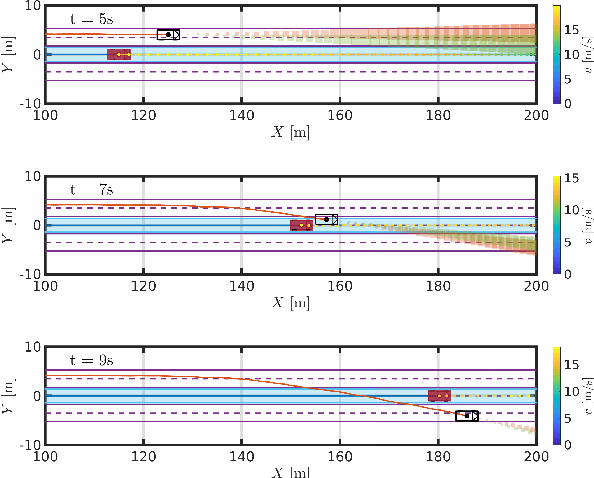
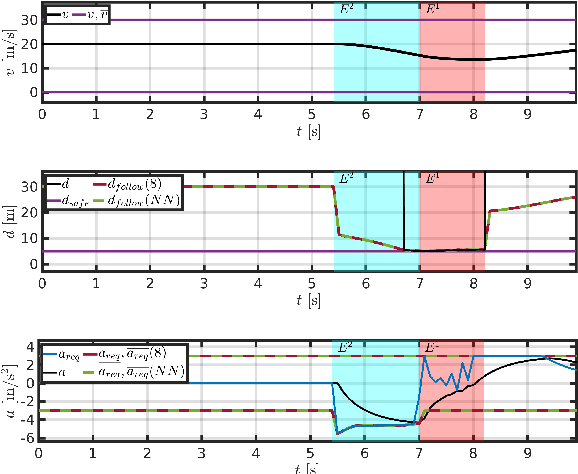
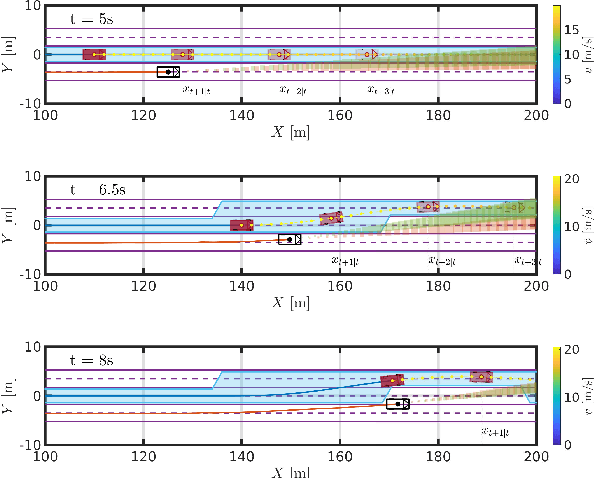
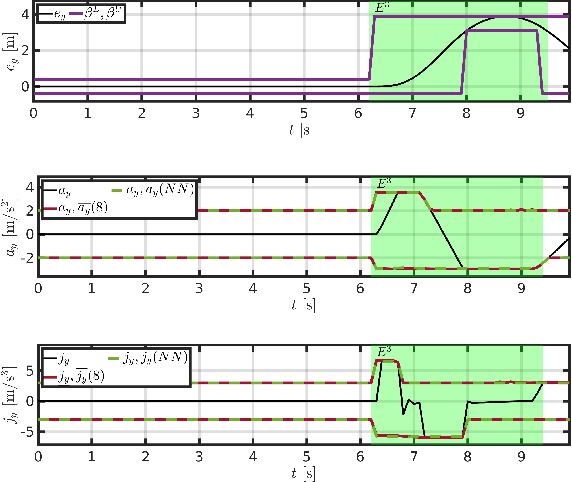
This paper demonstrates the applicability of the safe model predictive control (SMPC) framework to autonomous driving scenarios, focusing on the design of adaptive cruise control (ACC) and automated lane-change systems. Building on the SMPC approach with priority-driven constraint softening -- which ensures the satisfaction of \emph{hard} constraints under external disturbances by selectively softening a predefined subset of adjustable constraints -- we show how the algorithm dynamically relaxes lower-priority, comfort-related constraints in response to unexpected disturbances while preserving critical safety requirements such as collision avoidance and lane-keeping. A learning-based algorithm approximating the time consuming SMPC is introduced to enable real-time execution. Simulations in real-world driving scenarios subject to unpredicted disturbances confirm that this prioritized softening mechanism consistently upholds stringent safety constraints, underscoring the effectiveness of the proposed method.