 Add to Chrome
 Add to Firefox
 Add to Edge
SlimPer: Make Personalization Model Slim and Smart
Jul 14, 2026
Transformer-style architectures are increasingly adopted for industrial recommendation systems, yet they inherit a design premise misaligned with the task: generative models rely on per-token autoregressive prediction, which justifies maintaining large intermediate tensors that scale with sequence length. In contrast, recommendation systems produce a single set of relevance scores for each <user, item> pair without token-level supervision. Leveraging this observation, we propose SlimPer, which reformulates personalized ranking as iterative refinement of a compact, unified <user, item> knowledge base. At each layer, the model selectively queries raw multi-modal user-side tokens, computes explicit relevance matching scores, and refines the knowledge base, all in O(N) per-layer cost with a fixed-size intermediate representation. As a result, model depth is decoupled from user history length, enabling deeper relevance understanding without proportional growth in compute or memory; request-only optimization further trims memory by sharing a single copy of user-side tokens across all candidate items. SlimPer unifies sparse, dense, and sequence features within a single backbone and provides inherent interpretability through its attention mechanism. Deployed on Instagram Reels and Feed, SlimPer yields measurable improvements in user engagement while streamlining the overall system and enabling effective modeling of 10k+ fine-grained user history events.

Flag-Preamble-Based Delay-Doppler Channel Estimation for Next-Evolution Waveforms
Mar 16, 2026Accurate delay-Doppler channel estimation is critical for next-evolution waveforms (NEWs) to enable reliable signal detection. This paper proposes a robust channel estimation algorithm that integrates Flag sequences optimized via an adaptive accelerated parallel majorization-minimization (AP-MM) algorithm with a proposed channel estimation algorithm. To enable efficient, low-complexity parameter extraction and further overcome the robustness issues of conventional greedy estimation, we introduce two key enhancements, i.e., a candidate selection strategy to mitigate spurious sidelobe peaks, and a global least squares (LS) refinement stage to eliminate error propagation caused by sidelobe masking effects. Numerical results demonstrate that the proposed scheme significantly outperforms traditional existing algorithms, achieving the desired estimation accuracy.
Does "Reasoning" with Large Language Models Improve Recognizing, Generating, and Reframing Unhelpful Thoughts?
Mar 31, 2025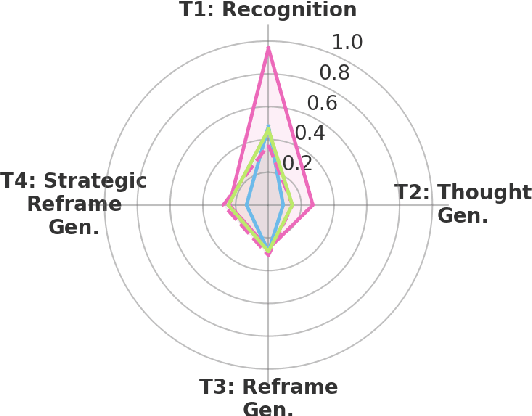
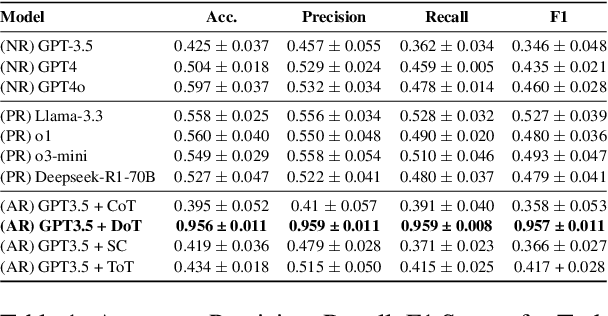
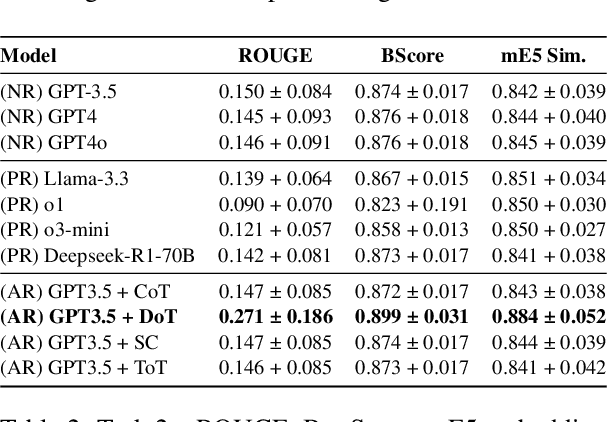
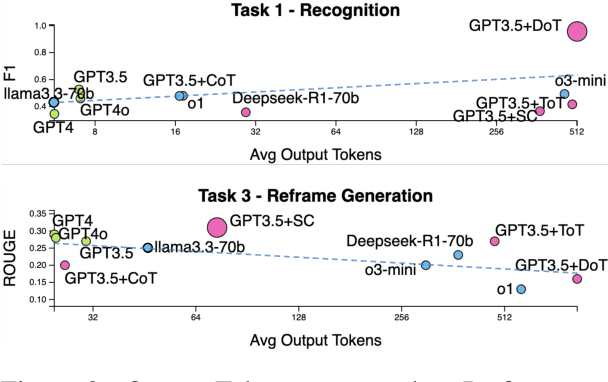
Cognitive Reframing, a core element of Cognitive Behavioral Therapy (CBT), helps individuals reinterpret negative experiences by finding positive meaning. Recent advances in Large Language Models (LLMs) have demonstrated improved performance through reasoning-based strategies. This inspires a promising direction of leveraging the reasoning capabilities of LLMs to improve CBT and mental reframing by simulating the process of critical thinking, potentially enabling more effective recognition, generation, and reframing of cognitive distortions. In this work, we investigate the role of various reasoning methods, including pre-trained reasoning LLMs and augmented reasoning strategies such as CoT and self-consistency in enhancing LLMs' ability to perform cognitive reframing tasks. We find that augmented reasoning methods, even when applied to "outdated" LLMs like GPT-3.5, consistently outperform state-of-the-art pretrained reasoning models on recognizing, generating and reframing unhelpful thoughts.