 Add to Chrome
 Add to Firefox
 Add to Edge
Decision-Focused Scenario Generation and Selection for Efficient and Robust Grid Dispatch
Jul 07, 2026
The increasing uncertainty from flexible demand and renewable generation has made distributionally robust optimization (DRO) an important tool for robust power system dispatch. DRO relies on forecast scenarios to construct ambiguity sets, but conventional scenario generation pipelines are often trained in an accuracy-oriented manner and may neglect spatial correlations among uncertainties. This mismatch can produce ambiguity sets that are statistically plausible but suboptimal for downstream operation. This work proposes a decision-focused generative framework for correlated scenario generation in DRO-based dispatch. Instead of training generative models solely to fit the historical uncertainty distribution, the proposed framework optimizes generated scenarios according to their induced downstream operational cost. The proposed framework is tailored to mainstream generative models, including variational autoencoders, generative adversarial networks, and diffusion models, while capturing the joint distribution of uncertainties across buses. To improve computational tractability, we further develop a differentiable scenario selector that selects decision-relevant scenarios from a generated pool and can be trained within the same decision-focused pipeline. Case studies demonstrate that the proposed framework effectively reduces 0.80%-2.02% operational cost across different generative models compared to accuracy-oriented methods.

Supervised Reinforcement Learning for the Coordination of Distributed Energy Resources
Jun 23, 2026The increasing integration of distributed energy resources (DERs) is crucial for power system decarbonization, yet unlocking DERs' flexibility is challenged by their inherent uncertainties and modelling complexity. As traditional optimization methods struggle with such uncertainty and complexity of DERs, reinforcement learning (RL) has emerged as a promising alternative for DER management. However, standard RL methods suffer from sample inefficiency and sub-optimality when trained from scratch. Inspired by the training paradigms in large language models, this paper proposes a Supervised Reinforcement Learning (SRL) framework for learning DER coordination policies. This framework first pre-trains a policy on demonstration data in a supervised-learning fashion, which is then further fine-tuned using RL. Furthermore, we propose a two-step fine-tuning process: offline fine-tuning for enhancing policy performance and online fine-tuning for adapting it to the real-world dynamics. Experiments demonstrate that RL implementations based on the proposed framework significantly outperform all benchmarks, achieving high cost efficiency even under low-quality demonstration data.
GradMAP: Gradient-Based Multi-Agent Proximal Learning for Grid-Edge Flexibility
Apr 27, 2026Coordinating large populations of grid-edge devices requires learning methods that remain fully decentralised in deployment while still respecting three-phase AC distribution-network physics. This paper proposes gradient-based multi-agent proximal learning (GradMAP) to address this challenge. GradMAP trains independent neural-network policies for each agent without any parameter sharing, and each agent uses only its own local observation for online decision-making without communication. During offline training, GradMAP embeds a differentiable three-phase AC power-flow model in a primal-dual learning loop and uses implicit differentiation to propagate exact network-constraint violations to update the policy parameters. To speed up training, GradMAP reuses expensive environment gradients through a proximal surrogate within a trust region defined in the more direct policy-output (action) space, instead of the probability distribution space used in other works, such as PPO. In case studies with 1,000 agents managing batteries, heat pumps, and controllable generators on the IEEE 123-bus feeder, GradMAP learns decentralised policies that minimise three-phase AC load-flow constraint violations within 15 minutes of training on a single workstation-class NVIDIA RTX PRO 5000 Blackwell 48GB GPU. This is a 3--5x training speed-up over gradient-based self-supervised learning benchmarks and substantially better training efficiency than multi-agent reinforcement-learning benchmarks. In out-of-sample tests, GradMAP also delivers among the lowest operating cost and constraint violations.
Large Language Model Interface for Home Energy Management Systems
Jan 14, 2025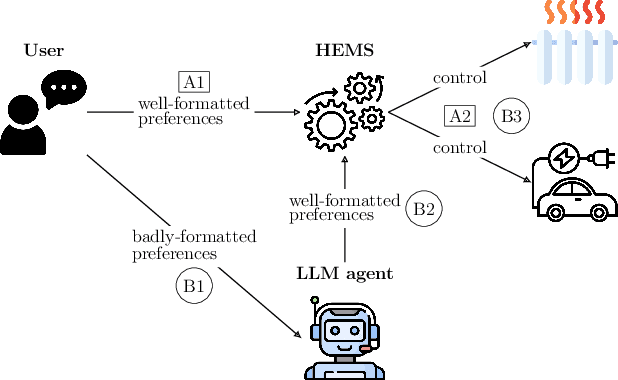
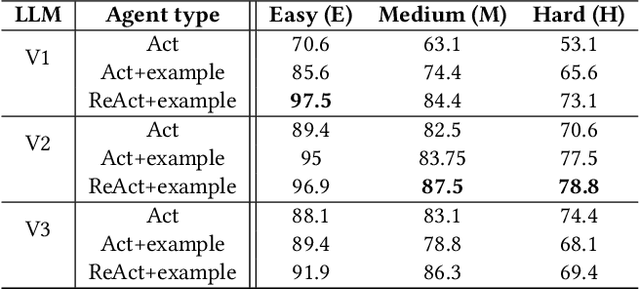
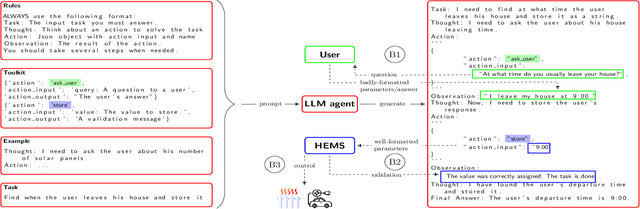
Home Energy Management Systems (HEMSs) help households tailor their electricity usage based on power system signals such as energy prices. This technology helps to reduce energy bills and offers greater demand-side flexibility that supports the power system stability. However, residents who lack a technical background may find it difficult to use HEMSs effectively, because HEMSs require well-formatted parameterization that reflects the characteristics of the energy resources, houses, and users' needs. Recently, Large-Language Models (LLMs) have demonstrated an outstanding ability in language understanding. Motivated by this, we propose an LLM-based interface that interacts with users to understand and parameterize their ``badly-formatted answers'', and then outputs well-formatted parameters to implement an HEMS. We further use Reason and Act method (ReAct) and few-shot prompting to enhance the LLM performance. Evaluating the interface performance requires multiple user--LLM interactions. To avoid the efforts in finding volunteer users and reduce the evaluation time, we additionally propose a method that uses another LLM to simulate users with varying expertise, ranging from knowledgeable to non-technical. By comprehensive evaluation, the proposed LLM-based HEMS interface achieves an average parameter retrieval accuracy of 88\%, outperforming benchmark models without ReAct and/or few-shot prompting.