 Add to Chrome
 Add to Firefox
 Add to Edge
Generating Effective CoT Traces for Mitigating Causal Hallucination
Apr 14, 2026
Although large language models (LLMs) excel in complex reasoning tasks, they suffer from severe causal hallucination in event causality identification (ECI), particularly in smaller models ($\leq$1.5B parameters). A promising approach to address this issue is to fine-tune them with Chain-of-Thought (CoT) traces. However, there is currently a lack of CoT trace dataset available for ECI. In this paper, we first investigate the essential criteria that effective CoT traces should possess to mitigate causal hallucination in smaller models. We then design a pipeline to generate CoT traces that meet these criteria. Moreover, since there is currently no metric for quantifying causal hallucination, we also introduce a new metric, the Causal Hallucination Rate (CHR), to quantify causal hallucination, guide the formulation of effective CoT trace criteria, and validate the effectiveness of our pipeline. Our experiments show that fine-tuning with the CoT traces generated by our pipeline not only substantially reduces causal hallucination in smaller LLMs but also improves mean accuracy. Moreover, the fine-tuned models exhibit strong cross-dataset and cross-difficulty generalization, as well as robustness under misleading intervention prompts.

Edge-guided inverse design of digital metamaterials for ultra-high-capacity on-chip multi-dimensional interconnect
Oct 10, 2024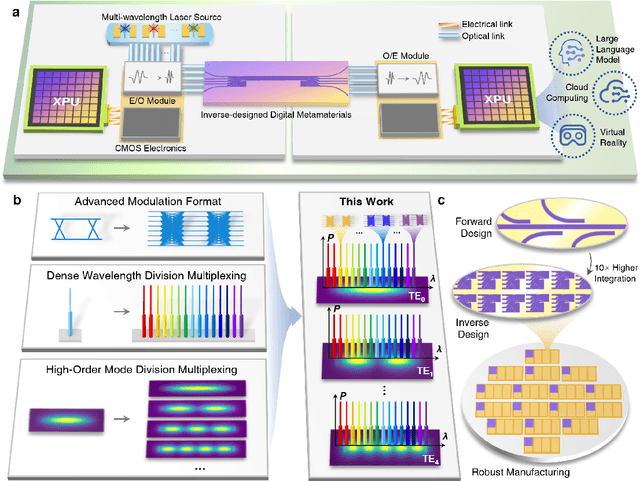
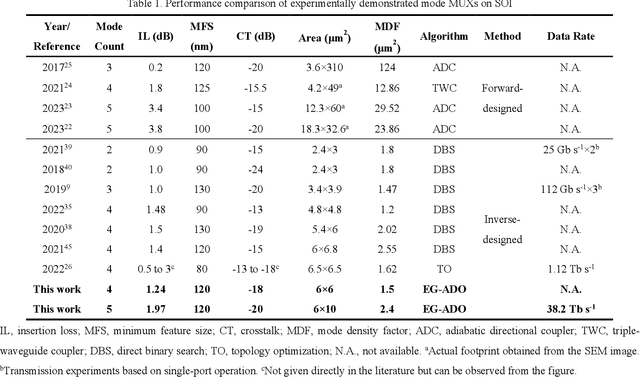
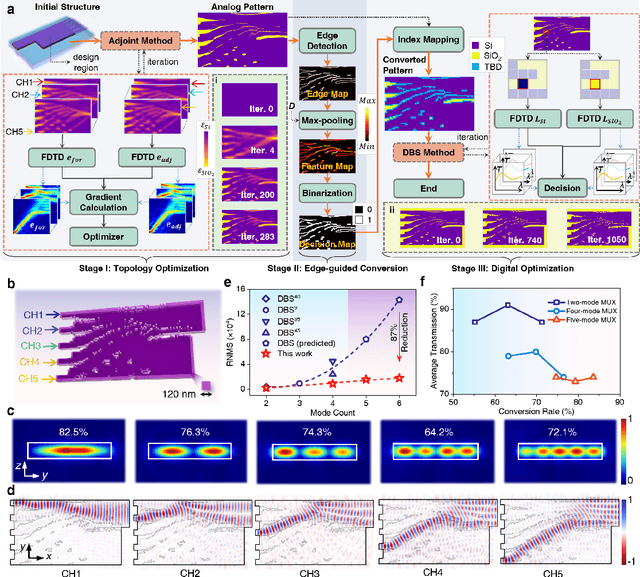
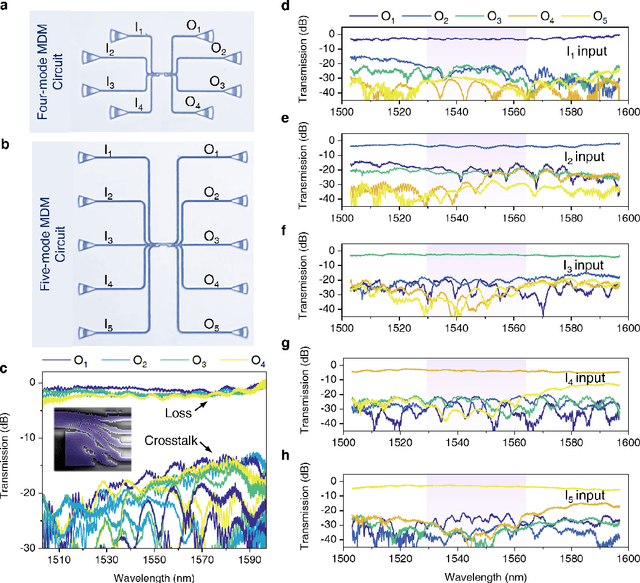
The escalating demands of compute-intensive applications, including artificial intelligence, urgently necessitate the adoption of sophisticated optical on-chip interconnect technologies to overcome critical bottlenecks in scaling future computing systems. This transition requires leveraging the inherent parallelism of wavelength and mode dimensions of light, complemented by high-order modulation formats, to significantly enhance data throughput. Here we experimentally demonstrate a novel synergy of these three dimensions, achieving multi-tens-of-terabits-per-second on-chip interconnects using ultra-broadband, multi-mode digital metamaterials. Employing a highly efficient edge-guided analog-and-digital optimization method, we inversely design foundry-compatible, robust, and multi-port digital metamaterials with an 8xhigher computational efficiency. Using a packaged five-mode multiplexing chip, we demonstrate a single-wavelength interconnect capacity of 1.62 Tbit s-1 and a record-setting multi-dimensional interconnect capacity of 38.2 Tbit s-1 across 5 modes and 88 wavelength channels. A theoretical analysis suggests that further system optimization can enable on-chip interconnects to reach sub-petabit-per-second data transmission rates. This study highlights the transformative potential of optical interconnect technologies to surmount the constraints of electronic links, thus setting the stage for next-generation datacenter and optical compute interconnects.