 Add to Chrome
 Add to Firefox
 Add to Edge
EEG-FM-Audit: A Systematic Evaluation and Analysis Pipeline for EEG Foundation Models
May 26, 2026
Large EEG Foundation Models (FMs) have shown great potential for decoding EEG signals across diverse cognitive tasks. However, existing EEG-FM studies exhibit three critical limitations: opaque supervised baseline tuning, unverified contributions of complex learning paradigms, and a lack of transparency in model decision-making. To address these, we propose EEG-FM-Audit, a comprehensive evaluation and analysis pipeline designed to systematize the assessment of EEG-FMs. EEG-FM-Audit consists of three primary components: (1) an ASHA-driven benchmarking protocol that ensures fair comparisons by transparently optimizing supervised baselines; (2) paradigm-level ablation studies to evaluate the effectiveness of learning paradigms in FMs; and (3) a neurophysiological probing (NPP) framework, which explores whether FMs leverage valid temporal, spatial, and spectral EEG properties. We apply EEG-FM-Audit to four state-of-the-art EEG-FMs and five representative supervised models across three public datasets. Our results reveal that properly tuned supervised baselines can match or outperform advanced FMs, despite requiring significantly fewer parameters. Furthermore, we find that the effectiveness of learning paradigms of FMs is highly dependent on dataset scale and architecture. Finally, NPP analysis demonstrates how FMs rely on specific physiological features, establishing a framework for more interpretable neural decoding.

Toward Motion Robustness: A masked attention regularization framework in remote photoplethysmography
Jul 09, 2024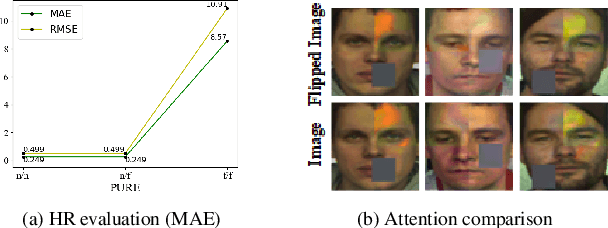
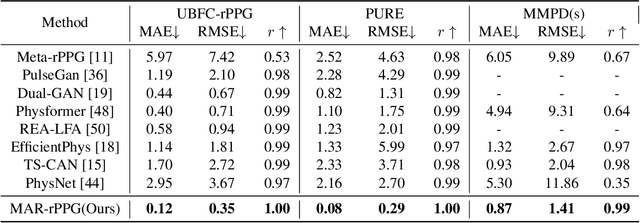
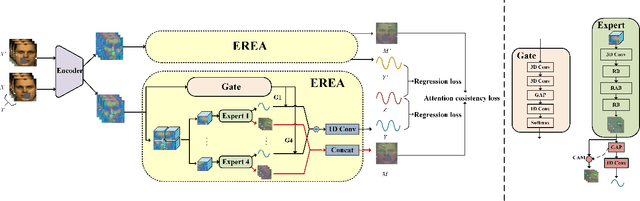
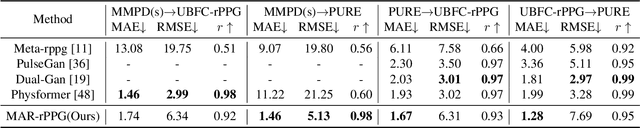
There has been growing interest in facial video-based remote photoplethysmography (rPPG) measurement recently, with a focus on assessing various vital signs such as heart rate and heart rate variability. Despite previous efforts on static datasets, their approaches have been hindered by inaccurate region of interest (ROI) localization and motion issues, and have shown limited generalization in real-world scenarios. To address these challenges, we propose a novel masked attention regularization (MAR-rPPG) framework that mitigates the impact of ROI localization and complex motion artifacts. Specifically, our approach first integrates a masked attention regularization mechanism into the rPPG field to capture the visual semantic consistency of facial clips, while it also employs a masking technique to prevent the model from overfitting on inaccurate ROIs and subsequently degrading its performance. Furthermore, we propose an enhanced rPPG expert aggregation (EREA) network as the backbone to obtain rPPG signals and attention maps simultaneously. Our EREA network is capable of discriminating divergent attentions from different facial areas and retaining the consistency of spatiotemporal attention maps. For motion robustness, a simple open source detector MediaPipe for data preprocessing is sufficient for our framework due to its superior capability of rPPG signal extraction and attention regularization. Exhaustive experiments on three benchmark datasets (UBFC-rPPG, PURE, and MMPD) substantiate the superiority of our proposed method, outperforming recent state-of-the-art works by a considerable margin.