 Add to Chrome
 Add to Firefox
 Add to Edge
Learning Residual Kinematic Corrections for Continuous Neural Decoding via Reinforcement Learning
Jul 13, 2026
Decoding continuous three-dimensional (3D) motor imagery (MI) using non-invasive electroencephalography (EEG)-based brain--computer interfaces (BCIs) remains challenging due to signal variability and residual decoding errors. Deep learning architectures such as convolutional neural network--long short-term memory (CNN--LSTM) models can capture spatial and temporal dynamics for continuous kinematic decoding; however, systematic residual errors persist in predicted trajectories. We propose a two-stage decoding framework that applies reinforcement learning (RL) to perform residual kinematic correction on the outputs of a CNN--LSTM decoder (CNN--LSTM--RL). The RL agent is trained offline without direct EEG input and instead operates on predicted kinematic trajectories to optimize movement accuracy relative to target trajectories. Decoding performance was quantified using Pearson correlation coefficients ($r$) and Root Mean Square Errors (RMSE) along the $x, y$, and $z$ axes. Compared to CNN--LSTM applied alone, CNN--LSTM--RL improved the mean correlation from $0.5076$ to $0.7181$ ($p = 0.0005$) in 2D and from $0.6420$ to $0.7780$ ($p = 0.0059$) in VR, with relative gains of $41.5\%$ and $21.2\%$, respectively. Correspondingly, RMSE was reduced from $0.0890$ to $0.0532$ (2D, $p < 0.0001$) and from $0.0714$ to $0.0441$ (VR, $p < 0.0001$), representing relative reductions of $40.2\%$ and $38.2\%$. These findings demonstrate that this scalable framework enhances 3D BCI MI decoding by correcting kinematic errors via offline residual RL without extra neural data, advancing neurorehabilitation, prosthetics, and virtual interaction.

Embodied Virtual Reality Feedback Reshapes Neural Representations to Support Continuous Three-Dimensional Motor Imagery Decoding
May 28, 2026Continuous brain-computer interfaces (BCIs) that decode motion trajectories from imagined movement offer intuitive motor control, yet how feedback modality and longitudinal training shape neural representations and decoding performance remains poorly understood. We present the first systematic investigation of embodied virtual reality (VR) feedback during real-time 3D virtual limb control driven by motor imagery, across ten longitudinal sessions in ten participants. Performance was evaluated using three strategies: actual online performance (Fixed Decoder Generalisation, FDG), periodic retraining (Sequential Adaptive Training, SAT), and within-session upper-bound estimation (Within-Session Reconstruction, WSR). A CNN-LSTM decoder achieved within-session imagined movement correlations of r = 0.762 under VR and r = 0.672 under screen feedback. VR significantly outperformed screen feedback across all strategies and movement dimensions (improvements of 8.9-13.0%, all p <= 0.002, d = 1.42-2.05). This advantage persisted under fixed decoders without retraining, demonstrating that embodied VR feedback elicits inherently more decodable and generalisable neural representations. Linear mixed-effects modelling confirmed robust main effects of feedback modality and movement axis with no interaction. Neurophysiologically, VR produced stronger sensorimotor-parietal desynchronisation and enhanced motor-frontal functional connectivity, with pervasive anterior insula engagement across all frequency bands and increased superior parietal lobule coupling, paralleling patterns associated with real movement execution. These findings establish embodied spatial feedback as a key design principle for next-generation continuous BCIs targeting intuitive motor control and neurorehabilitation.
EEG-FM-Audit: A Systematic Evaluation and Analysis Pipeline for EEG Foundation Models
May 26, 2026Large EEG Foundation Models (FMs) have shown great potential for decoding EEG signals across diverse cognitive tasks. However, existing EEG-FM studies exhibit three critical limitations: opaque supervised baseline tuning, unverified contributions of complex learning paradigms, and a lack of transparency in model decision-making. To address these, we propose EEG-FM-Audit, a comprehensive evaluation and analysis pipeline designed to systematize the assessment of EEG-FMs. EEG-FM-Audit consists of three primary components: (1) an ASHA-driven benchmarking protocol that ensures fair comparisons by transparently optimizing supervised baselines; (2) paradigm-level ablation studies to evaluate the effectiveness of learning paradigms in FMs; and (3) a neurophysiological probing (NPP) framework, which explores whether FMs leverage valid temporal, spatial, and spectral EEG properties. We apply EEG-FM-Audit to four state-of-the-art EEG-FMs and five representative supervised models across three public datasets. Our results reveal that properly tuned supervised baselines can match or outperform advanced FMs, despite requiring significantly fewer parameters. Furthermore, we find that the effectiveness of learning paradigms of FMs is highly dependent on dataset scale and architecture. Finally, NPP analysis demonstrates how FMs rely on specific physiological features, establishing a framework for more interpretable neural decoding.
Towards improving Alzheimer's intervention: a machine learning approach for biomarker detection through combining MEG and MRI pipelines
Aug 09, 2024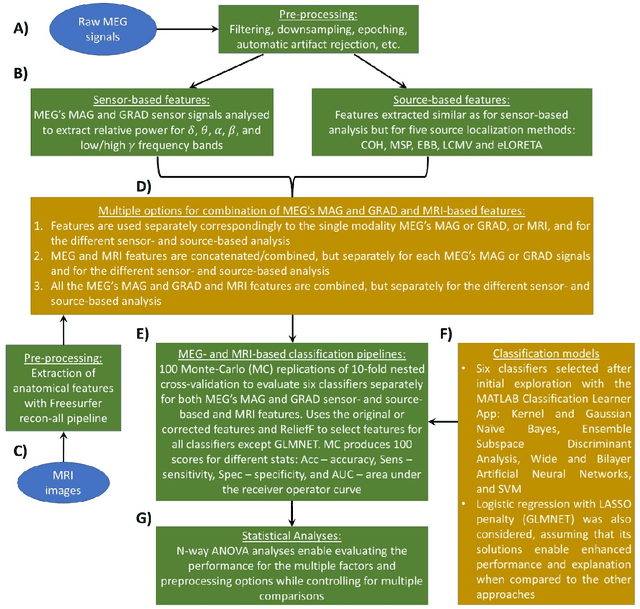
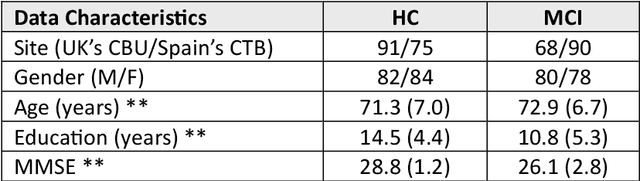
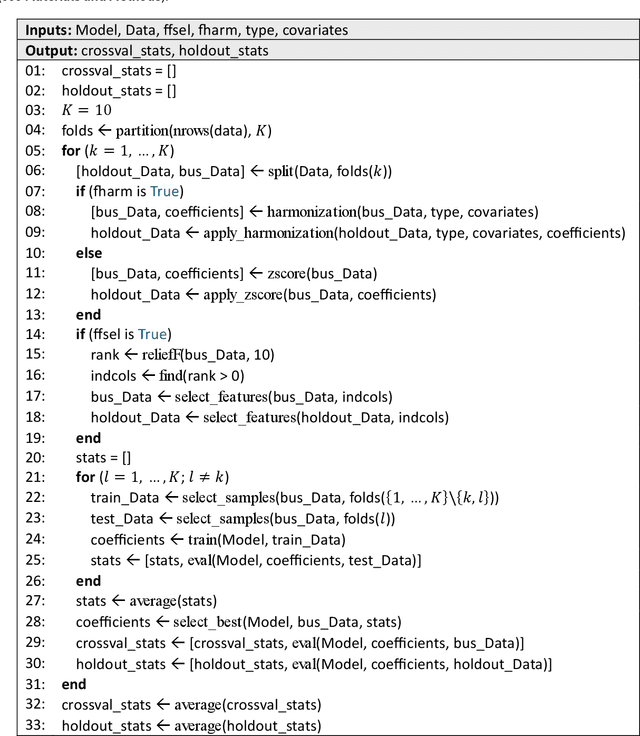
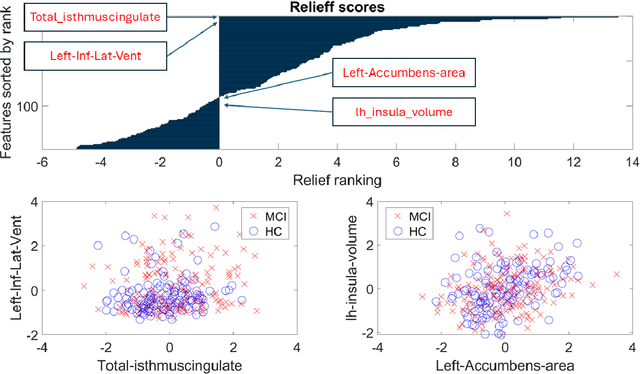
MEG are non invasive neuroimaging techniques with excellent temporal and spatial resolution, crucial for studying brain function in dementia and Alzheimer Disease. They identify changes in brain activity at various Alzheimer stages, including preclinical and prodromal phases. MEG may detect pathological changes before clinical symptoms, offering potential biomarkers for intervention. This study evaluates classification techniques using MEG features to distinguish between healthy controls and mild cognitive impairment participants from the BioFIND study. We compare MEG based biomarkers with MRI based anatomical features, both independently and combined. We used 3 Tesla MRI and MEG data from 324 BioFIND participants;158 MCI and 166 HC. Analyses were performed using MATLAB with SPM12 and OSL toolboxes. Machine learning analyses, including 100 Monte Carlo replications of 10 fold cross validation, were conducted on sensor and source spaces. Combining MRI with MEG features achieved the best performance; 0.76 accuracy and AUC of 0.82 for GLMNET using LCMV source based MEG. MEG only analyses using LCMV and eLORETA also performed well, suggesting that combining uncorrected MEG with z-score-corrected MRI features is optimal.
R2 Indicator and Deep Reinforcement Learning Enhanced Adaptive Multi-Objective Evolutionary Algorithm
Apr 11, 2024Choosing an appropriate optimization algorithm is essential to achieving success in optimization challenges. Here we present a new evolutionary algorithm structure that utilizes a reinforcement learning-based agent aimed at addressing these issues. The agent employs a double deep q-network to choose a specific evolutionary operator based on feedback it receives from the environment during optimization. The algorithm's structure contains five single-objective evolutionary algorithm operators. This single-objective structure is transformed into a multi-objective one using the R2 indicator. This indicator serves two purposes within our structure: first, it renders the algorithm multi-objective, and second, provides a means to evaluate each algorithm's performance in each generation to facilitate constructing the reinforcement learning-based reward function. The proposed R2-reinforcement learning multi-objective evolutionary algorithm (R2-RLMOEA) is compared with six other multi-objective algorithms that are based on R2 indicators. These six algorithms include the operators used in R2-RLMOEA as well as an R2 indicator-based algorithm that randomly selects operators during optimization. We benchmark performance using the CEC09 functions, with performance measured by inverted generational distance and spacing. The R2-RLMOEA algorithm outperforms all other algorithms with strong statistical significance (p<0.001) when compared with the average spacing metric across all ten benchmarks.
Deep Predictive Coding with Bi-directional Propagation for Classification and Reconstruction
May 29, 2023This paper presents a new learning algorithm, termed Deep Bi-directional Predictive Coding (DBPC) that allows developing networks to simultaneously perform classification and reconstruction tasks using the same weights. Predictive Coding (PC) has emerged as a prominent theory underlying information processing in the brain. The general concept for learning in PC is that each layer learns to predict the activities of neurons in the previous layer which enables local computation of error and in-parallel learning across layers. In this paper, we extend existing PC approaches by developing a network which supports both feedforward and feedback propagation of information. Each layer in the networks trained using DBPC learn to predict the activities of neurons in the previous and next layer which allows the network to simultaneously perform classification and reconstruction tasks using feedforward and feedback propagation, respectively. DBPC also relies on locally available information for learning, thus enabling in-parallel learning across all layers in the network. The proposed approach has been developed for training both, fully connected networks and convolutional neural networks. The performance of DBPC has been evaluated on both, classification and reconstruction tasks using the MNIST and FashionMNIST datasets. The classification and the reconstruction performance of networks trained using DBPC is similar to other approaches used for comparison but DBPC uses a significantly smaller network. Further, the significant benefit of DBPC is its ability to achieve this performance using locally available information and in-parallel learning mechanisms which results in an efficient training protocol. This results clearly indicate that DBPC is a much more efficient approach for developing networks that can simultaneously perform both classification and reconstruction.
Solving large-scale MEG/EEG source localization and functional connectivity problems simultaneously using state-space models
Aug 26, 2022


State-space models are used in many fields when dynamics are unobserved. Popular methods such as the Kalman filter and expectation maximization enable estimation of these models but pay a high computational cost in large-scale analysis. In these approaches, sparse inverse covariance estimators can reduce the cost; however, a trade-off between enforced sparsity and increased estimation bias occurs, which demands careful consideration in low signal-to-noise ratio scenarios. We overcome these limitations by 1) Introducing multiple penalized state-space models based on data-driven regularization; 2) Implementing novel algorithms such as backpropagation, state-space gradient descent, and alternating least squares; 3) Proposing an extension of K-fold cross-validation to evaluate the regularization parameters. Finally, we solve the simultaneous brain source localization and functional connectivity problems for simulated and real MEG/EEG signals for thousands of sources on the cortical surface, demonstrating a substantial improvement over state-of-the-art methods.