 Add to Chrome
 Add to Firefox
 Add to Edge
Learn to Access and Backhaul the Sky: Multi-Scale Radio Map Guided Multi-UAV Cooperation
Jun 05, 2026
Driven by the emerging low-altitude economy, uncrewed aerial vehicle (UAV) swarms offer flexible integrated air-ground access and backhaul. However, providing seamless connectivity is difficult due to the interdependent dynamics of user mobility and building blockages in these 3D scenarios. These factors create rapidly shifting bottlenecks in end-to-end paths. Furthermore, the multi-dimensional nature of joint control limits the effectiveness of traditional heuristics. To address these challenges, a \textbf{\underline{M}}ulti-Scale \textbf{\underline{R}}adio \textbf{\underline{M}}ap-\textbf{\underline{G}}uided (MRMG) framework is proposed. The MRMG framework handles heterogeneous dynamics by integrating three distinct levels of radio information: global-level maps provide regional coverage insights, local-level maps capture neighborhood-scale service conditions, and link-level maps characterize high-resolution channel features. This design effectively decouples macro-movement from micro-link adaptation. To yield long-term performance improvements, A multi-agent reinforcement learning (MARL) controller learns cooperative policies for UAV movement, next-hop selection, and transmit-power control. Simulation results show that the MRMG framework not only improves network throughput but also significantly bolsters cell-edge service, nearly doubling the 5th-percentile user rate.

Predictive Target-to-User Association in Complex Scenarios via Hybrid-Field ISAC Signaling
Jan 18, 2025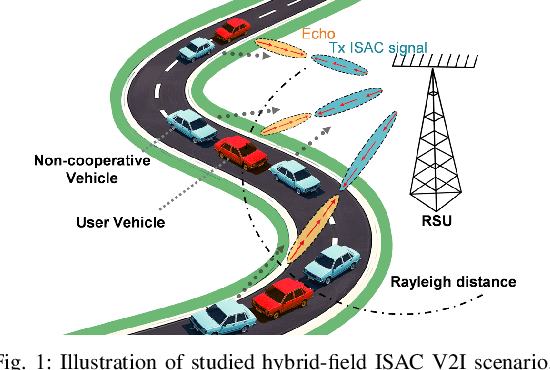
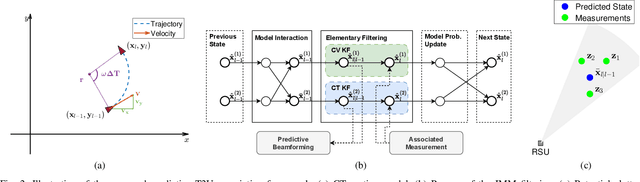
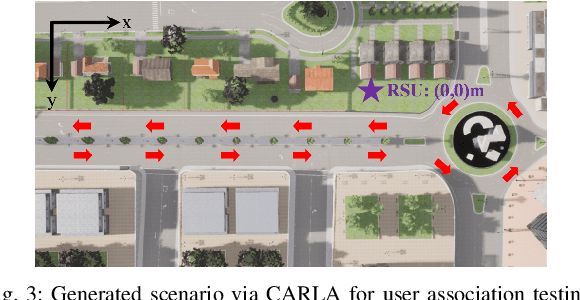
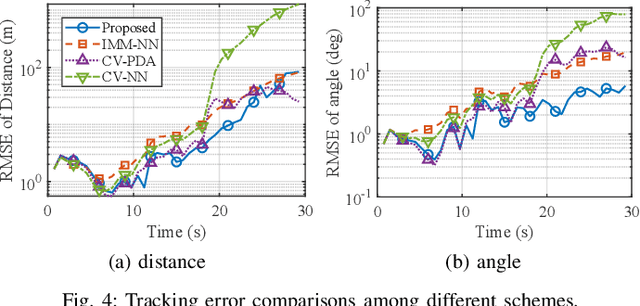
This paper presents a novel and robust target-to-user (T2U) association framework to support reliable vehicle-to-infrastructure (V2I) networks that potentially operate within the hybrid field (near-field and far-field). To address the challenges posed by complex vehicle maneuvers and user association ambiguity, an interacting multiple-model filtering scheme is developed, which combines coordinated turn and constant velocity models for predictive beamforming. Building upon this foundation, a lightweight association scheme leverages user-specific integrated sensing and communication (ISAC) signaling while employing probabilistic data association to manage clutter measurements in dense traffic. Numerical results validate that the proposed framework significantly outperforms conventional methods in terms of both tracking accuracy and association reliability.