 Add to Chrome
 Add to Firefox
 Add to Edge
Pearcey-Inspired Quartic Wavefront Shaping for Obstructed Near-Field Multi-User Communications
Mar 04, 2026
Radiative near-field (RNF) beamforming is vulnerable to blockages that disrupt Fresnel zones. This letter proposes an obstruction-unaware wavefront shaping strategy inspired by catastrophe optics. By superimposing a calibrated quartic phase, we generate a Pearcey-like wave packet that exhibits structural stability against perturbations. We establish a fair comparison protocol where the quartic beam is calibrated in free space to avoid exploiting obstruction knowledge. Numerical results demonstrate up to 8.5~dB SINR gain over conventional focusing for multi-user scenarios near the depth-of-focus limit. Crucially, this gain stems from improved channel conditioning under partial blockage, which mitigates the severe noise amplification inherent to zero-forcing precoding.

Airy Beamforming for Radiative Near-Field MU-XL-MIMO: Overcoming Half-Space Blockage
Jan 16, 2026The move to next-generation wireless communications with extremely large-scale antenna arrays (ELAAs) brings the communications into the radiative near-field (RNF) region, where distance-aware focusing is feasible. However, high-frequency RNF links are highly vulnerable to blockage in indoor environments dominated by half-space obstacles (walls, corners) that create knife-edge shadows. Conventional near-field focused beams offer high gain in line-of-sight (LoS) scenarios but suffer from severe energy truncation and effective-rank collapse in shadowed regions, often necessitating the deployment of auxiliary hardware such as Reconfigurable Intelligent Surfaces (RIS) to restore connectivity. We propose a beamforming strategy that exploits the auto-bending property of Airy beams to mitigate half-space blockage without additional hardware. The Airy beam is designed to ``ride'' the diffraction edge, accelerating its main lobe into the shadow to restore connectivity. Our contributions are threefold: (i) a Green's function-based RNF multi-user channel model that analytically reveals singular-value collapse behind knife-edge obstacles; (ii) an Airy analog beamforming scheme that optimizes the bending trajectory to recover the effective channel rank; and (iii) an Airy null-steering method that aligns oscillatory nulls with bright-region users to suppress interference in mixed shadow/bright scenarios. Simulations show that the proposed edge-riding Airy strategy achieves a Signal-to-Noise Ratio (SNR) improvement of over 20 dB and restores full-rank connectivity in shadowed links compared to conventional RNF focusing, virtually eliminating outage in geometric shadows and increasing multi-user spectral efficiency by approximately 35\% under typical indoor ELAA configurations. These results demonstrate robust RNF multi-user access in half-space blockage scenarios without relying on RIS.
Diffusion Probabilistic Model Based Accurate and High-Degree-of-Freedom Metasurface Inverse Design
Apr 25, 2023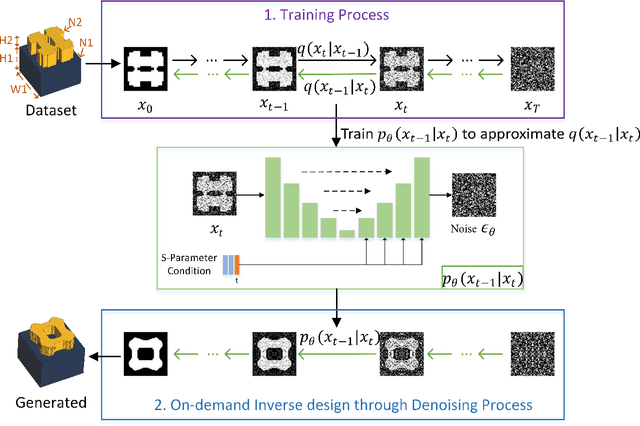
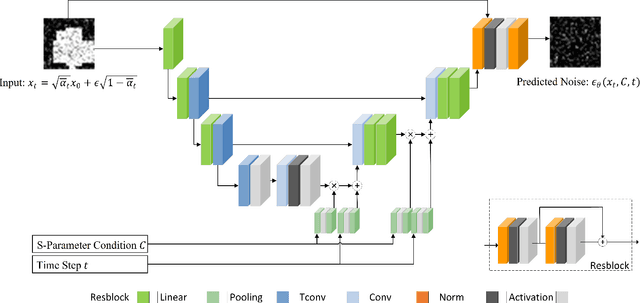
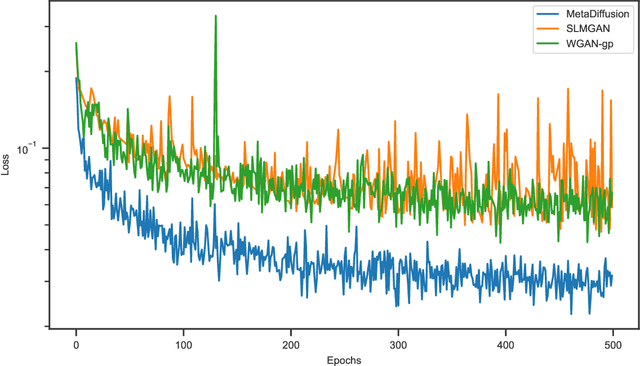
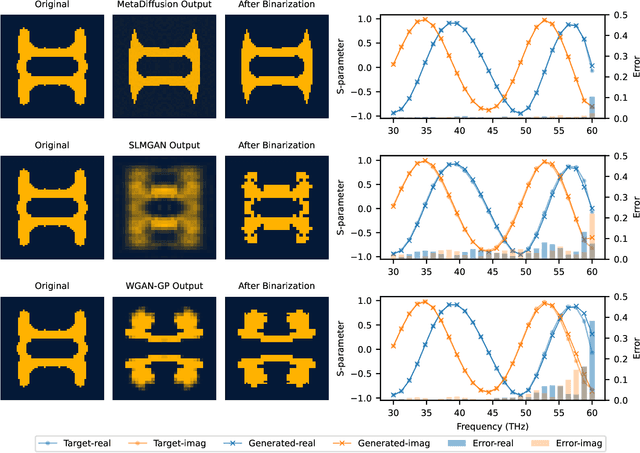
Conventional meta-atom designs rely heavily on researchers' prior knowledge and trial-and-error searches using full-wave simulations, resulting in time-consuming and inefficient processes. Inverse design methods based on optimization algorithms, such as evolutionary algorithms, and topological optimizations, have been introduced to design metamaterials. However, none of these algorithms are general enough to fulfill multi-objective tasks. Recently, deep learning methods represented by Generative Adversarial Networks (GANs) have been applied to inverse design of metamaterials, which can directly generate high-degree-of-freedom meta-atoms based on S-parameter requirements. However, the adversarial training process of GANs makes the network unstable and results in high modeling costs. This paper proposes a novel metamaterial inverse design method based on the diffusion probability theory. By learning the Markov process that transforms the original structure into a Gaussian distribution, the proposed method can gradually remove the noise starting from the Gaussian distribution and generate new high-degree-of-freedom meta-atoms that meet S-parameter conditions, which avoids the model instability introduced by the adversarial training process of GANs and ensures more accurate and high-quality generation results. Experiments have proven that our method is superior to representative methods of GANs in terms of model convergence speed, generation accuracy, and quality.