 Add to Chrome
 Add to Firefox
 Add to Edge
GALA: Graph-Augmented LLM Agents for Root Cause Analysis and Incident Response in Microservices
Aug 10, 2026
Microservice root cause analysis (RCA) requires correlating failures across heterogeneous telemetry within complex service dependency graphs. Existing methods often rely on a single telemetry modality; recent LLM-based approaches can suffer from unconstrained exploration and hallucination; and most systems stop at fault ranking without producing actionable incident response. We present GALA+, a graph-augmented LLM agentic framework centered on graph-guided investigation, which uses service dependencies to bound exploration and refine diagnosis through localized multi-modal evidence. For initial hypothesis generation, GALA+ combines complementary telemetry signals with STRIX, a novel trace- and graph-structure-aware scoring module. GALA+ then produces ranked diagnoses, incident summaries, and stratified action recommendations. We further introduce SURE-Score, a human-guided evaluation framework co-developed with industry SRE experts for assessing RCA-specific output quality beyond conventional text similarity metrics. On two microservice benchmarks, GALA+ consistently achieves the strongest overall results, surpassing the best LLM-based baseline by more than 25 percentage points in AC@1, while also receiving the highest ratings from both SURE-Score and independent human SRE evaluation.

FAME: Failure-Aware Mixture-of-Experts for Message-Level Log Anomaly Detection
May 21, 2026Production systems generate millions of log lines daily, yet most anomaly detectors operate at the session or window-level, flagging groups of lines rather than identifying the specific message responsible. This coarse granularity forces operators to inspect many routine lines per alert. Message-level detection offers finer granularity, but remains challenging. A single event template may correspond to both normal and anomalous messages, failures arise from heterogeneous subsystems, and line-level labeling at scale is impractical. Although large language models (LLMs) can reason over log semantics, applying them to every line is too costly for continuous monitoring. We present FAME (Failure-Aware Mixture-of-Experts), a label-efficient message-level mixture-of-experts framework that uses an LLM only once offline. We annotate at most K labeled lines per template to derive binary normal/anomaly indicators and representative examples. The LLM proposes a partition of templates into failure domains, and a certification step validates the proposal before training. FAME trains a lightweight router and domain experts that run on-premise and output anomaly predictions and failure-domain labels. On BGL, FAME achieves F1 = 98.16 at K = 100 reducing annotation effort by 76x and detects 86.3% of anomalies from unseen EventIDs. On Thunderbird, FAME reaches F1 = 99.95 with perfect recall.
GALA: Can Graph-Augmented Large Language Model Agentic Workflows Elevate Root Cause Analysis?
Aug 17, 2025Root cause analysis (RCA) in microservice systems is challenging, requiring on-call engineers to rapidly diagnose failures across heterogeneous telemetry such as metrics, logs, and traces. Traditional RCA methods often focus on single modalities or merely rank suspect services, falling short of providing actionable diagnostic insights with remediation guidance. This paper introduces GALA, a novel multi-modal framework that combines statistical causal inference with LLM-driven iterative reasoning for enhanced RCA. Evaluated on an open-source benchmark, GALA achieves substantial improvements over state-of-the-art methods of up to 42.22% accuracy. Our novel human-guided LLM evaluation score shows GALA generates significantly more causally sound and actionable diagnostic outputs than existing methods. Through comprehensive experiments and a case study, we show that GALA bridges the gap between automated failure diagnosis and practical incident resolution by providing both accurate root cause identification and human-interpretable remediation guidance.
RAG-Verus: Repository-Level Program Verification with LLMs using Retrieval Augmented Generation
Feb 07, 2025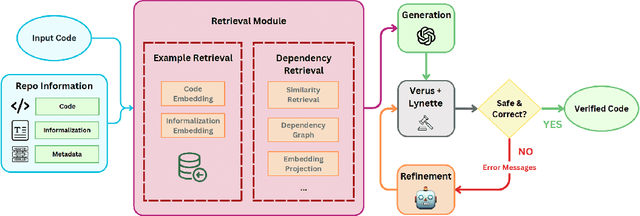
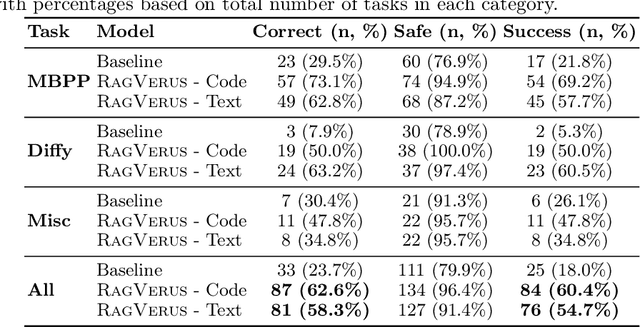
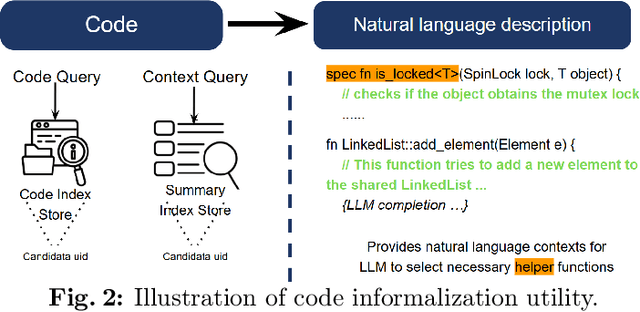
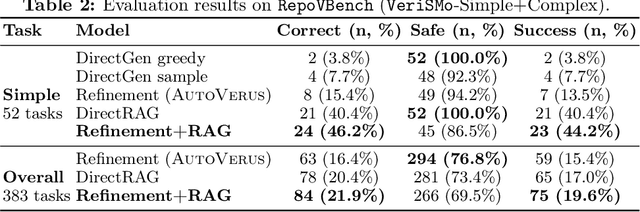
Scaling automated formal verification to real-world projects requires resolving cross-module dependencies and global contexts, which are challenges overlooked by existing function-centric methods. We introduce RagVerus, a framework that synergizes retrieval-augmented generation with context-aware prompting to automate proof synthesis for multi-module repositories, achieving a 27% relative improvement on our novel RepoVBench benchmark -- the first repository-level dataset for Verus with 383 proof completion tasks. RagVerus triples proof pass rates on existing benchmarks under constrained language model budgets, demonstrating a scalable and sample-efficient verification.