 Add to Chrome
 Add to Firefox
 Add to Edge
SHroom: A Python Framework for Ambisonics Room Acoustics Simulation and Binaural Rendering
Mar 28, 2026
Spherical Harmonics ROOM), an open-source Python library for room acoustics simulation using Ambisonics, available at https://github.com/Yhonatangayer/shroom and installable via \texttt{pip install pyshroom}. \textbf{shroom} projects image-source contributions onto a Spherical Harmonics (SH) basis, yielding a composable pipeline for binaural decoding, spherical array simulation, and real-time head rotation. Benchmarked against \texttt{pyroomacoustics} with an $N=30$ reference, \textbf{shroom} with Magnitude Least Squares (MagLS) achieves perceptual transparency (2.02~dB Log Spectral Distance (LSD) at $N=5$, within the 1--2~dB Just Noticeable Difference (JND)) while its fixed-once decode amortises over multiple sources ($K=1$-to-$8$: slowdown narrows from $7\times$ to $3.1\times$). For dynamic head rotation, \textbf{shroom} applies a Wigner-D multiply at $<1$~ms/frame, making it the only architecturally viable real-time choice.

Ambisonics Encoding For Arbitrary Microphone Arrays Incorporating Residual Channels For Binaural Reproduction
Feb 27, 2024

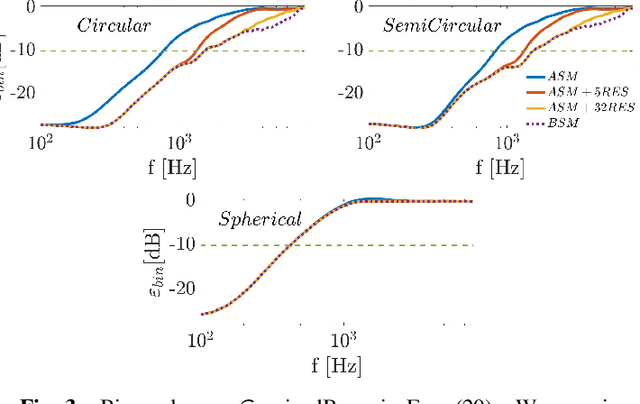
In the rapidly evolving fields of virtual and augmented reality, accurate spatial audio capture and reproduction are essential. For these applications, Ambisonics has emerged as a standard format. However, existing methods for encoding Ambisonics signals from arbitrary microphone arrays face challenges, such as errors due to the irregular array configurations and limited spatial resolution resulting from a typically small number of microphones. To address these limitations and challenges, a mathematical framework for studying Ambisonics encoding is presented, highlighting the importance of incorporating the full steering function, and providing a novel measure for predicting the accuracy of encoding each Ambisonics channel from the steering functions alone. Furthermore, novel residual channels are formulated supplementing the Ambisonics channels. A simulation study for several array configurations demonstrates a reduction in binaural error for this approach.