 Add to Chrome
 Add to Firefox
 Add to Edge
DA-Fusion: Deformable Attention-Based RGB-D Fusion Transformer for Unseen Object Instance Segmentation
Jul 20, 2026
In logistics automation, precise segmentation of unseen objects is crucial for efficient robotic manipulation in cluttered environments. Tasks such as bin-picking and shelf-picking require robust perception to handle occlusions, varying object shapes, and complex spatial arrangements. Traditional RGB-based methods tend to over-segment objects due to their reliance on texture, while depth-based methods often under-segment by focusing primarily on geometric features. To address these limitations, we propose DA-Fusion, a deformable attention-based RGB-D fusion Transformer designed for unseen object instance segmentation. DA-Fusion effectively combines the strengths of both RGB and depth data, enhancing segmentation accuracy in cluttered and multi-layered object environments. We also introduce the Object Clutter Bin Dataset (OCBD), a benchmark dataset specifically tailored for evaluating bin-picking scenarios in top-down views. Extensive evaluations demonstrate that DA-Fusion outperforms state-of-the-art methods across diverse environments, making it particularly suited for real-world logistics tasks.
* 7 pages, 5 figures. Published in the Proceedings of the 2025 IEEE International Conference on Robotics and Automation (ICRA 2025)

CDIS: Cross-Dimensional Class-Agnostic 3D Instance Segmentation via 2D Mask Tracking and 3D-2D Projection Merging
Jul 20, 2026Class-agnostic 3D instance segmentation is critical for robotic systems operating in unknown environments, enabling perception of previously unseen objects for reliable manipulation and navigation. Existing approaches typically project per-frame 2D instance masks into 3D and merge them, which often breaks object identities across time and yields fragmented 3D instances. We introduce Cross-Dimensional Class-Agnostic 3D Instance Segmentation (CDIS), a zero-shot framework that explicitly tracks 2D instance masks across frames and associates them with 3D superpoints, creating a feedback loop between 2D and 3D. This cross-dimensional reasoning links temporally stable 2D tracks with spatially coherent 3D regions, producing globally consistent 3D instance labels without any 3D-specific training. Experiments on benchmark datasets demonstrate that CDIS achieves higher accuracy and consistency than state-of-the-art zero-shot methods, while remaining efficient and scalable to diverse real-world environments.
* 6 pages, 5 figures. Published in the proceedings of the 2025 IEEE/RSJ International Conference on Intelligent Robots and Systems (IROS)
Seg2Grasp: A Robust Modular Suction Grasping in Bin Picking
Jul 20, 2026Current bin picking methods that rely heavily on end-to-end learning often falter when confronted with unfamiliar or complex objects in unstructured environments. To overcome these limitations, we introduce Seg2Grasp, a modular pipeline designed for robust suction grasping in dynamic and cluttered bin scenarios. Seg2Grasp is built on a three-step process: Segmentation, Grasping, and Classification. The Segmentation module employs a Transformer-based model to generate class-agnostic object masks from RGB-D images, ensuring accurate detection across various conditions. The Grasping module uses surface normals and mask proposals to determine the optimal suction points, enhancing grasp success. Finally, the Classification module leverages fine-tuned open-vocabulary Mask-CLIP for precise object identification, enabling versatile handling of diverse objects. Real-world robotic experiments demonstrate that Seg2Grasp outperforms existing methods in success rates and adaptability, establishing it as a powerful tool for automated bin picking in industrial settings.
* 7 pages, 6 figures, 2 tables. Published in the 2024 IEEE/RSJ International Conference on Intelligent Robots and Systems (IROS 2024)
Toward a Robust and Generalizable Metamaterial Foundation Model
Jul 03, 2025Advances in material functionalities drive innovations across various fields, where metamaterials-defined by structure rather than composition-are leading the way. Despite the rise of artificial intelligence (AI)-driven design strategies, their impact is limited by task-specific retraining, poor out-of-distribution(OOD) generalization, and the need for separate models for forward and inverse design. To address these limitations, we introduce the Metamaterial Foundation Model (MetaFO), a Bayesian transformer-based foundation model inspired by large language models. MetaFO learns the underlying mechanics of metamaterials, enabling probabilistic, zero-shot predictions across diverse, unseen combinations of material properties and structural responses. It also excels in nonlinear inverse design, even under OOD conditions. By treating metamaterials as an operator that maps material properties to structural responses, MetaFO uncovers intricate structure-property relationships and significantly expands the design space. This scalable and generalizable framework marks a paradigm shift in AI-driven metamaterial discovery, paving the way for next-generation innovations.
OV-MAP : Open-Vocabulary Zero-Shot 3D Instance Segmentation Map for Robots
Jun 13, 2025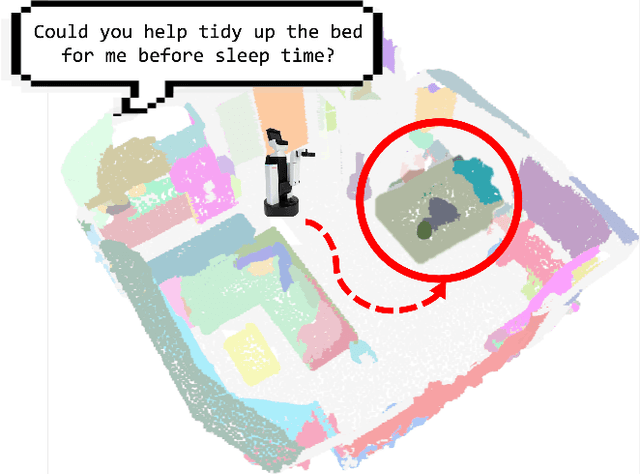

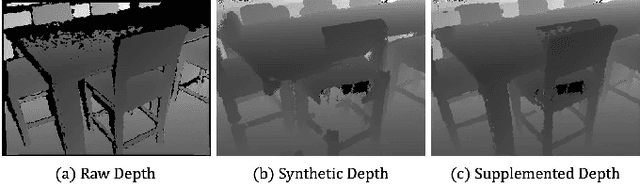
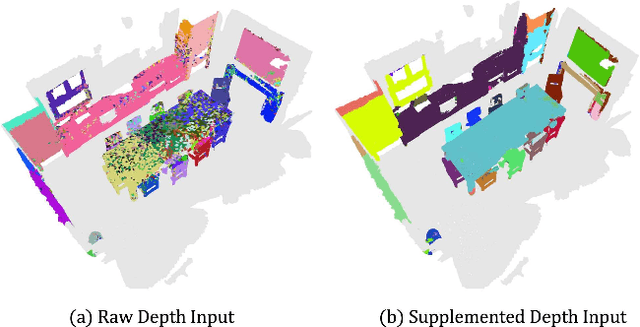
We introduce OV-MAP, a novel approach to open-world 3D mapping for mobile robots by integrating open-features into 3D maps to enhance object recognition capabilities. A significant challenge arises when overlapping features from adjacent voxels reduce instance-level precision, as features spill over voxel boundaries, blending neighboring regions together. Our method overcomes this by employing a class-agnostic segmentation model to project 2D masks into 3D space, combined with a supplemented depth image created by merging raw and synthetic depth from point clouds. This approach, along with a 3D mask voting mechanism, enables accurate zero-shot 3D instance segmentation without relying on 3D supervised segmentation models. We assess the effectiveness of our method through comprehensive experiments on public datasets such as ScanNet200 and Replica, demonstrating superior zero-shot performance, robustness, and adaptability across diverse environments. Additionally, we conducted real-world experiments to demonstrate our method's adaptability and robustness when applied to diverse real-world environments.