 Add to Chrome
 Add to Firefox
 Add to Edge
Temporally Consistent Long-Term Memory for 3D Single Object Tracking
Apr 15, 2026
3D Single Object Tracking (3D-SOT) aims to localize a target object across a sequence of LiDAR point clouds, given its 3D bounding box in the first frame. Recent methods have adopted a memory-based approach to utilize previously observed features of the target object, but remain limited to only a few recent frames. This work reveals that their temporal capacity is fundamentally constrained to short-term context due to severe temporal feature inconsistency and excessive memory overhead. To this end, we propose a robust long-term 3D-SOT framework, ChronoTrack, which preserves the temporal feature consistency while efficiently aggregating the diverse target features via long-term memory. Based on a compact set of learnable memory tokens, ChronoTrack leverages long-term information through two complementary objectives: a temporal consistency loss and a memory cycle consistency loss. The former enforces feature alignment across frames, alleviating temporal drift and improving the reliability of proposed long-term memory. In parallel, the latter encourages each token to encode diverse and discriminative target representations observed throughout the sequence via memory-point-memory cyclic walks. As a result, ChronoTrack achieves new state-of-the-art performance on multiple 3D-SOT benchmarks, demonstrating its effectiveness in long-term target modeling with compact memory while running at real-time speed of 42 FPS on a single RTX 4090 GPU. The code is available at https://github.com/ujaejoon/ChronoTrack

Mutually-Aware Feature Learning for Few-Shot Object Counting
Aug 19, 2024
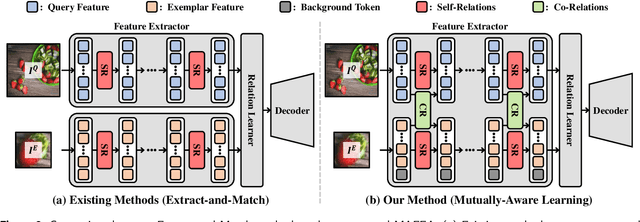
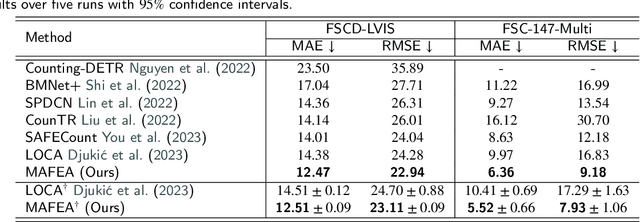
Few-shot object counting has garnered significant attention for its practicality as it aims to count target objects in a query image based on given exemplars without the need for additional training. However, there is a shortcoming in the prevailing extract-and-match approach: query and exemplar features lack interaction during feature extraction since they are extracted unaware of each other and later correlated based on similarity. This can lead to insufficient target awareness of the extracted features, resulting in target confusion in precisely identifying the actual target when multiple class objects coexist. To address this limitation, we propose a novel framework, Mutually-Aware FEAture learning(MAFEA), which encodes query and exemplar features mutually aware of each other from the outset. By encouraging interaction between query and exemplar features throughout the entire pipeline, we can obtain target-aware features that are robust to a multi-category scenario. Furthermore, we introduce a background token to effectively associate the target region of query with exemplars and decouple its background region from them. Our extensive experiments demonstrate that our model reaches a new state-of-the-art performance on the two challenging benchmarks, FSCD-LVIS and FSC-147, with a remarkably reduced degree of the target confusion problem.
Boundary-Recovering Network for Temporal Action Detection
Aug 18, 2024Temporal action detection (TAD) is challenging, yet fundamental for real-world video applications. Large temporal scale variation of actions is one of the most primary difficulties in TAD. Naturally, multi-scale features have potential in localizing actions of diverse lengths as widely used in object detection. Nevertheless, unlike objects in images, actions have more ambiguity in their boundaries. That is, small neighboring objects are not considered as a large one while short adjoining actions can be misunderstood as a long one. In the coarse-to-fine feature pyramid via pooling, these vague action boundaries can fade out, which we call 'vanishing boundary problem'. To this end, we propose Boundary-Recovering Network (BRN) to address the vanishing boundary problem. BRN constructs scale-time features by introducing a new axis called scale dimension by interpolating multi-scale features to the same temporal length. On top of scale-time features, scale-time blocks learn to exchange features across scale levels, which can effectively settle down the issue. Our extensive experiments demonstrate that our model outperforms the state-of-the-art on the two challenging benchmarks, ActivityNet-v1.3 and THUMOS14, with remarkably reduced degree of the vanishing boundary problem.