 Add to Chrome
 Add to Firefox
 Add to Edge
Temporally Consistent Long-Term Memory for 3D Single Object Tracking
Apr 15, 2026
3D Single Object Tracking (3D-SOT) aims to localize a target object across a sequence of LiDAR point clouds, given its 3D bounding box in the first frame. Recent methods have adopted a memory-based approach to utilize previously observed features of the target object, but remain limited to only a few recent frames. This work reveals that their temporal capacity is fundamentally constrained to short-term context due to severe temporal feature inconsistency and excessive memory overhead. To this end, we propose a robust long-term 3D-SOT framework, ChronoTrack, which preserves the temporal feature consistency while efficiently aggregating the diverse target features via long-term memory. Based on a compact set of learnable memory tokens, ChronoTrack leverages long-term information through two complementary objectives: a temporal consistency loss and a memory cycle consistency loss. The former enforces feature alignment across frames, alleviating temporal drift and improving the reliability of proposed long-term memory. In parallel, the latter encourages each token to encode diverse and discriminative target representations observed throughout the sequence via memory-point-memory cyclic walks. As a result, ChronoTrack achieves new state-of-the-art performance on multiple 3D-SOT benchmarks, demonstrating its effectiveness in long-term target modeling with compact memory while running at real-time speed of 42 FPS on a single RTX 4090 GPU. The code is available at https://github.com/ujaejoon/ChronoTrack

Foreground-Covering Prototype Generation and Matching for SAM-Aided Few-Shot Segmentation
Jan 01, 2025
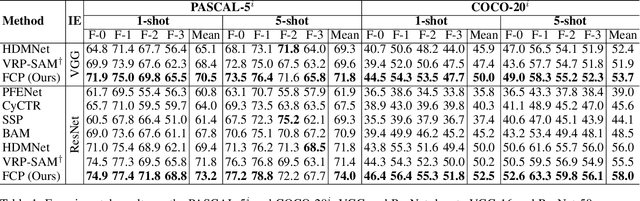
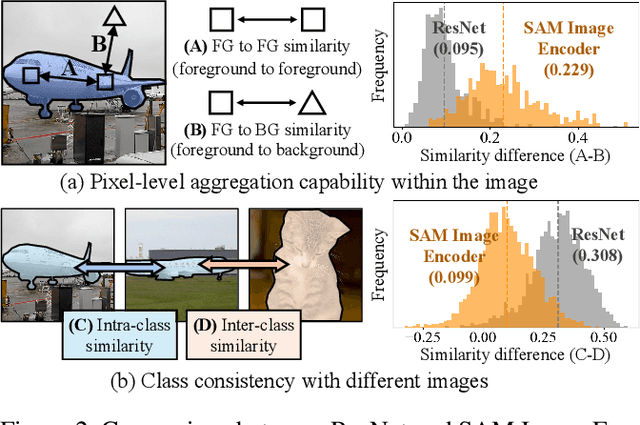
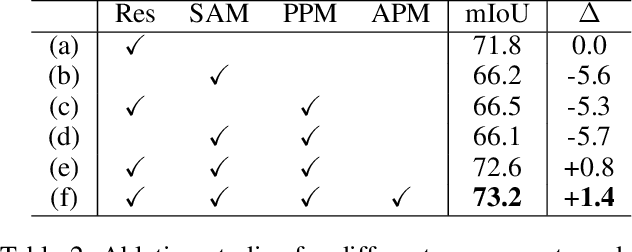
We propose Foreground-Covering Prototype Generation and Matching to resolve Few-Shot Segmentation (FSS), which aims to segment target regions in unlabeled query images based on labeled support images. Unlike previous research, which typically estimates target regions in the query using support prototypes and query pixels, we utilize the relationship between support and query prototypes. To achieve this, we utilize two complementary features: SAM Image Encoder features for pixel aggregation and ResNet features for class consistency. Specifically, we construct support and query prototypes with SAM features and distinguish query prototypes of target regions based on ResNet features. For the query prototype construction, we begin by roughly guiding foreground regions within SAM features using the conventional pseudo-mask, then employ iterative cross-attention to aggregate foreground features into learnable tokens. Here, we discover that the cross-attention weights can effectively alternate the conventional pseudo-mask. Therefore, we use the attention-based pseudo-mask to guide ResNet features to focus on the foreground, then infuse the guided ResNet feature into the learnable tokens to generate class-consistent query prototypes. The generation of the support prototype is conducted symmetrically to that of the query one, with the pseudo-mask replaced by the ground-truth mask. Finally, we compare these query prototypes with support ones to generate prompts, which subsequently produce object masks through the SAM Mask Decoder. Our state-of-the-art performances on various datasets validate the effectiveness of the proposed method for FSS. Our official code is available at https://github.com/SuhoPark0706/FCP