 Add to Chrome
 Add to Firefox
 Add to Edge
GraspGraphNet: Graph-Structured Multi-Embodiment Dexterous Grasp Generation
Jul 13, 2026
Dexterous grasp generation across robot hands is challenging because hands differ in kinematic topology, actuation dimensions, and native command spaces. We introduce GraspGraphNet, a topology-aware grasp generation framework that represents each hand as a URDF-derived kinematic graph and directly generates executable palm poses and joint configurations. GraspGraphNet combines hierarchical object surface encoding, differentiable forward kinematics, and dynamic world-edge message passing to model evolving robot-object interactions. It applies conditional flow matching directly in executable palm-pose and joint-state space, avoiding post-processing optimization, inverse kinematics, and retargeting. Using a shared model trained on Barrett Hand, Allegro Hand, and Shadow Hand, GraspGraphNet achieves an average success rate of 83.48% with 40ms inference time per grasp on a 40-object benchmark. Without retraining, the same model achieves 72.70% success on controlled finger-removal variants, demonstrating robustness to hand-topology variations. These results suggest that graph-structured hand representations can effectively support dexterous grasp generation across robot hands with different kinematic structures. Project: https://lysees.github.io/graspgraphnet-page

From Prediction to Application: Language Model-based Code Knowledge Tracing with Domain Adaptive Pre-Training and Automatic Feedback System with Pedagogical Prompting for Comprehensive Programming Education
Aug 31, 2024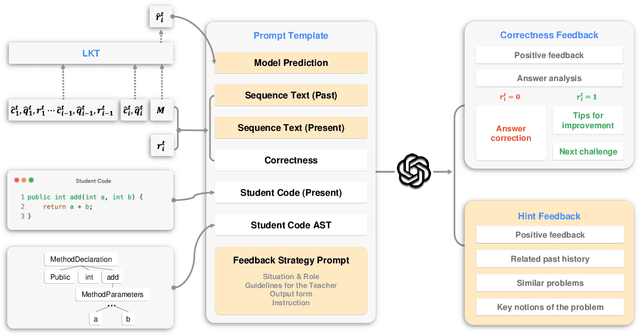
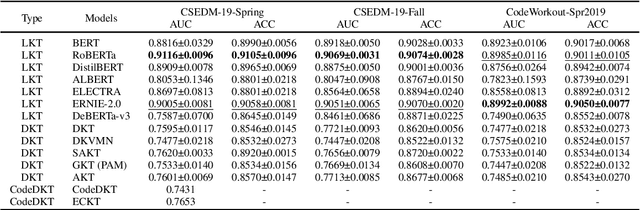
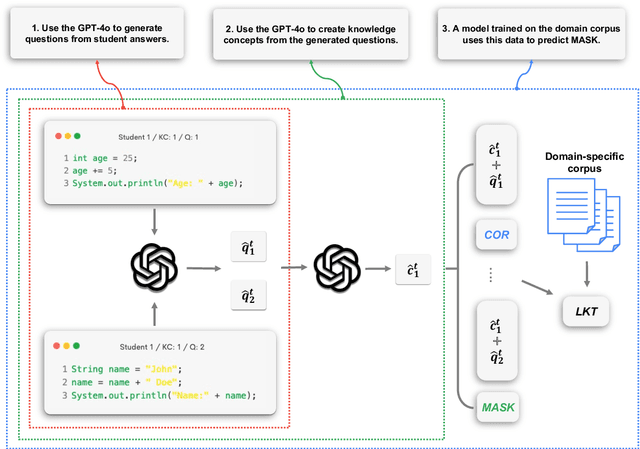
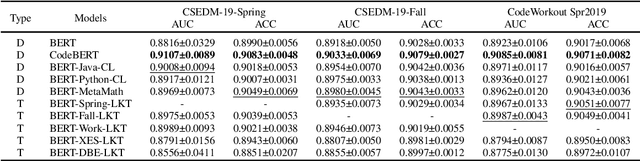
Knowledge Tracing (KT) is a critical component in online learning, but traditional approaches face limitations in interpretability and cross-domain adaptability. This paper introduces Language Model-based Code Knowledge Tracing (CodeLKT), an innovative application of Language model-based Knowledge Tracing (LKT) to programming education. CodeLKT leverages pre-trained language models to process learning data, demonstrating superior performance over existing KT and Code KT models. We explore Domain Adaptive Pre-Training (DAPT) and Task Adaptive Pre-Training (TAPT), showing enhanced performance in the coding domain and investigating cross-domain transfer between mathematics and coding. Additionally, we present an theoretically-informed integrated system combining CodeLKT with large language models to generate personalized, in-depth feedback to support students' programming learning. This work advances the field of Code Knowledge Tracing by expanding the knowledge base with language model-based approach and offering practical implications for programming education through data-informed feedback.