 Add to Chrome
 Add to Firefox
 Add to Edge
OpenLearnLM Benchmark: A Unified Framework for Evaluating Knowledge, Skill, and Attitude in Educational Large Language Models
Jan 20, 2026
Large Language Models are increasingly deployed as educational tools, yet existing benchmarks focus on narrow skills and lack grounding in learning sciences. We introduce OpenLearnLM Benchmark, a theory-grounded framework evaluating LLMs across three dimensions derived from educational assessment theory: Knowledge (curriculum-aligned content and pedagogical understanding), Skills (scenario-based competencies organized through a four-level center-role-scenario-subscenario hierarchy), and Attitude (alignment consistency and deception resistance). Our benchmark comprises 124K+ items spanning multiple subjects, educational roles, and difficulty levels based on Bloom's taxonomy. The Knowledge domain prioritizes authentic assessment items from established benchmarks, while the Attitude domain adapts Anthropic's Alignment Faking methodology to detect behavioral inconsistency under varying monitoring conditions. Evaluation of seven frontier models reveals distinct capability profiles: Claude-Opus-4.5 excels in practical skills despite lower content knowledge, while Grok-4.1-fast leads in knowledge but shows alignment concerns. Notably, no single model dominates all dimensions, validating the necessity of multi-axis evaluation. OpenLearnLM provides an open, comprehensive framework for advancing LLM readiness in authentic educational contexts.

From Prediction to Application: Language Model-based Code Knowledge Tracing with Domain Adaptive Pre-Training and Automatic Feedback System with Pedagogical Prompting for Comprehensive Programming Education
Aug 31, 2024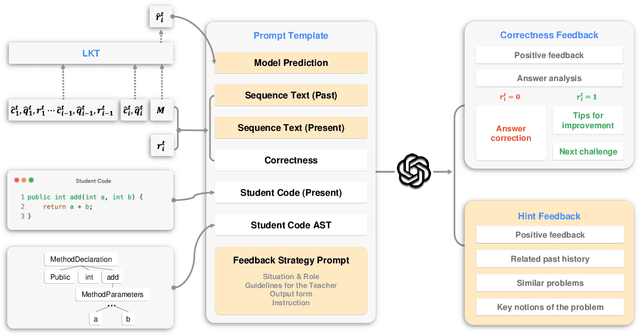
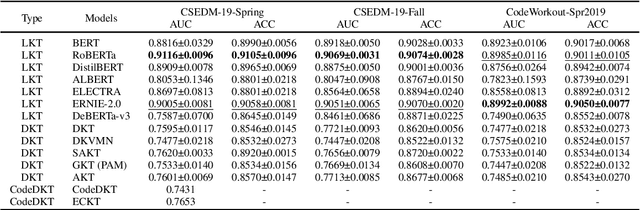
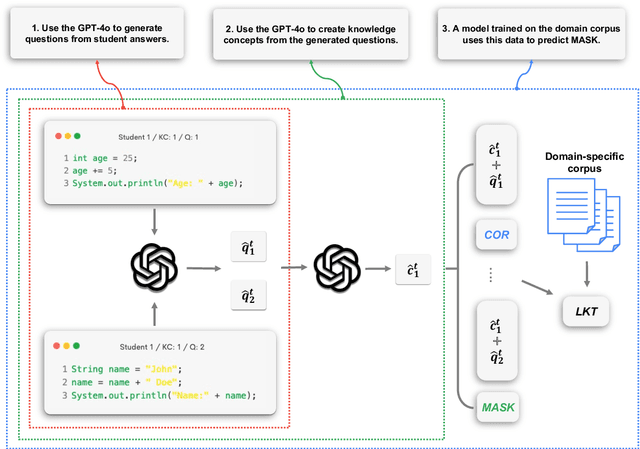
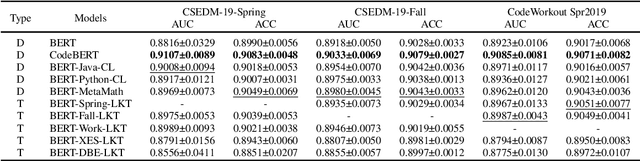
Knowledge Tracing (KT) is a critical component in online learning, but traditional approaches face limitations in interpretability and cross-domain adaptability. This paper introduces Language Model-based Code Knowledge Tracing (CodeLKT), an innovative application of Language model-based Knowledge Tracing (LKT) to programming education. CodeLKT leverages pre-trained language models to process learning data, demonstrating superior performance over existing KT and Code KT models. We explore Domain Adaptive Pre-Training (DAPT) and Task Adaptive Pre-Training (TAPT), showing enhanced performance in the coding domain and investigating cross-domain transfer between mathematics and coding. Additionally, we present an theoretically-informed integrated system combining CodeLKT with large language models to generate personalized, in-depth feedback to support students' programming learning. This work advances the field of Code Knowledge Tracing by expanding the knowledge base with language model-based approach and offering practical implications for programming education through data-informed feedback.