 Add to Chrome
 Add to Firefox
 Add to Edge
AGDC: Autoregressive Generation of Variable-Length Sequences with Joint Discrete and Continuous Spaces
Jan 09, 2026
Transformer-based autoregressive models excel in data generation but are inherently constrained by their reliance on discretized tokens, which limits their ability to represent continuous values with high precision. We analyze the scalability limitations of existing discretization-based approaches for generating hybrid discrete-continuous sequences, particularly in high-precision domains such as semiconductor circuit designs, where precision loss can lead to functional failure. To address the challenge, we propose AGDC, a novel unified framework that jointly models discrete and continuous values for variable-length sequences. AGDC employs a hybrid approach that combines categorical prediction for discrete values with diffusion-based modeling for continuous values, incorporating two key technical components: an end-of-sequence (EOS) logit adjustment mechanism that uses an MLP to dynamically adjust EOS token logits based on sequence context, and a length regularization term integrated into the loss function. Additionally, we present ContLayNet, a large-scale benchmark comprising 334K high-precision semiconductor layout samples with specialized evaluation metrics that capture functional correctness where precision errors significantly impact performance. Experiments on semiconductor layouts (ContLayNet), graphic layouts, and SVGs demonstrate AGDC's superior performance in generating high-fidelity hybrid vector representations compared to discretization-based and fixed-schema baselines, achieving scalable high-precision generation across diverse domains.

Generating Animated Layouts as Structured Text Representations
May 02, 2025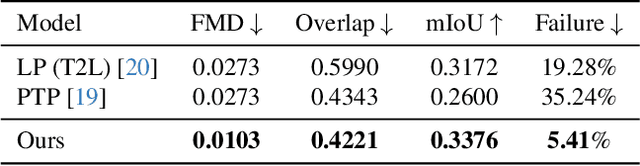
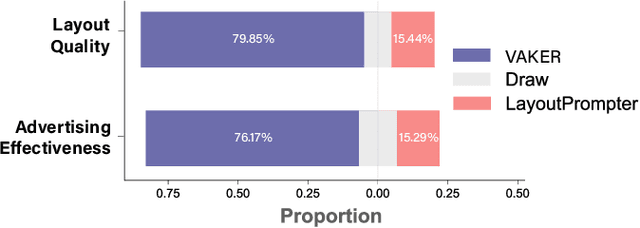
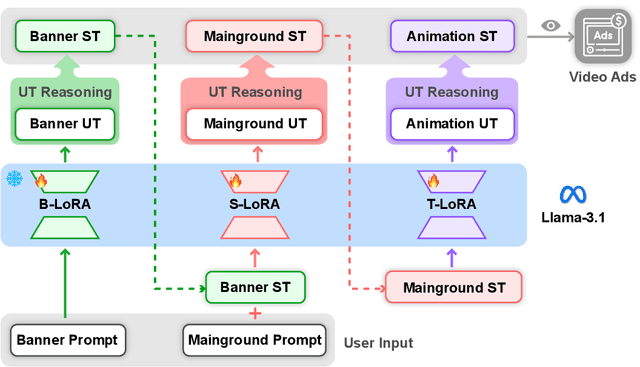
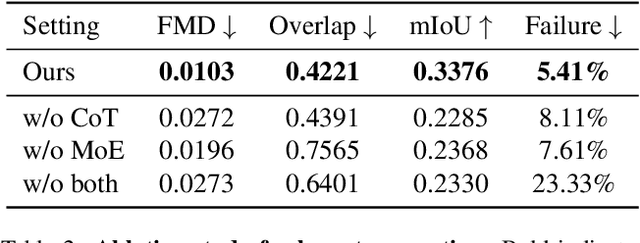
Despite the remarkable progress in text-to-video models, achieving precise control over text elements and animated graphics remains a significant challenge, especially in applications such as video advertisements. To address this limitation, we introduce Animated Layout Generation, a novel approach to extend static graphic layouts with temporal dynamics. We propose a Structured Text Representation for fine-grained video control through hierarchical visual elements. To demonstrate the effectiveness of our approach, we present VAKER (Video Ad maKER), a text-to-video advertisement generation pipeline that combines a three-stage generation process with Unstructured Text Reasoning for seamless integration with LLMs. VAKER fully automates video advertisement generation by incorporating dynamic layout trajectories for objects and graphics across specific video frames. Through extensive evaluations, we demonstrate that VAKER significantly outperforms existing methods in generating video advertisements. Project Page: https://yeonsangshin.github.io/projects/Vaker