 Add to Chrome
 Add to Firefox
 Add to Edge
SpatialBoost: Enhancing Visual Representation through Language-Guided Reasoning
Mar 23, 2026
Despite the remarkable success of large-scale pre-trained image representation models (i.e., vision encoders) across various vision tasks, they are predominantly trained on 2D image data and therefore often fail to capture 3D spatial relationships between objects and backgrounds in the real world, constraining their effectiveness in many downstream applications. To address this, we propose SpatialBoost, a scalable framework that enhances the spatial awareness of existing pre-trained vision encoders by injecting 3D spatial knowledge expressed in linguistic descriptions. The core idea involves converting dense 3D spatial information from 2D images into linguistic expressions, which is then used to inject such spatial knowledge into vision encoders through a Large Language Model (LLM). To this end, we adopt a multi-turn Chain-of-Thought (CoT) reasoning process that progressively incorporates dense spatial knowledge and builds hierarchical spatial understanding. To validate effectiveness, we adapt SpatialBoost to state-of-the-art vision encoders such as DINOv3, and evaluate its performance gains on a wide range of benchmarks requiring both 3D perception and general vision abilities. For instance, SpatialBoost improves DINOv3 performance from 55.9 to 59.7 mIoU on ADE20K, achieving state-of-the-art performance with 3.8% gain over the pre-trained DINOv3.

AGDC: Autoregressive Generation of Variable-Length Sequences with Joint Discrete and Continuous Spaces
Jan 09, 2026Transformer-based autoregressive models excel in data generation but are inherently constrained by their reliance on discretized tokens, which limits their ability to represent continuous values with high precision. We analyze the scalability limitations of existing discretization-based approaches for generating hybrid discrete-continuous sequences, particularly in high-precision domains such as semiconductor circuit designs, where precision loss can lead to functional failure. To address the challenge, we propose AGDC, a novel unified framework that jointly models discrete and continuous values for variable-length sequences. AGDC employs a hybrid approach that combines categorical prediction for discrete values with diffusion-based modeling for continuous values, incorporating two key technical components: an end-of-sequence (EOS) logit adjustment mechanism that uses an MLP to dynamically adjust EOS token logits based on sequence context, and a length regularization term integrated into the loss function. Additionally, we present ContLayNet, a large-scale benchmark comprising 334K high-precision semiconductor layout samples with specialized evaluation metrics that capture functional correctness where precision errors significantly impact performance. Experiments on semiconductor layouts (ContLayNet), graphic layouts, and SVGs demonstrate AGDC's superior performance in generating high-fidelity hybrid vector representations compared to discretization-based and fixed-schema baselines, achieving scalable high-precision generation across diverse domains.
Real-World Efficient Blind Motion Deblurring via Blur Pixel Discretization
Apr 18, 2024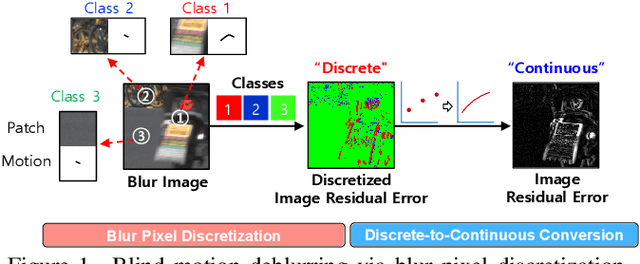
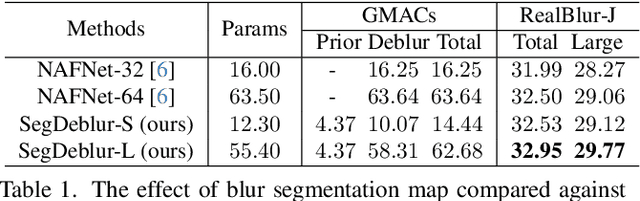
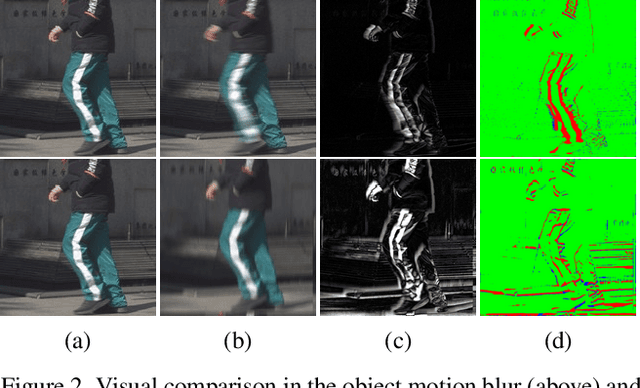
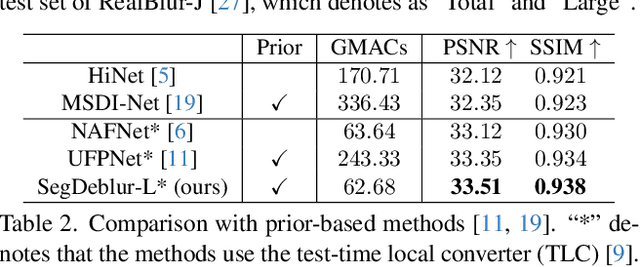
As recent advances in mobile camera technology have enabled the capability to capture high-resolution images, such as 4K images, the demand for an efficient deblurring model handling large motion has increased. In this paper, we discover that the image residual errors, i.e., blur-sharp pixel differences, can be grouped into some categories according to their motion blur type and how complex their neighboring pixels are. Inspired by this, we decompose the deblurring (regression) task into blur pixel discretization (pixel-level blur classification) and discrete-to-continuous conversion (regression with blur class map) tasks. Specifically, we generate the discretized image residual errors by identifying the blur pixels and then transform them to a continuous form, which is computationally more efficient than naively solving the original regression problem with continuous values. Here, we found that the discretization result, i.e., blur segmentation map, remarkably exhibits visual similarity with the image residual errors. As a result, our efficient model shows comparable performance to state-of-the-art methods in realistic benchmarks, while our method is up to 10 times computationally more efficient.