 Add to Chrome
 Add to Firefox
 Add to Edge
Parallel Test-Time Scaling with Multi-Sequence Verifiers
Mar 03, 2026
Parallel test-time scaling, which generates multiple candidate solutions for a single problem, is a powerful technique for improving large language model performance. However, it is hindered by two key bottlenecks: accurately selecting the correct solution from the candidate pool, and the high inference latency from generating many full solutions. We argue that both challenges are fundamentally linked to verifier calibration. A well-calibrated verifier not only improves answer selection, but also enables early-stopping strategies to reduce latency. However, existing verifiers are limited as they score each candidate in isolation, overlooking rich contextual information across the set of candidates. To address this, we introduce the Multi-Sequence Verifier (MSV), the first verifier designed to jointly process all candidate solutions and model their interactions. MSV achieves improved calibration, which directly enhances best-of-N selection performance. We further introduce a streaming MSV variant that empowers a novel early-stopping framework. Our novel framework fully leverages parallel decoding, which contrasts with the existing multi-sequence early exit works that decode sequences one by one and thus incur significant latency. In this novel setting, MSV can achieve the same target accuracy with around half the latency that would be required with its counterpart that scores each solution in isolation.

Mitigating Legibility Tax with Decoupled Prover-Verifier Games
Feb 26, 2026As large language models become increasingly capable, it is critical that their outputs can be easily checked by less capable systems. Prover-verifier games can be used to improve checkability of model outputs, but display a degradation in accuracy compared to a baseline trained only to maximize correctness -- a phenonemon named legibility tax. We propose a solution by decoupling the correctness from the checkability condition and instead training a "translator" model that turns a fixed solver model's solution into a checkable form. This allows us to first train the solver to maximize correctness, and then train the translator to translate the solver into a checkable form while retaining the solver's answer. To accommodate this new objective of translation, we formulate a decoupled prover-verifier game where the equilibria correspond to faithful and checkable translators.
A Model-Free Universal AI
Feb 26, 2026In general reinforcement learning, all established optimal agents, including AIXI, are model-based, explicitly maintaining and using environment models. This paper introduces Universal AI with Q-Induction (AIQI), the first model-free agent proven to be asymptotically $\varepsilon$-optimal in general RL. AIQI performs universal induction over distributional action-value functions, instead of policies or environments like previous works. Under a grain of truth condition, we prove that AIQI is strong asymptotically $\varepsilon$-optimal and asymptotically $\varepsilon$-Bayes-optimal. Our results significantly expand the diversity of known universal agents.
Variational Partial Group Convolutions for Input-Aware Partial Equivariance of Rotations and Color-Shifts
Jul 05, 2024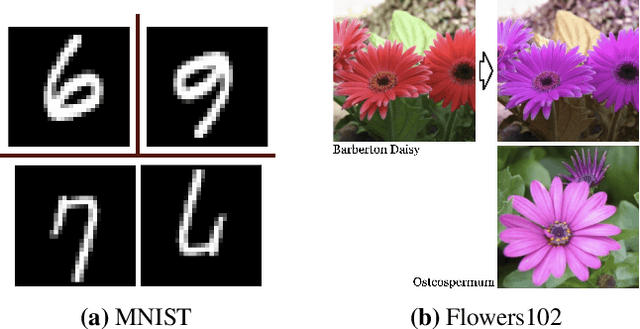
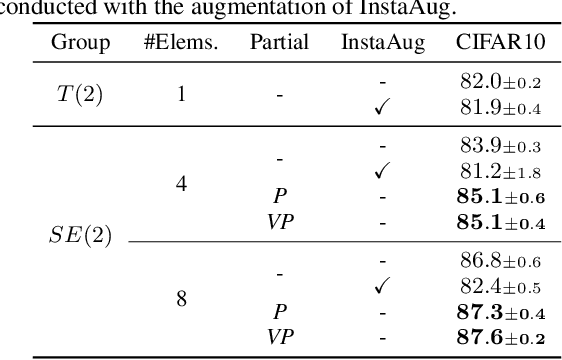
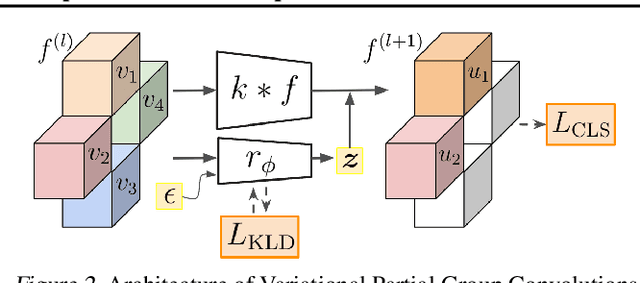
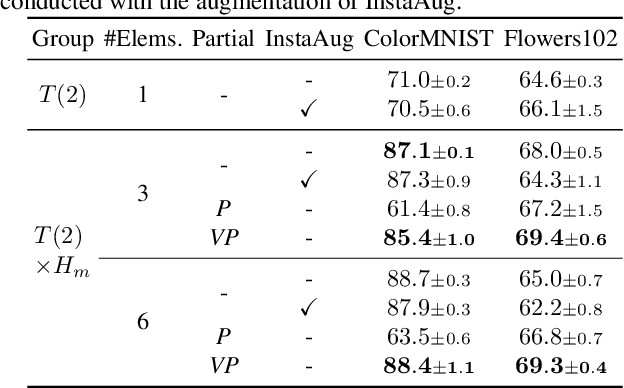
Group Equivariant CNNs (G-CNNs) have shown promising efficacy in various tasks, owing to their ability to capture hierarchical features in an equivariant manner. However, their equivariance is fixed to the symmetry of the whole group, limiting adaptability to diverse partial symmetries in real-world datasets, such as limited rotation symmetry of handwritten digit images and limited color-shift symmetry of flower images. Recent efforts address this limitation, one example being Partial G-CNN which restricts the output group space of convolution layers to break full equivariance. However, such an approach still fails to adjust equivariance levels across data. In this paper, we propose a novel approach, Variational Partial G-CNN (VP G-CNN), to capture varying levels of partial equivariance specific to each data instance. VP G-CNN redesigns the distribution of the output group elements to be conditioned on input data, leveraging variational inference to avoid overfitting. This enables the model to adjust its equivariance levels according to the needs of individual data points. Additionally, we address training instability inherent in discrete group equivariance models by redesigning the reparametrizable distribution. We demonstrate the effectiveness of VP G-CNN on both toy and real-world datasets, including MNIST67-180, CIFAR10, ColorMNIST, and Flowers102. Our results show robust performance, even in uncertainty metrics.