 Add to Chrome
 Add to Firefox
 Add to Edge
Geo-EVS: Geometry-Conditioned Extrapolative View Synthesis for Autonomous Driving
Apr 08, 2026
Extrapolative novel view synthesis can reduce camera-rig dependency in autonomous driving by generating standardized virtual views from heterogeneous sensors. Existing methods degrade outside recorded trajectories because extrapolated poses provide weak geometric support and no dense target-view supervision. The key is to explicitly expose the model to out-of-trajectory condition defects during training. We propose Geo-EVS, a geometry-conditioned framework under sparse supervision. Geo-EVS has two components. Geometry-Aware Reprojection (GAR) uses fine-tuned VGGT to reconstruct colored point clouds and reproject them to observed and virtual target poses, producing geometric condition maps. This design unifies the reprojection path between training and inference. Artifact-Guided Latent Diffusion (AGLD) injects reprojection-derived artifact masks during training so the model learns to recover structure under missing support. For evaluation, we use a LiDAR-Projected Sparse-Reference (LPSR) protocol when dense extrapolated-view ground truth is unavailable. On Waymo, Geo-EVS improves sparse-view synthesis quality and geometric accuracy, especially in high-angle and low-coverage settings. It also improves downstream 3D detection.

ArbiViewGen: Controllable Arbitrary Viewpoint Camera Data Generation for Autonomous Driving via Stable Diffusion Models
Aug 07, 2025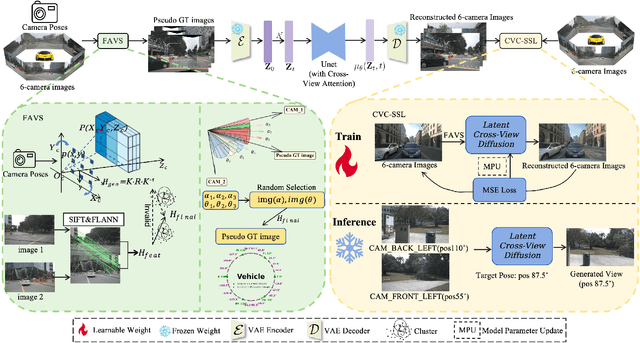
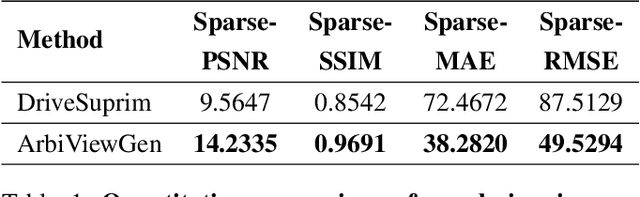
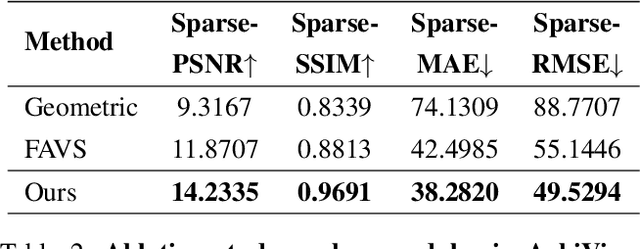
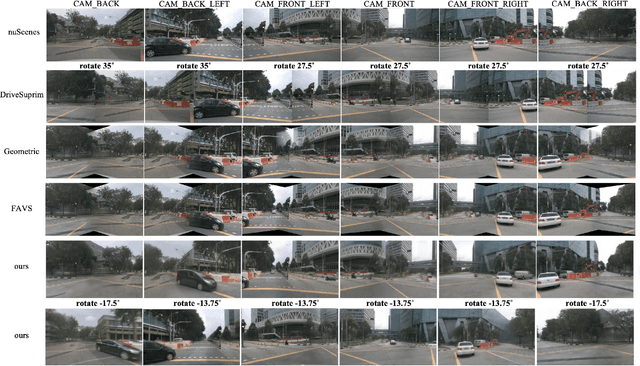
Arbitrary viewpoint image generation holds significant potential for autonomous driving, yet remains a challenging task due to the lack of ground-truth data for extrapolated views, which hampers the training of high-fidelity generative models. In this work, we propose Arbiviewgen, a novel diffusion-based framework for the generation of controllable camera images from arbitrary points of view. To address the absence of ground-truth data in unseen views, we introduce two key components: Feature-Aware Adaptive View Stitching (FAVS) and Cross-View Consistency Self-Supervised Learning (CVC-SSL). FAVS employs a hierarchical matching strategy that first establishes coarse geometric correspondences using camera poses, then performs fine-grained alignment through improved feature matching algorithms, and identifies high-confidence matching regions via clustering analysis. Building upon this, CVC-SSL adopts a self-supervised training paradigm where the model reconstructs the original camera views from the synthesized stitched images using a diffusion model, enforcing cross-view consistency without requiring supervision from extrapolated data. Our framework requires only multi-camera images and their associated poses for training, eliminating the need for additional sensors or depth maps. To our knowledge, Arbiviewgen is the first method capable of controllable arbitrary view camera image generation in multiple vehicle configurations.