 Add to Chrome
 Add to Firefox
 Add to Edge
Continual Learning through Control Minimization
Feb 04, 2026
Catastrophic forgetting remains a fundamental challenge for neural networks when tasks are trained sequentially. In this work, we reformulate continual learning as a control problem where learning and preservation signals compete within neural activity dynamics. We convert regularization penalties into preservation signals that protect prior-task representations. Learning then proceeds by minimizing the control effort required to integrate new tasks while competing with the preservation of prior tasks. At equilibrium, the neural activities produce weight updates that implicitly encode the full prior-task curvature, a property we term the continual-natural gradient, requiring no explicit curvature storage. Experiments confirm that our learning framework recovers true prior-task curvature and enables task discrimination, outperforming existing methods on standard benchmarks without replay.

COGITAO: A Visual Reasoning Framework To Study Compositionality & Generalization
Sep 05, 2025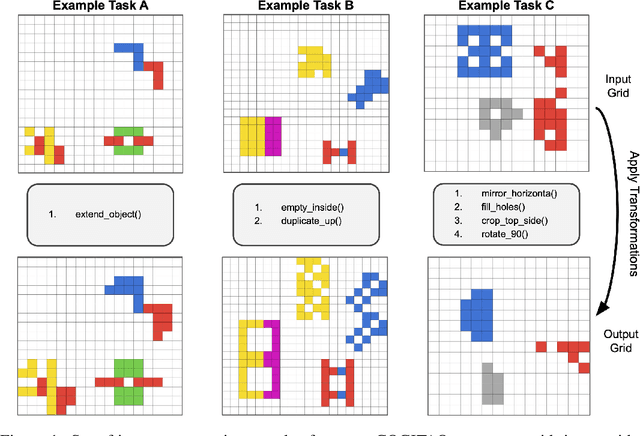
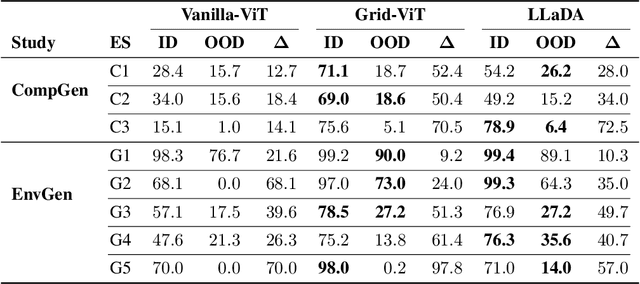
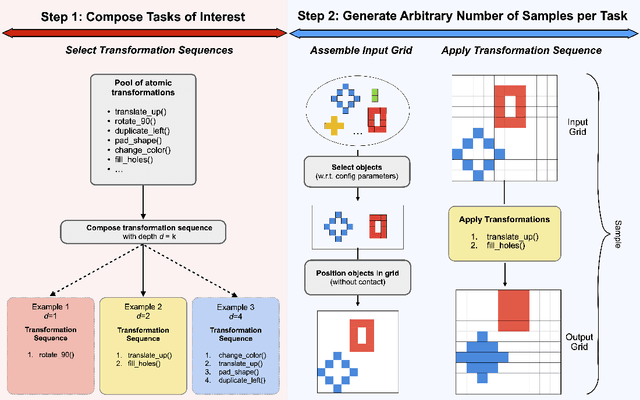
The ability to compose learned concepts and apply them in novel settings is key to human intelligence, but remains a persistent limitation in state-of-the-art machine learning models. To address this issue, we introduce COGITAO, a modular and extensible data generation framework and benchmark designed to systematically study compositionality and generalization in visual domains. Drawing inspiration from ARC-AGI's problem-setting, COGITAO constructs rule-based tasks which apply a set of transformations to objects in grid-like environments. It supports composition, at adjustable depth, over a set of 28 interoperable transformations, along with extensive control over grid parametrization and object properties. This flexibility enables the creation of millions of unique task rules -- surpassing concurrent datasets by several orders of magnitude -- across a wide range of difficulties, while allowing virtually unlimited sample generation per rule. We provide baseline experiments using state-of-the-art vision models, highlighting their consistent failures to generalize to novel combinations of familiar elements, despite strong in-domain performance. COGITAO is fully open-sourced, including all code and datasets, to support continued research in this field.