 Add to Chrome
 Add to Firefox
 Add to Edge
Perception with Guarantees: Certified Pose Estimation via Reachability Analysis
Feb 10, 2026
Agents in cyber-physical systems are increasingly entrusted with safety-critical tasks. Ensuring safety of these agents often requires localizing the pose for subsequent actions. Pose estimates can, e.g., be obtained from various combinations of lidar sensors, cameras, and external services such as GPS. Crucially, in safety-critical domains, a rough estimate is insufficient to formally determine safety, i.e., guaranteeing safety even in the worst-case scenario, and external services might additionally not be trustworthy. We address this problem by presenting a certified pose estimation in 3D solely from a camera image and a well-known target geometry. This is realized by formally bounding the pose, which is computed by leveraging recent results from reachability analysis and formal neural network verification. Our experiments demonstrate that our approach efficiently and accurately localizes agents in both synthetic and real-world experiments.

Can LLMs Discern the Traits Influencing Your Preferences? Evaluating Personality-Driven Preference Alignment in LLMs
Feb 06, 2026User preferences are increasingly used to personalize Large Language Model (LLM) responses, yet how to reliably leverage preference signals for answer generation remains under-explored. In practice, preferences can be noisy, incomplete, or even misleading, which can degrade answer quality when applied naively. Motivated by the observation that stable personality traits shape everyday preferences, we study personality as a principled ''latent'' signal behind preference statements. Through extensive experiments, we find that conditioning on personality-aligned preferences substantially improves personalized question answering: selecting preferences consistent with a user's inferred personality increases answer-choice accuracy from 29.25% to 76%, compared to using randomly selected preferences. Based on these findings, we introduce PACIFIC (Preference Alignment Choices Inference for Five-factor Identity Characterization), a personality-labeled preference dataset containing 1200 preference statements spanning diverse domains (e.g., travel, movies, education), annotated with Big-Five (OCEAN) trait directions. Finally, we propose a framework that enables an LLM model to automatically retrieve personality-aligned preferences and incorporate them during answer generation.
From Dead Neurons to Deep Approximators: Deep Bernstein Networks as a Provable Alternative to Residual Layers
Feb 04, 2026Residual connections are the de facto standard for mitigating vanishing gradients, yet they impose structural constraints and fail to address the inherent inefficiencies of piecewise linear activations. We show that Deep Bernstein Networks (which utilizes Bernstein polynomials as activation functions) can act as residual-free architecture while simultaneously optimize trainability and representation power. We provide a two-fold theoretical foundation for our approach. First, we derive a theoretical lower bound on the local derivative, proving it remains strictly bounded away from zero. This directly addresses the root cause of gradient stagnation; empirically, our architecture reduces ``dead'' neurons from 90\% in standard deep networks to less than 5\%, outperforming ReLU, Leaky ReLU, SeLU, and GeLU. Second, we establish that the approximation error for Bernstein-based networks decays exponentially with depth, a significant improvement over the polynomial rates of ReLU-based architectures. By unifying these results, we demonstrate that Bernstein activations provide a superior mechanism for function approximation and signal flow. Our experiments on HIGGS and MNIST confirm that Deep Bernstein Networks achieve high-performance training without skip-connections, offering a principled path toward deep, residual-free architectures with enhanced expressive capacity.
Correct-by-Construction Vision-based Pose Estimation using Geometric Generative Models
Jan 24, 2026We consider the problem of vision-based pose estimation for autonomous systems. While deep neural networks have been successfully used for vision-based tasks, they inherently lack provable guarantees on the correctness of their output, which is crucial for safety-critical applications. We present a framework for designing certifiable neural networks (NNs) for perception-based pose estimation that integrates physics-driven modeling with learning-based estimation. The proposed framework begins by leveraging the known geometry of planar objects commonly found in the environment, such as traffic signs and runway markings, referred to as target objects. At its core, it introduces a geometric generative model (GGM), a neural-network-like model whose parameters are derived from the image formation process of a target object observed by a camera. Once designed, the GGM can be used to train NN-based pose estimators with certified guarantees in terms of their estimation errors. We first demonstrate this framework in uncluttered environments, where the target object is the only object present in the camera's field of view. We extend this using ideas from NN reachability analysis to design certified object NN that can detect the presence of the target object in cluttered environments. Subsequently, the framework consolidates the certified object detector with the certified pose estimator to design a multi-stage perception pipeline that generalizes the proposed approach to cluttered environments, while maintaining its certified guarantees. We evaluate the proposed framework using both synthetic and real images of various planar objects commonly encountered by autonomous vehicles. Using images captured by an event-based camera, we show that the trained encoder can effectively estimate the pose of a traffic sign in accordance with the certified bound provided by the framework.
KoALA: KL-L0 Adversarial Detector via Label Agreement
Oct 14, 2025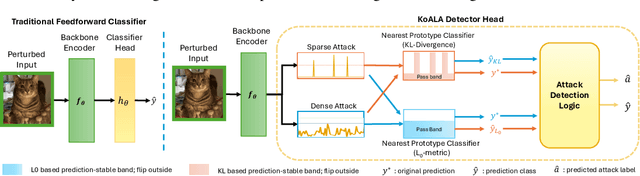
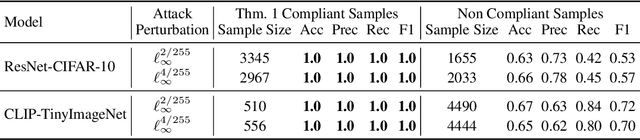
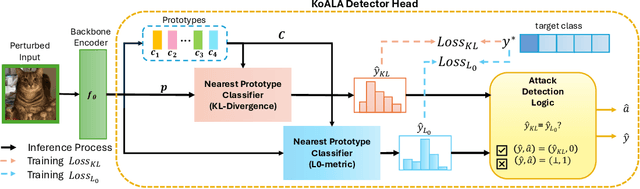
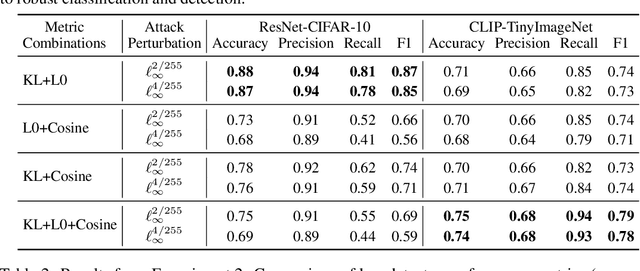
Deep neural networks are highly susceptible to adversarial attacks, which pose significant risks to security- and safety-critical applications. We present KoALA (KL-L0 Adversarial detection via Label Agreement), a novel, semantics-free adversarial detector that requires no architectural changes or adversarial retraining. KoALA operates on a simple principle: it detects an adversarial attack when class predictions from two complementary similarity metrics disagree. These metrics-KL divergence and an L0-based similarity-are specifically chosen to detect different types of perturbations. The KL divergence metric is sensitive to dense, low-amplitude shifts, while the L0-based similarity is designed for sparse, high-impact changes. We provide a formal proof of correctness for our approach. The only training required is a simple fine-tuning step on a pre-trained image encoder using clean images to ensure the embeddings align well with both metrics. This makes KOALA a lightweight, plug-and-play solution for existing models and various data modalities. Our extensive experiments on ResNet/CIFAR-10 and CLIP/Tiny-ImageNet confirm our theoretical claims. When the theorem's conditions are met, KoALA consistently and effectively detects adversarial examples. On the full test sets, KoALA achieves a precision of 0.94 and a recall of 0.81 on ResNet/CIFAR-10, and a precision of 0.66 and a recall of 0.85 on CLIP/Tiny-ImageNet.
Extracting Forward Invariant Sets from Neural Network-Based Control Barrier Functions
Jan 25, 2025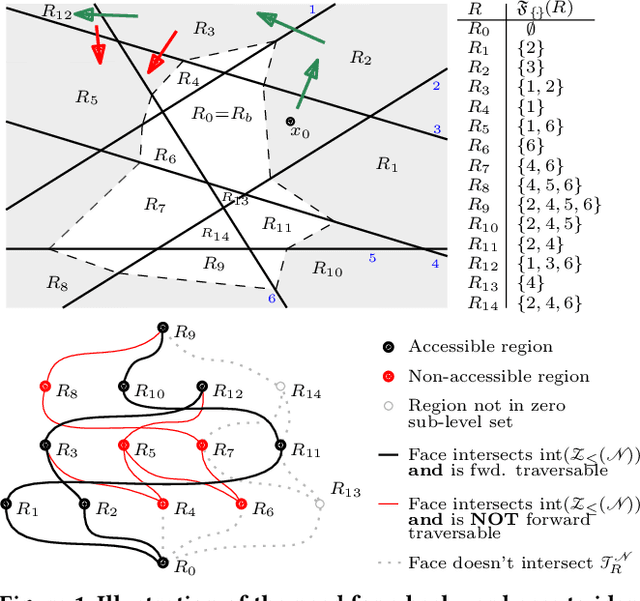
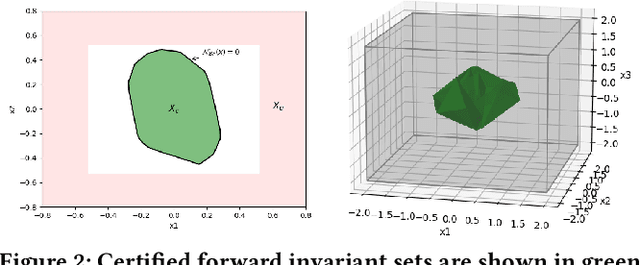
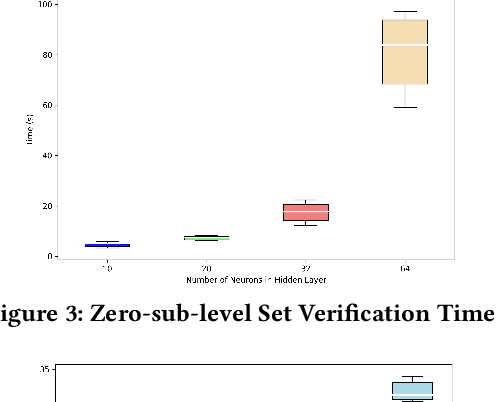
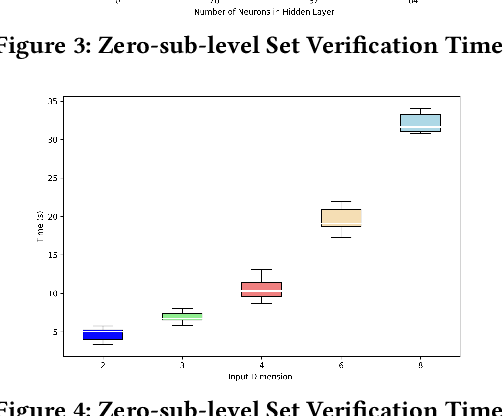
Training Neural Networks (NNs) to serve as Barrier Functions (BFs) is a popular way to improve the safety of autonomous dynamical systems. Despite significant practical success, these methods are not generally guaranteed to produce true BFs in a provable sense, which undermines their intended use as safety certificates. In this paper, we consider the problem of formally certifying a learned NN as a BF with respect to state avoidance for an autonomous system: viz. computing a region of the state space on which the candidate NN is provably a BF. In particular, we propose a sound algorithm that efficiently produces such a certificate set for a shallow NN. Our algorithm combines two novel approaches: it first uses NN reachability tools to identify a subset of states for which the output of the NN does not increase along system trajectories; then, it uses a novel enumeration algorithm for hyperplane arrangements to find the intersection of the NN's zero-sub-level set with the first set of states. In this way, our algorithm soundly finds a subset of states on which the NN is certified as a BF. We further demonstrate the effectiveness of our algorithm at certifying for real-world NNs as BFs in two case studies. We complemented these with scalability experiments that demonstrate the efficiency of our algorithm.
Certified Vision-based State Estimation for Autonomous Landing Systems using Reachability Analysis
Sep 10, 2023This paper studies the problem of designing a certified vision-based state estimator for autonomous landing systems. In such a system, a neural network (NN) processes images from a camera to estimate the aircraft relative position with respect to the runway. We propose an algorithm to design such NNs with certified properties in terms of their ability to detect runways and provide accurate state estimation. At the heart of our approach is the use of geometric models of perspective cameras to obtain a mathematical model that captures the relation between the aircraft states and the inputs. We show that such geometric models enjoy mixed monotonicity properties that can be used to design state estimators with certifiable error bounds. We show the effectiveness of the proposed approach using an experimental testbed on data collected from event-based cameras.
DeepBern-Nets: Taming the Complexity of Certifying Neural Networks using Bernstein Polynomial Activations and Precise Bound Propagation
May 22, 2023Formal certification of Neural Networks (NNs) is crucial for ensuring their safety, fairness, and robustness. Unfortunately, on the one hand, sound and complete certification algorithms of ReLU-based NNs do not scale to large-scale NNs. On the other hand, incomplete certification algorithms are easier to compute, but they result in loose bounds that deteriorate with the depth of NN, which diminishes their effectiveness. In this paper, we ask the following question; can we replace the ReLU activation function with one that opens the door to incomplete certification algorithms that are easy to compute but can produce tight bounds on the NN's outputs? We introduce DeepBern-Nets, a class of NNs with activation functions based on Bernstein polynomials instead of the commonly used ReLU activation. Bernstein polynomials are smooth and differentiable functions with desirable properties such as the so-called range enclosure and subdivision properties. We design a novel algorithm, called Bern-IBP, to efficiently compute tight bounds on DeepBern-Nets outputs. Our approach leverages the properties of Bernstein polynomials to improve the tractability of neural network certification tasks while maintaining the accuracy of the trained networks. We conduct comprehensive experiments in adversarial robustness and reachability analysis settings to assess the effectiveness of the proposed Bernstein polynomial activation in enhancing the certification process. Our proposed framework achieves high certified accuracy for adversarially-trained NNs, which is often a challenging task for certifiers of ReLU-based NNs. Moreover, using Bern-IBP bounds for certified training results in NNs with state-of-the-art certified accuracy compared to ReLU networks. This work establishes Bernstein polynomial activation as a promising alternative for improving NN certification tasks across various applications.
Model Extraction Attacks Against Reinforcement Learning Based Controllers
Apr 25, 2023We introduce the problem of model-extraction attacks in cyber-physical systems in which an attacker attempts to estimate (or extract) the feedback controller of the system. Extracting (or estimating) the controller provides an unmatched edge to attackers since it allows them to predict the future control actions of the system and plan their attack accordingly. Hence, it is important to understand the ability of the attackers to perform such an attack. In this paper, we focus on the setting when a Deep Neural Network (DNN) controller is trained using Reinforcement Learning (RL) algorithms and is used to control a stochastic system. We play the role of the attacker that aims to estimate such an unknown DNN controller, and we propose a two-phase algorithm. In the first phase, also called the offline phase, the attacker uses side-channel information about the RL-reward function and the system dynamics to identify a set of candidate estimates of the unknown DNN. In the second phase, also called the online phase, the attacker observes the behavior of the unknown DNN and uses these observations to shortlist the set of final policy estimates. We provide theoretical analysis of the error between the unknown DNN and the estimated one. We also provide numerical results showing the effectiveness of the proposed algorithm.
SEO: Safety-Aware Energy Optimization Framework for Multi-Sensor Neural Controllers at the Edge
Feb 24, 2023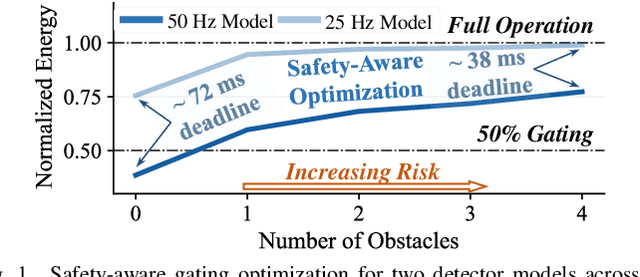
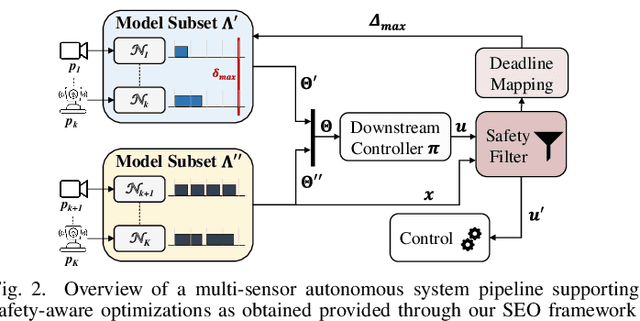


Runtime energy management has become quintessential for multi-sensor autonomous systems at the edge for achieving high performance given the platform constraints. Typical for such systems, however, is to have their controllers designed with formal guarantees on safety that precede in priority such optimizations, which in turn limits their application in real settings. In this paper, we propose a novel energy optimization framework that is aware of the autonomous system's safety state, and leverages it to regulate the application of energy optimization methods so that the system's formal safety properties are preserved. In particular, through the formal characterization of a system's safety state as a dynamic processing deadline, the computing workloads of the underlying models can be adapted accordingly. For our experiments, we model two popular runtime energy optimization methods, offloading and gating, and simulate an autonomous driving system (ADS) use-case in the CARLA simulation environment with performance characterizations obtained from the standard Nvidia Drive PX2 ADS platform. Our results demonstrate that through a formal awareness of the perceived risks in the test case scenario, energy efficiency gains are still achieved (reaching 89.9%) while maintaining the desired safety properties.