 Add to Chrome
 Add to Firefox
 Add to Edge
Directional Neural Collapse Explains Few-Shot Transfer in Self-Supervised Learning
Mar 03, 2026
Frozen self-supervised representations often transfer well with only a few labels across many semantic tasks. We argue that a single geometric quantity, \emph{directional} CDNV (decision-axis variance), sits at the core of two favorable behaviors: strong few-shot transfer within a task, and low interference across many tasks. We show that both emerge when variability \emph{along} class-separating directions is small. First, we prove sharp non-asymptotic multiclass generalization bounds for downstream classification whose leading term is the directional CDNV. The bounds include finite-shot corrections that cleanly separate intrinsic decision-axis variability from centroid-estimation error. Second, we link decision-axis collapse to multitask geometry: for independent balanced labelings, small directional CDNV across tasks forces the corresponding decision axes to be nearly orthogonal, helping a single representation support many tasks with minimal interference. Empirically, across SSL objectives, directional CDNV collapses during pretraining even when classical CDNV remains large, and our bounds closely track few-shot error at practical shot sizes. Additionally, on synthetic multitask data, we verify that SSL learns representations whose induced decision axes are nearly orthogonal. The code and project page of the paper are available at [\href{https://dlfundamentals.github.io/directional-neural-collapse/}{project page}].

REJEPA: A Novel Joint-Embedding Predictive Architecture for Efficient Remote Sensing Image Retrieval
Apr 04, 2025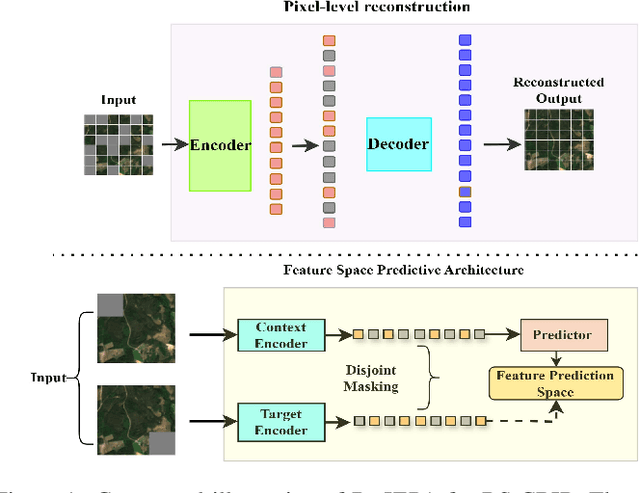
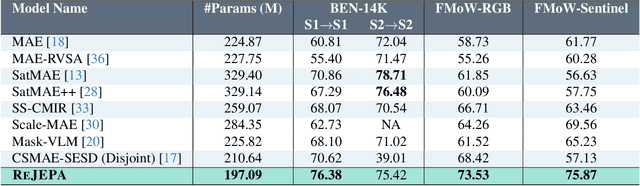
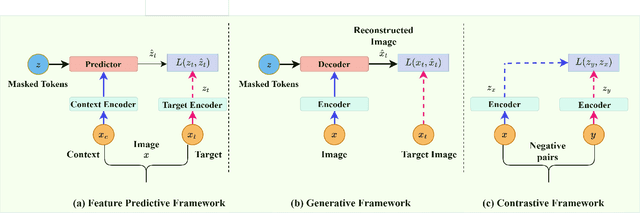
The rapid expansion of remote sensing image archives demands the development of strong and efficient techniques for content-based image retrieval (RS-CBIR). This paper presents REJEPA (Retrieval with Joint-Embedding Predictive Architecture), an innovative self-supervised framework designed for unimodal RS-CBIR. REJEPA utilises spatially distributed context token encoding to forecast abstract representations of target tokens, effectively capturing high-level semantic features and eliminating unnecessary pixel-level details. In contrast to generative methods that focus on pixel reconstruction or contrastive techniques that depend on negative pairs, REJEPA functions within feature space, achieving a reduction in computational complexity of 40-60% when compared to pixel-reconstruction baselines like Masked Autoencoders (MAE). To guarantee strong and varied representations, REJEPA incorporates Variance-Invariance-Covariance Regularisation (VICReg), which prevents encoder collapse by promoting feature diversity and reducing redundancy. The method demonstrates an estimated enhancement in retrieval accuracy of 5.1% on BEN-14K (S1), 7.4% on BEN-14K (S2), 6.0% on FMoW-RGB, and 10.1% on FMoW-Sentinel compared to prominent SSL techniques, including CSMAE-SESD, Mask-VLM, SatMAE, ScaleMAE, and SatMAE++, on extensive RS benchmarks BEN-14K (multispectral and SAR data), FMoW-RGB and FMoW-Sentinel. Through effective generalisation across sensor modalities, REJEPA establishes itself as a sensor-agnostic benchmark for efficient, scalable, and precise RS-CBIR, addressing challenges like varying resolutions, high object density, and complex backgrounds with computational efficiency.