 Add to Chrome
 Add to Firefox
 Add to Edge
Optimizing Service Operations via LLM-Powered Multi-Agent Simulation
Apr 06, 2026
Service system performance depends on how participants respond to design choices, but modeling these responses is hard due to the complexity of human behavior. We introduce an LLM-powered multi-agent simulation (LLM-MAS) framework for optimizing service operations. We pose the problem as stochastic optimization with decision-dependent uncertainty: design choices are embedded in prompts and shape the distribution of outcomes from interacting LLM-powered agents. By embedding key numerical information in prompts and extracting it from LLM-generated text, we model this uncertainty as a controlled Markov chain. We develop an on-trajectory learning algorithm that, on a single simulation run, simultaneously constructs zeroth-order gradient estimates and updates design parameters to optimize steady-state performance. We also incorporate variance reduction techniques. In a sustainable supply chain application, our method outperforms benchmarks, including blackbox optimization and using LLMs as numerical solvers or as role-playing system designers. A case study on optimal contest design with real behavioral data shows that LLM-MAS is both as a cost-effective evaluator of known designs and an exploratory tool that can uncover strong designs overlooked by traditional approaches.

Statistical Inference for Weighted Sample Average Approximation in Contextual Stochastic Optimization
Mar 17, 2025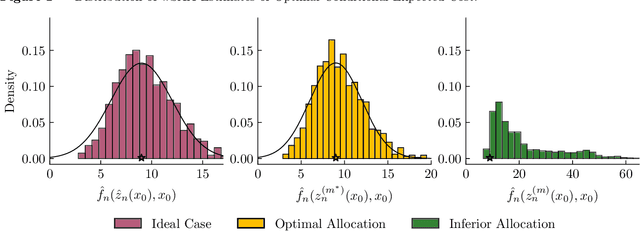
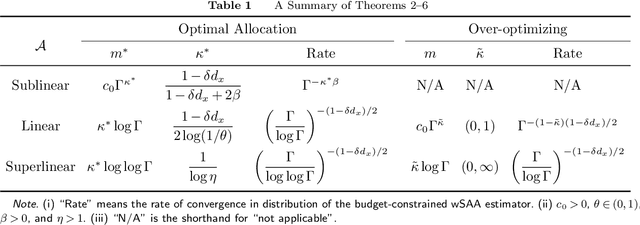
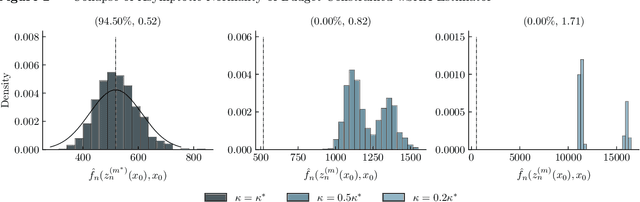
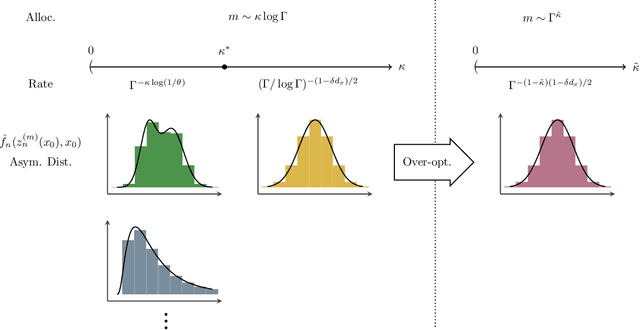
Contextual stochastic optimization provides a framework for decision-making under uncertainty incorporating observable contextual information through covariates. We analyze statistical inference for weighted sample average approximation (wSAA), a widely-used method for solving contextual stochastic optimization problems. We first establish central limit theorems for wSAA estimates of optimal values when problems can be solved exactly, characterizing how estimation uncertainty scales with covariate sample size. We then investigate practical scenarios with computational budget constraints, revealing a fundamental tradeoff between statistical accuracy and computational cost as sample sizes increase. Through central limit theorems for budget-constrained wSAA estimates, we precisely characterize this statistical-computational tradeoff. We also develop "over-optimizing" strategies for solving wSAA problems that ensure valid statistical inference. Extensive numerical experiments on both synthetic and real-world datasets validate our theoretical findings.
Smooth Nested Simulation: Bridging Cubic and Square Root Convergence Rates in High Dimensions
Jan 25, 2022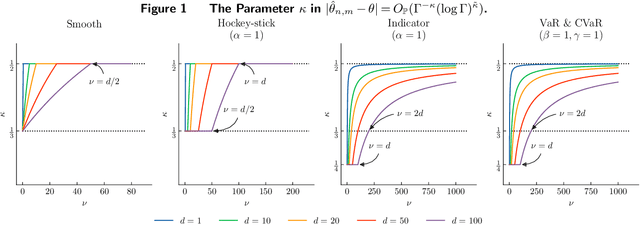
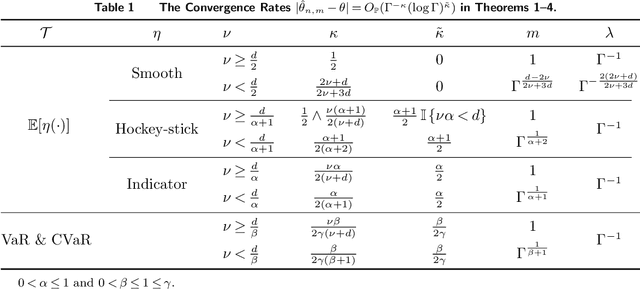
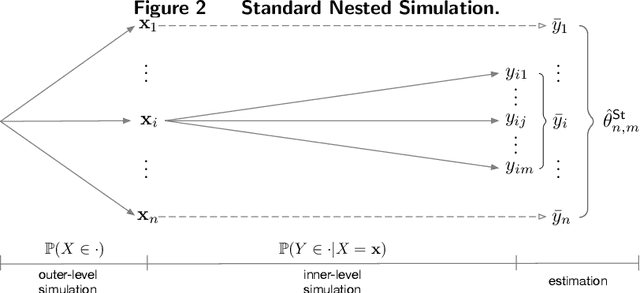
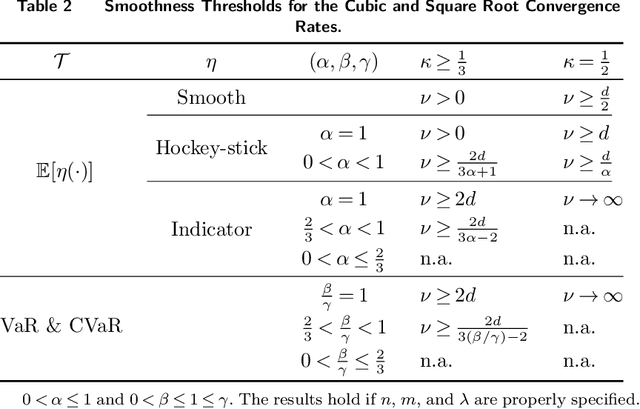
Nested simulation concerns estimating functionals of a conditional expectation via simulation. In this paper, we propose a new method based on kernel ridge regression to exploit the smoothness of the conditional expectation as a function of the multidimensional conditioning variable. Asymptotic analysis shows that the proposed method can effectively alleviate the curse of dimensionality on the convergence rate as the simulation budget increases, provided that the conditional expectation is sufficiently smooth. The smoothness bridges the gap between the cubic root convergence rate (that is, the optimal rate for the standard nested simulation) and the square root convergence rate (that is, the canonical rate for the standard Monte Carlo simulation). We demonstrate the performance of the proposed method via numerical examples from portfolio risk management and input uncertainty quantification.