 Add to Chrome
 Add to Firefox
 Add to Edge
Understanding Large Language Models
Jul 01, 2026
Large Language Models (LLMs) represent one of the most significant advances in AI and natural language processing in recent years. Still, many pressing questions about their mechanisms, capabilities, and relationship to human cognition remain highly debated. This chapter aims to outline our current understanding of LLMs by discussing recent evidence on emerging capabilities and their mechanistic implementation within processing layers. We begin with a concise overview of the Transformer architecture, emphasizing how the attention mechanism enables training on massive datasets, allowing LLMs to function as generalist rather than specialized models. Next, we examine emergent LLM capabilities that appear to resemble aspects of human cognition, including symbolic reasoning, theory of mind, and deception strategies. Several studies provide evidence that LLMs can solve tasks previously thought to require human-like cognition. Other studies reveal insightful failure cases that shed light on the differences between human and LLM cognition. Alongside these findings, we review explainable AI approaches ranging from neuron activation analysis to circuit tracing. In the final section, we address current debates concerning what LLMs genuinely understand versus what they merely appear to understand. Prominent arguments against AI anthropomorphism point to the simplicity of LLM training objectives, claiming that LLM behavior is better explained by pattern memorization of training data than by genuine cognition. We argue that this standpoint is guided by misconceptions about optimization processes and cognitive capacity, and advocate for a more nuanced discussion of LLM cognition that neither dismisses the differences between humans and LLMs nor precludes the possibility of AI cognition through overly simplistic reductionist arguments.

From Images to Connections: Can DQN with GNNs learn the Strategic Game of Hex?
Nov 22, 2023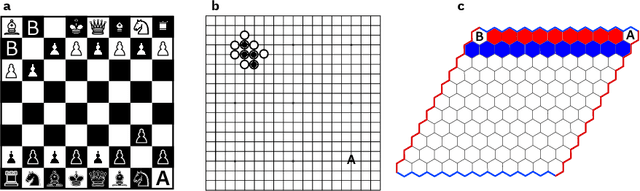

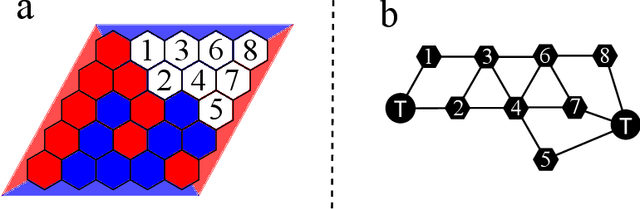
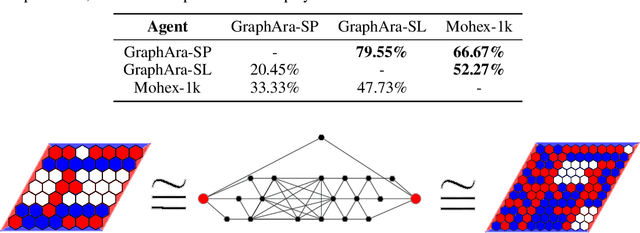
The gameplay of strategic board games such as chess, Go and Hex is often characterized by combinatorial, relational structures -- capturing distinct interactions and non-local patterns -- and not just images. Nonetheless, most common self-play reinforcement learning (RL) approaches simply approximate policy and value functions using convolutional neural networks (CNN). A key feature of CNNs is their relational inductive bias towards locality and translational invariance. In contrast, graph neural networks (GNN) can encode more complicated and distinct relational structures. Hence, we investigate the crucial question: Can GNNs, with their ability to encode complex connections, replace CNNs in self-play reinforcement learning? To this end, we do a comparison with Hex -- an abstract yet strategically rich board game -- serving as our experimental platform. Our findings reveal that GNNs excel at dealing with long range dependency situations in game states and are less prone to overfitting, but also showing a reduced proficiency in discerning local patterns. This suggests a potential paradigm shift, signaling the use of game-specific structures to reshape self-play reinforcement learning.
BERT-Defense: A Probabilistic Model Based on BERT to Combat Cognitively Inspired Orthographic Adversarial Attacks
Jun 02, 2021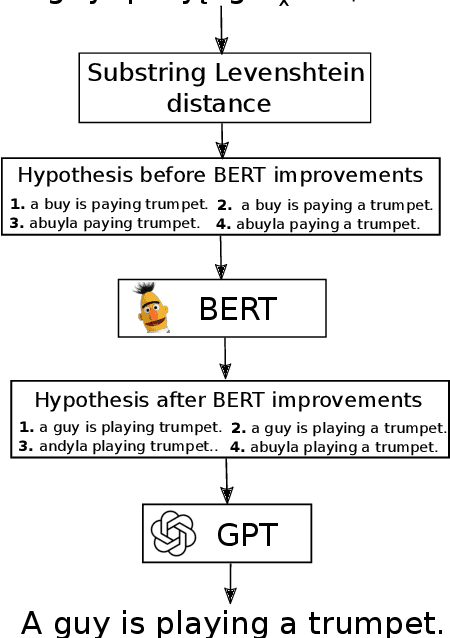
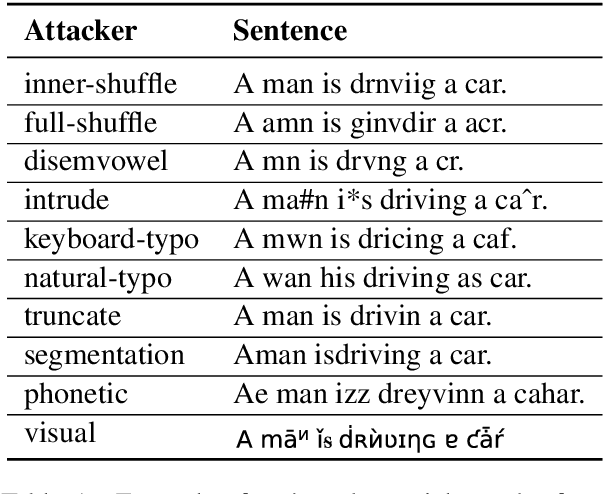
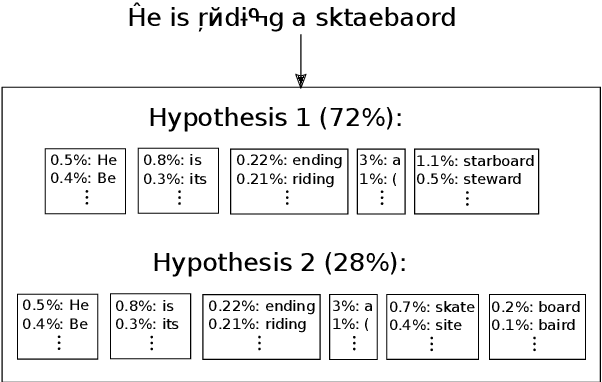

Adversarial attacks expose important blind spots of deep learning systems. While word- and sentence-level attack scenarios mostly deal with finding semantic paraphrases of the input that fool NLP models, character-level attacks typically insert typos into the input stream. It is commonly thought that these are easier to defend via spelling correction modules. In this work, we show that both a standard spellchecker and the approach of Pruthi et al. (2019), which trains to defend against insertions, deletions and swaps, perform poorly on the character-level benchmark recently proposed in Eger and Benz (2020) which includes more challenging attacks such as visual and phonetic perturbations and missing word segmentations. In contrast, we show that an untrained iterative approach which combines context-independent character-level information with context-dependent information from BERT's masked language modeling can perform on par with human crowd-workers from Amazon Mechanical Turk (AMT) supervised via 3-shot learning.
AdaptiFont: Increasing Individuals' Reading Speed with a Generative Font Model and Bayesian Optimization
Apr 21, 2021
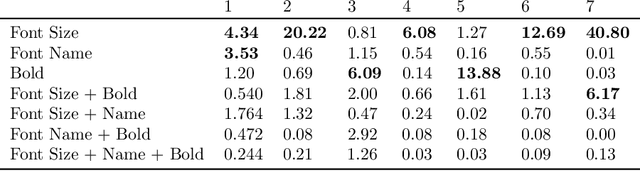
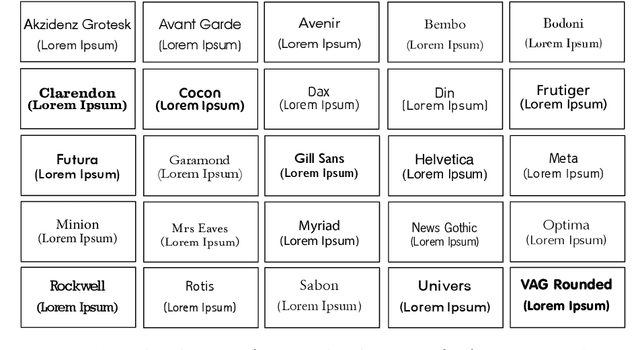
Digital text has become one of the primary ways of exchanging knowledge, but text needs to be rendered to a screen to be read. We present AdaptiFont, a human-in-the-loop system that is aimed at interactively increasing readability of text displayed on a monitor. To this end, we first learn a generative font space with non-negative matrix factorization from a set of classic fonts. In this space we generate new true-type-fonts through active learning, render texts with the new font, and measure individual users' reading speed. Bayesian optimization sequentially generates new fonts on the fly to progressively increase individuals' reading speed. The results of a user study show that this adaptive font generation system finds regions in the font space corresponding to high reading speeds, that these fonts significantly increase participants' reading speed, and that the found fonts are significantly different across individual readers.