 Add to Chrome
 Add to Firefox
 Add to Edge
EXCODER: EXplainable Classification Of DiscretE time series Representations
Feb 13, 2026
Deep learning has significantly improved time series classification, yet the lack of explainability in these models remains a major challenge. While Explainable AI (XAI) techniques aim to make model decisions more transparent, their effectiveness is often hindered by the high dimensionality and noise present in raw time series data. In this work, we investigate whether transforming time series into discrete latent representations-using methods such as Vector Quantized Variational Autoencoders (VQ-VAE) and Discrete Variational Autoencoders (DVAE)-not only preserves but enhances explainability by reducing redundancy and focusing on the most informative patterns. We show that applying XAI methods to these compressed representations leads to concise and structured explanations that maintain faithfulness without sacrificing classification performance. Additionally, we propose Similar Subsequence Accuracy (SSA), a novel metric that quantitatively assesses the alignment between XAI-identified salient subsequences and the label distribution in the training data. SSA provides a systematic way to validate whether the features highlighted by XAI methods are truly representative of the learned classification patterns. Our findings demonstrate that discrete latent representations not only retain the essential characteristics needed for classification but also offer a pathway to more compact, interpretable, and computationally efficient explanations in time series analysis.

Towards a Deep Learning-based Online Quality Prediction System for Welding Processes
Oct 20, 2023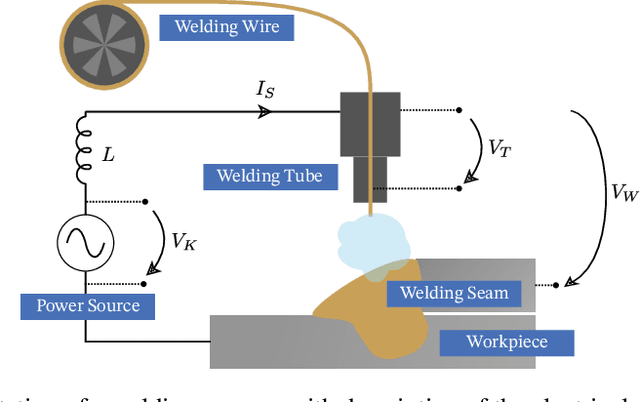
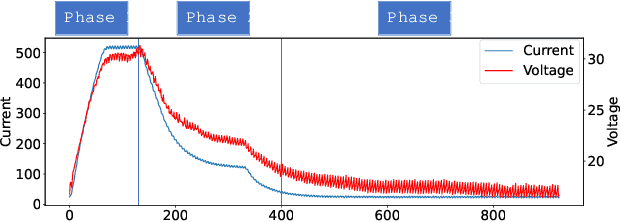
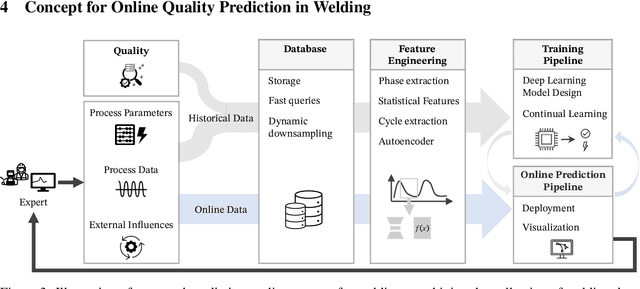
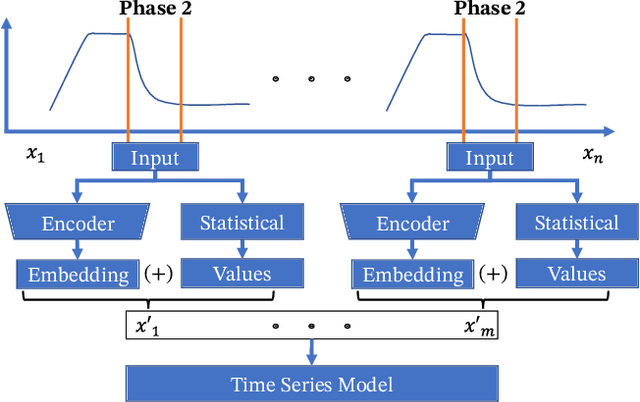
The digitization of manufacturing processes enables promising applications for machine learning-assisted quality assurance. A widely used manufacturing process that can strongly benefit from data-driven solutions is gas metal arc welding (GMAW). The welding process is characterized by complex cause-effect relationships between material properties, process conditions and weld quality. In non-laboratory environments with frequently changing process parameters, accurate determination of weld quality by destructive testing is economically unfeasible. Deep learning offers the potential to identify the relationships in available process data and predict the weld quality from process observations. In this paper, we present a concept for a deep learning based predictive quality system in GMAW. At its core, the concept involves a pipeline consisting of four major phases: collection and management of multi-sensor data (e.g. current and voltage), real-time processing and feature engineering of the time series data by means of autoencoders, training and deployment of suitable recurrent deep learning models for quality predictions, and model evolutions under changing process conditions using continual learning. The concept provides the foundation for future research activities in which we will realize an online predictive quality system for running production.