 Add to Chrome
 Add to Firefox
 Add to Edge
PinNet: Keypoint-Aware Learned Local Descriptors with Geometric Embedding for Loop Closure in LiDAR SLAM
Jun 26, 2026
Loop closure is essential to reduce drift and build globally consistent maps in large-scale environments. However, reliable loop closure with only geometric information from, e.g., a LiDAR sensor, remains challenging due to the difficulty of constructing discriminative geometric features. We present PinNet, a neural network that produces local geometric descriptors from point clouds for place recognition and scanto-scan registration. PinNet incorporates a neural network that generates keypoints and their corresponding descriptors, together with a plane-based geometric self-attention module that models inter-keypoint spatial relationships to enhance descriptor discriminability for loop-closure detection and point-cloud registration. The approach is comprehensively evaluated on multiple datasets collected with different LiDAR sensors. Experimental results demonstrate strong place-recognition performance, precise relative pose estimation, and successful single-shot localization in different environments.

Geometric Multi-Session Map Merging with Learned Local Descriptors
Dec 30, 2025Multi-session map merging is crucial for extended autonomous operations in large-scale environments. In this paper, we present GMLD, a learning-based local descriptor framework for large-scale multi-session point cloud map merging that systematically aligns maps collected across different sessions with overlapping regions. The proposed framework employs a keypoint-aware encoder and a plane-based geometric transformer to extract discriminative features for loop closure detection and relative pose estimation. To further improve global consistency, we include inter-session scan matching cost factors in the factor-graph optimization stage. We evaluate our framework on the public datasets, as well as self-collected data from diverse environments. The results show accurate and robust map merging with low error, and the learned features deliver strong performance in both loop closure detection and relative pose estimation.
Submodular Optimization for Keyframe Selection & Usage in SLAM
Oct 08, 2024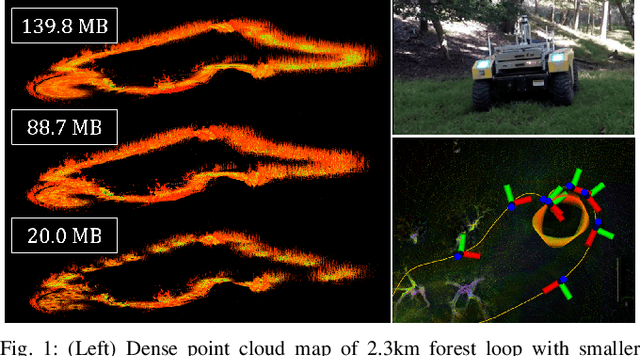

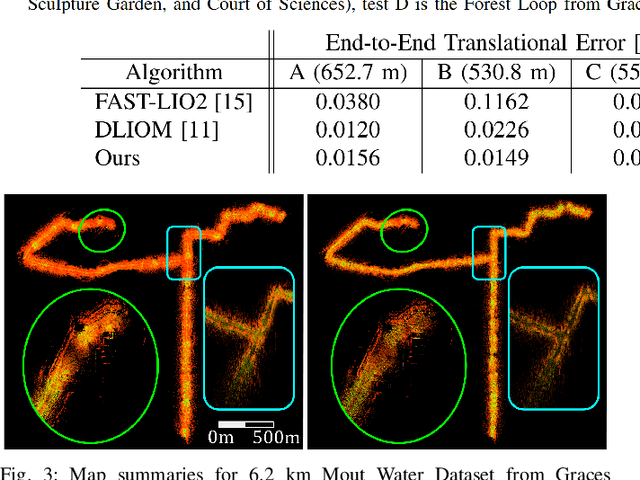

Keyframes are LiDAR scans saved for future reference in Simultaneous Localization And Mapping (SLAM), but despite their central importance most algorithms leave choices of which scans to save and how to use them to wasteful heuristics. This work proposes two novel keyframe selection strategies for localization and map summarization, as well as a novel approach to submap generation which selects keyframes that best constrain localization. Our results show that online keyframe selection and submap generation reduce the number of saved keyframes and improve per scan computation time without compromising localization performance. We also present a map summarization feature for quickly capturing environments under strict map size constraints.