 Add to Chrome
 Add to Firefox
 Add to Edge
Sparsity-Aware Evolution for Model Merging
Feb 09, 2026
We propose a sparsity-aware evolutionary (SAE) framework for model merging that involves iterative pruning-merging cycles to act as a novel mutation operator. We incorporate the sparsity constraints into the score function, which steers the evolutionary process to favor more sparse models, in addition to other conventional performance scores. Interestingly, the by-product of \textit{competition} for sparsity introduces an extra local \textit{attraction} and interplay into the evolutionary process: if one competitor has more zero elements, the other competitor's non-zero elements will occupy those positions, even though the less sparse competitor loses to the more sparse competitor in other positions. The proposed pipeline is evaluated on a variety of large-scale LLM benchmarks. Experiments demonstrate that our approach can improve model merging reliability across multiple benchmarks, and is easy to incorporate due to its simplicity and being orthogonal to most existing approaches.

Reasoning Strategies in Large Language Models: Can They Follow, Prefer, and Optimize?
Jul 16, 2025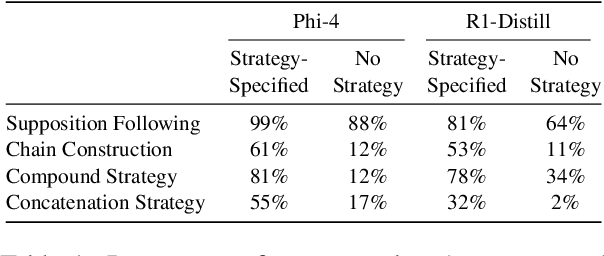
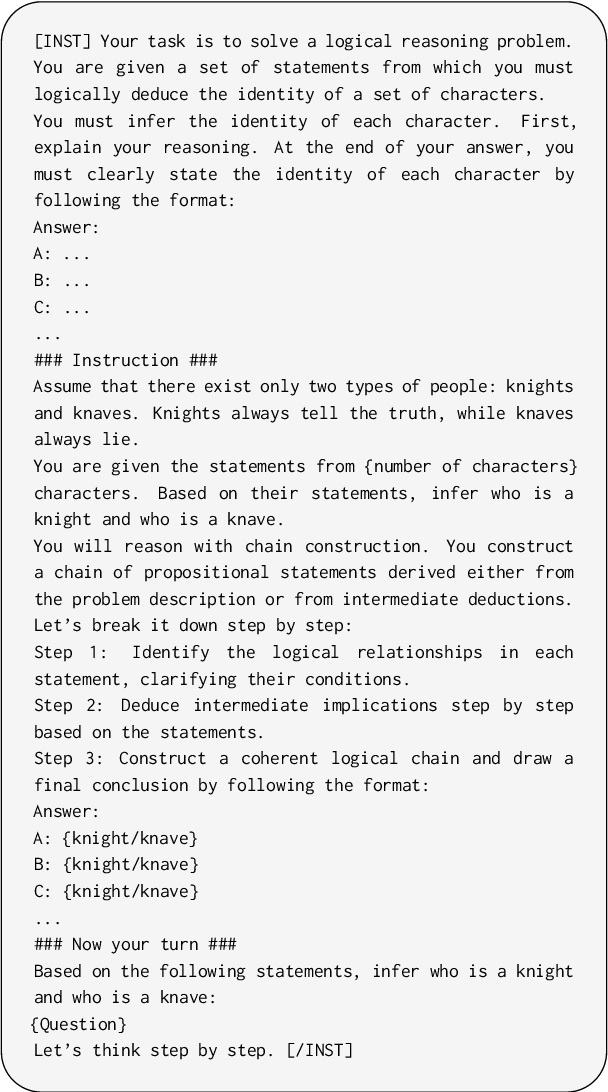
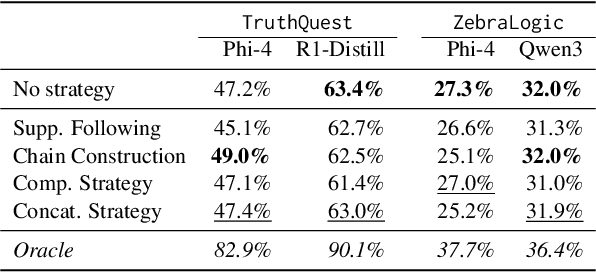
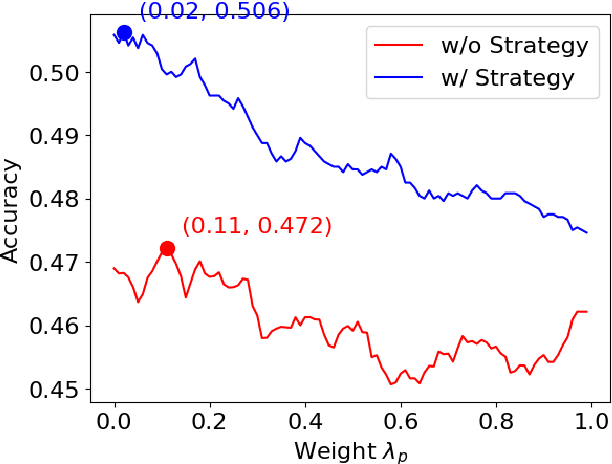
Human reasoning involves different strategies, each suited to specific problems. Prior work shows that large language model (LLMs) tend to favor a single reasoning strategy, potentially limiting their effectiveness in diverse reasoning challenges. In this work, we investigate whether prompting can control LLMs reasoning strategies and assess its impact on logical problem-solving. While our experiments show that no single strategy consistently improves accuracy, performance could be enhanced if models could adaptively choose the optimal strategy. We propose methods to guide LLMs in strategy selection, highlighting new ways to refine their reasoning abilities.