 Add to Chrome
 Add to Firefox
 Add to Edge
A Structure-Adaptive Random Feature Method for High-Dimensional Elliptic PDEs
Jul 22, 2026
Random-feature methods reduce high-dimensional elliptic PDE collocation to linear coefficient problems, but full-dimensional trial spaces overlook lower-dimensional structure. We introduce the Hierarchical Analysis-of-Variance Random Feature Method (HA-RFM), which selects coordinate blocks using closed Sobol indices of the PDE residual, identifies oblique low-rank features from fitted-predictor gradients, and couples all retained features in one regularized least-squares solve. Under structural and stability hypotheses, we establish an $L^2$ error bound that links solution and residual truncation to finite-width approximation and regularized finite-sample fitting, and we derive guarantees for width and structure recovery. The resulting width is polynomial in the dimension at fixed interaction order, with dimension-independent higher-order contributions under uniform structural control. Residual screening achieves exact recovery of the prescribed three-pair support, while fitted-predictor gradients recover oblique directions through dimension $50$. In random-ridge tests, less than $1\%$ additional width reduces errors by factors of $14$-$39$ over coordinate blocks and $34$-$100$ over equal-width full-dimensional RFM. Semilinear computations extend HA-RFM through dimension $100$, while dense and distributed interactions delineate the coordinate families required for broader structure.

Trainable Photonic Measurement for Physics-Informed PDE Learning
Jun 17, 2026Photonic quantum machine learning offers a route to trainable physical representations built from phase, interference and measurement. However, its role in scientific machine learning remains largely unexplored. Physics-informed neural fields provide a natural setting, because differential equations require trial spaces that preserve phase, frequency and derivative structure. Here we introduce a photonic quantum neural field in which coordinates become trainable optical phases, are mixed by multi-photon Fock-space interference and are decoded from photon-number measurements. The photonic circuit is optimized as the neural-field representation itself, not as a fixed feature map or hardware accelerator. Photonic measurement is therefore a trainable representation on which the physics-informed residual is minimized. Across seven elliptic, wave, nonlinear dispersive and inverse PDE benchmarks, we observe a phase-complexity transition: classical coordinate and Fourier-feature networks suffice in smooth regimes, whereas the photonic field is most accurate when residual derivatives amplify phase mismatch. In the hardest regimes it gives the lowest errors, with margins reaching an order of magnitude and about one quarter of the trainable parameters of classical baselines. Frozen and shuffled controls, together with noise stress tests, attribute this gain to learned interference and stable Fock-probability readout under compound perturbations. These results identify photonic quantum measurement as a representation-learning principle for scientific machine learning.
Trainability-Oriented Hybrid Quantum Regression via Geometric Preconditioning and Curriculum Optimization
Jan 17, 2026Quantum neural networks (QNNs) have attracted growing interest for scientific machine learning, yet in regression settings they often suffer from limited trainability under noisy gradients and ill-conditioned optimization. We propose a hybrid quantum-classical regression framework designed to mitigate these bottlenecks. Our model prepends a lightweight classical embedding that acts as a learnable geometric preconditioner, reshaping the input representation to better condition a downstream variational quantum circuit. Building on this architecture, we introduce a curriculum optimization protocol that progressively increases circuit depth and transitions from SPSA-based stochastic exploration to Adam-based gradient fine-tuning. We evaluate the approach on PDE-informed regression benchmarks and standard regression datasets under a fixed training budget in a simulator setting. Empirically, the proposed framework consistently improves over pure QNN baselines and yields more stable convergence in data-limited regimes. We further observe reduced structured errors that are visually correlated with oscillatory components on several scientific benchmarks, suggesting that geometric preconditioning combined with curriculum training is a practical approach for stabilizing quantum regression.
MicroEvoEval: A Systematic Evaluation Framework for Image-Based Microstructure Evolution Prediction
Nov 18, 2025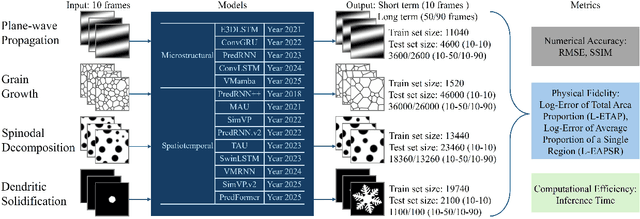
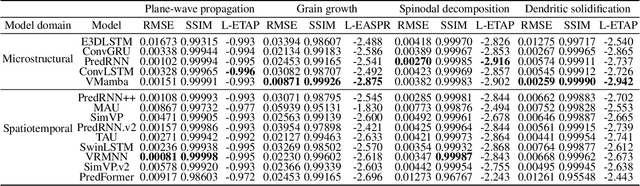

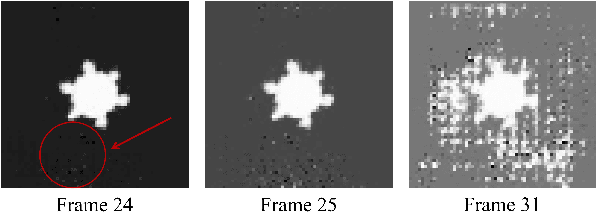
Simulating microstructure evolution (MicroEvo) is vital for materials design but demands high numerical accuracy, efficiency, and physical fidelity. Although recent studies on deep learning (DL) offer a promising alternative to traditional solvers, the field lacks standardized benchmarks. Existing studies are flawed due to a lack of comparing specialized MicroEvo DL models with state-of-the-art spatio-temporal architectures, an overemphasis on numerical accuracy over physical fidelity, and a failure to analyze error propagation over time. To address these gaps, we introduce MicroEvoEval, the first comprehensive benchmark for image-based microstructure evolution prediction. We evaluate 14 models, encompassing both domain-specific and general-purpose architectures, across four representative MicroEvo tasks with datasets specifically structured for both short- and long-term assessment. Our multi-faceted evaluation framework goes beyond numerical accuracy and computational cost, incorporating a curated set of structure-preserving metrics to assess physical fidelity. Our extensive evaluations yield several key insights. Notably, we find that modern architectures (e.g., VMamba), not only achieve superior long-term stability and physical fidelity but also operate with an order-of-magnitude greater computational efficiency. The results highlight the necessity of holistic evaluation and identify these modern architectures as a highly promising direction for developing efficient and reliable surrogate models in data-driven materials science.