 Add to Chrome
 Add to Firefox
 Add to Edge
Discovering Sparse Counterfactual Factors via Latent Adjustment for Survey-based Community Intervention
May 06, 2026
Transportation surveys are widely used to understand travel preferences and adoption barriers, yet most survey-based analyses remain descriptive or predictive and rarely provide sparse, policy-feasible intervention strategies. We study sparse counterfactual community intervention from survey responses, where the goal is to shift a target respondent group toward a desired reference group through controllable survey-variable adjustments. We formulate this task as a policy-feasible distributional alignment problem using a fixed-basis nonnegative latent representation that preserves pre/post comparability and provides a stable map from latent factors to original variables. To make latent movement actionable, target-relevant latent factors are identified through Shapley-guided attribution and transferred to controllable variables as intervention priorities. Feasible group-level adjustments are then learned by minimizing an entropy-regularized optimal-transport discrepancy between the post-intervention target distribution and the reference distribution, together with a weighted $\ell_{2,1}$ penalty that promotes shared policy-lever sparsity. Experiments on real-world transportation survey datasets show that the proposed framework produces compact and interpretable policy-feasible interventions with explicit adjustment magnitudes, improves population-level conversion, and preserves intervention sparsity. Code and datasets are publicly available at: https://github.com/pangjunbiao/latent-group-alignment.git

Exploiting Big Data in Logistics Risk Assessment via Bayesian Nonparametrics
Jul 21, 2016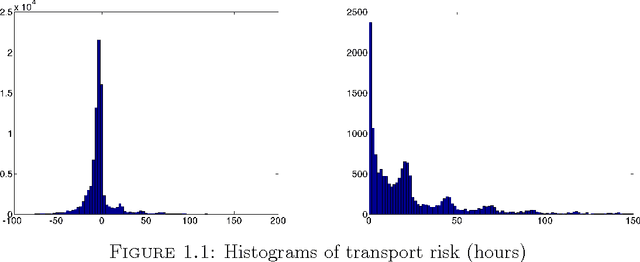

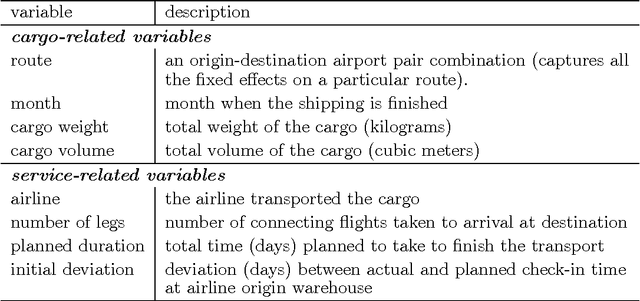
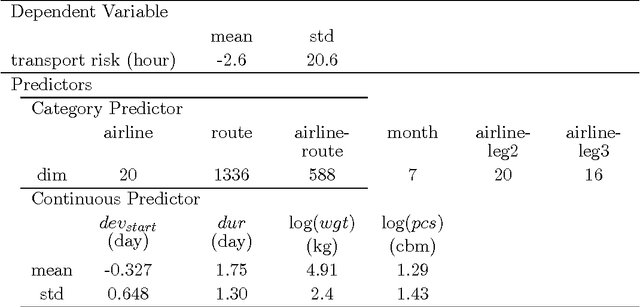
In cargo logistics, a key performance measure is transport risk, defined as the deviation of the actual arrival time from the planned arrival time. Neither earliness nor tardiness is desirable for customer and freight forwarders. In this paper, we investigate ways to assess and forecast transport risks using a half-year of air cargo data, provided by a leading forwarder on 1336 routes served by 20 airlines. Interestingly, our preliminary data analysis shows a strong multimodal feature in the transport risks, driven by unobserved events, such as cargo missing flights. To accommodate this feature, we introduce a Bayesian nonparametric model -- the probit stick-breaking process (PSBP) mixture model -- for flexible estimation of the conditional (i.e., state-dependent) density function of transport risk. We demonstrate that using simpler methods, such as OLS linear regression, can lead to misleading inferences. Our model provides a tool for the forwarder to offer customized price and service quotes. It can also generate baseline airline performance to enable fair supplier evaluation. Furthermore, the method allows us to separate recurrent risks from disruption risks. This is important, because hedging strategies for these two kinds of risks are often drastically different.