 Add to Chrome
 Add to Firefox
 Add to Edge
HyperKKL: Learning KKL Observers for Non-Autonomous Nonlinear Systems via Hypernetwork-Based Input Conditioning
Mar 31, 2026
Kazantzis-Kravaris/Luenberger (KKL) observers are a class of state observers for nonlinear systems that rely on an injective map to transform the nonlinear dynamics into a stable quasi-linear latent space, from where the state estimate is obtained in the original coordinates via a left inverse of the transformation map. Current learning-based methods for these maps are designed exclusively for autonomous systems and do not generalize well to controlled or non-autonomous systems. In this paper, we propose two learning-based designs of neural KKL observers for non-autonomous systems whose dynamics are influenced by exogenous inputs. To this end, a hypernetwork-based framework ($HyperKKL$) is proposed with two input-conditioning strategies. First, an augmented observer approach ($HyperKKL_{obs}$) adds input-dependent corrections to the latent observer dynamics while retaining static transformation maps. Second, a dynamic observer approach ($HyperKKL_{dyn}$) employs a hypernetwork to generate encoder and decoder weights that are input-dependent, yielding time-varying transformation maps. We derive a theoretical worst-case bound on the state estimation error. Numerical evaluations on four nonlinear benchmark systems show that input conditioning yields consistent improvements in estimation accuracy over static autonomous maps, with an average symmetric mean absolute percentage error (SMAPE) reduction of 29% across all non-zero input regimes.

HyperKKL: Enabling Non-Autonomous State Estimation through Dynamic Weight Conditioning
Feb 26, 2026This paper proposes HyperKKL, a novel learning approach for designing Kazantzis-Kravaris/Luenberger (KKL) observers for non-autonomous nonlinear systems. While KKL observers offer a rigorous theoretical framework by immersing nonlinear dynamics into a stable linear latent space, its practical realization relies on solving Partial Differential Equations (PDE) that are analytically intractable. Current existing learning-based approximations of the KKL observer are mostly designed for autonomous systems, failing to generalize to driven dynamics without expensive retraining or online gradient updates. HyperKKL addresses this by employing a hypernetwork architecture that encodes the exogenous input signal to instantaneously generate the parameters of the KKL observer, effectively learning a family of immersion maps parameterized by the external drive. We rigorously evaluate this approach against a curriculum learning strategy that attempts to generalize from autonomous regimes via training heuristics alone. The novel approach is illustrated on four numerical simulations in benchmark examples including the Duffing, Van der Pol, Lorenz, and Rössler systems.
SVRPBench: A Realistic Benchmark for Stochastic Vehicle Routing Problem
May 29, 2025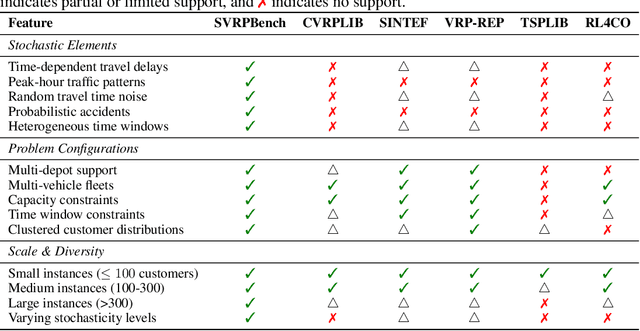
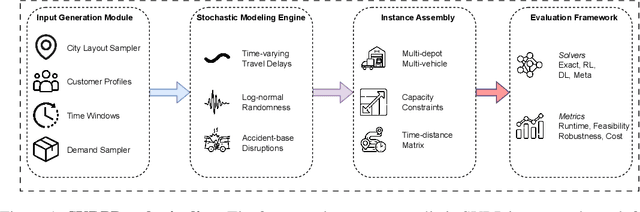
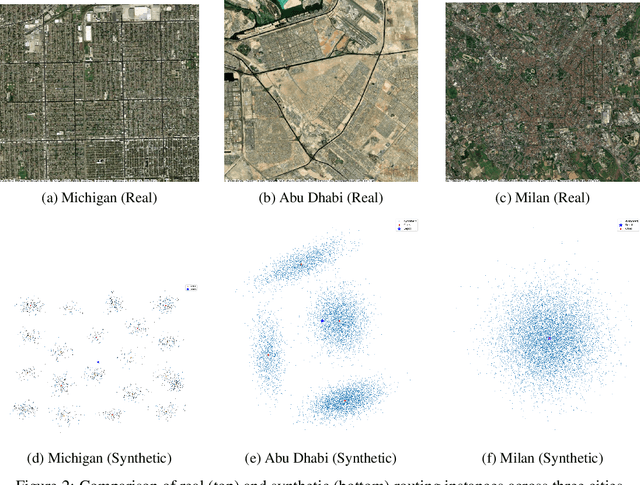
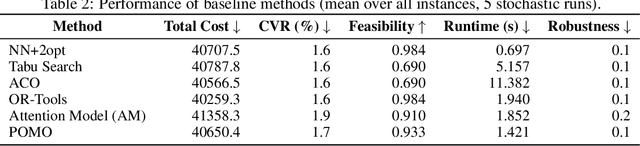
Robust routing under uncertainty is central to real-world logistics, yet most benchmarks assume static, idealized settings. We present SVRPBench, the first open benchmark to capture high-fidelity stochastic dynamics in vehicle routing at urban scale. Spanning more than 500 instances with up to 1000 customers, it simulates realistic delivery conditions: time-dependent congestion, log-normal delays, probabilistic accidents, and empirically grounded time windows for residential and commercial clients. Our pipeline generates diverse, constraint-rich scenarios, including multi-depot and multi-vehicle setups. Benchmarking reveals that state-of-the-art RL solvers like POMO and AM degrade by over 20% under distributional shift, while classical and metaheuristic methods remain robust. To enable reproducible research, we release the dataset and evaluation suite. SVRPBench challenges the community to design solvers that generalize beyond synthetic assumptions and adapt to real-world uncertainty.