 Add to Chrome
 Add to Firefox
 Add to Edge
Gaussian Phase Noise Effects on Hybrid Precoding MIMO Systems for Sub-THz Transmission
Mar 25, 2026
The sub-THz spectrum offers numerous advantages, including massive multiple-input multiple-output (MIMO) technology with large antenna arrays that enhance spectral efficiency (SE) of future systems. Hybrid precoding (HP) thus emerges as a cost-effective alternative to fully digital precoding regarding complexity and energy consumption. However, sub-THz frequencies introduce hardware challenges, particularly phase noise (PN) from local oscillators (LOs). We analyze PN impact on MIMO systems using HP, leveraging singular value decomposition and common LO architecture. We adopt the Gaussian PN (GPN) model, recognized as accurate for describing PN behavior in sub-THz transmissions. We derive a lower bound on achievable SE and provide closed-form bit error rate expressions for quadrature amplitude modulation (QAM), specifically 4-QAM and 16-QAM, under high-SNR and strong GPN conditions. These analytical results are validated through Monte Carlo simulations. We show that GPN can be effectively counteracted with a single pilot symbol in single-user MIMO systems, unlike single-input single-output systems where mitigation proves infeasible. Simulation results compare conventional QAM against polar-QAM tailored for GPN-impaired systems. Finally, we introduce perspectives for further improvements in performance and energy efficiency.

Exploiting Spatial Modulation for Strong PhaseNoise Mitigation in mmWave Massive MIMO
Mar 11, 2026This letter investigates phase noise (PN) mitigation in generalized receiver spatial modulation (GRSM) massive MIMO systems at mmWave under a common local oscillator (CLO). Under CLO, the received energy remains invariant relative to the no-PN scenario, enabling reliable energy-based spatial detection using the no-PN threshold. PN-sensitivity and geometry-based metrics are introduced to design compact, PN-resilient MQAM symbol pools with low detection complexity. PN robustness is further improved through an enhanced PN-aware GRSM-MQAM system that exploits spatial modulation (SM) to recover part of the MQAM bits and strategically maps spatial-pattern Hamming weights to reduce the effective PN impact. In addition, a practical single-stage PN estimation/compensation architecture is proposed, while a benchmark double-stage compensation is adopted to quantify the upper bound achievable via separate Tx/Rx PN mitigation. Results show that under PN, the overall BER is mainly dominated by MQAM symbol detection errors, especially for denser constellations, whereas spatial detection remains robust. The proposed single-stage compensation improves PN resilience, while the benchmark double-stage compensation approaches near PN-free performance.
X-REFINE: XAI-based RElevance input-Filtering and archItecture fiNe-tuning for channel Estimation
Feb 25, 2026AI-native architectures are vital for 6G wireless communications. The black-box nature and high complexity of deep learning models employed in critical applications, such as channel estimation, limit their practical deployment. While perturbation-based XAI solutions offer input filtering, they often neglect internal structural optimization. We propose X-REFINE, an XAI-based framework for joint input-filtering and architecture fine-tuning. By utilizing a decomposition-based, sign-stabilized LRP epsilon rule, X-REFINE backpropagates predictions to derive high-resolution relevance scores for both subcarriers and hidden neurons. This enables a holistic optimization that identifies the most faithful model components. Simulation results demonstrate that X-REFINE achieves a superior interpretability-performance-complexity trade-off, significantly reducing computational complexity while maintaining robust bit error rate (BER) performance across different scenarios.
On the Ambiguity Function of OFDM-based ISAC Signals Under Non-Ideal Power Amplifiers
Dec 10, 2025Integrated Sensing and Communications (ISAC) has garnered significant attention as a promising technology for next-generation wireless and vehicular communications. Among candidate waveforms, Orthogonal Frequency Division Multiplexing (OFDM) has been extensively investigated over the past decade for its robustness against frequency-selective fading and its favorable ranging performance. However, the waveform's sensing and communication (S&C) performance depends strongly on the modulation scheme; while variable-amplitude constellations such as quadrature amplitude (QAM) are more efficient for communication, constant-modulus modulations such as phase shift keying (PSK) are more suitable for sensing. Yet, it remains unclear whether these findings persist under power amplifier (PA) nonlinearity. Because OFDM signals exhibit a high peak-to-average power ratio (PAPR), they require highly linear PAs to avoid distortion, which conflicts with radar requirements, where high transmit power is always beneficial for sensing. In this work, we analyze the effect of PA-induced distortions on the sensing task for PSK and QAM constellations. By introducing the Signal-to-Distortion Ratio (SDR), we examine the extent of the distortion limitation on the ranging task. We complement simulation results with a theoretical characterization of the ambiguity function (AF), thereby explicitly demonstrating how distortion artifacts manifest in the zero-Doppler sidelobes (i.e, ranging sidelobes) and the zero-delay sidelobes. Simulations show that PA distortions impose a palpable performance ceiling for both constellations, reshape the AF, and reduce detection probability, diminishing the theoretical advantage of unimodular signaling and further compromising the OFDM sensing performance with non-uniform envelope signals.
Explainable AI for Enhancing Efficiency of DL-based Channel Estimation
Jul 09, 2024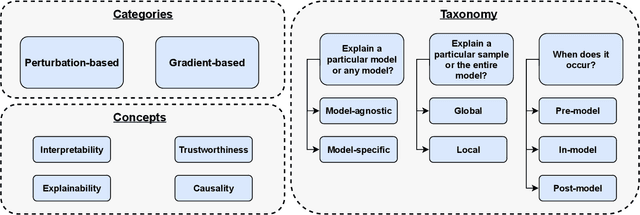
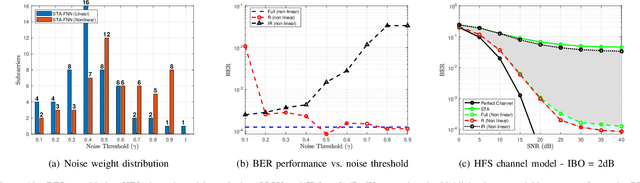
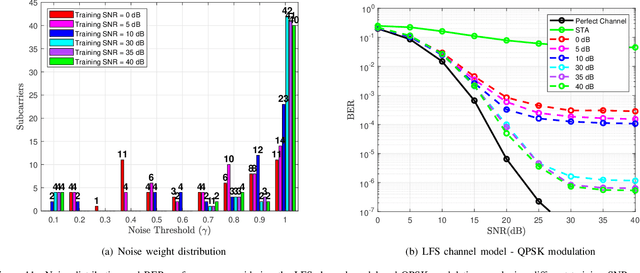
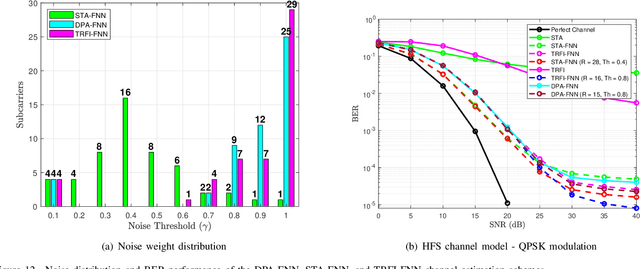
The support of artificial intelligence (AI) based decision-making is a key element in future 6G networks, where the concept of native AI will be introduced. Moreover, AI is widely employed in different critical applications such as autonomous driving and medical diagnosis. In such applications, using AI as black-box models is risky and challenging. Hence, it is crucial to understand and trust the decisions taken by these models. Tackling this issue can be achieved by developing explainable AI (XAI) schemes that aim to explain the logic behind the black-box model behavior, and thus, ensure its efficient and safe deployment. Recently, we proposed a novel perturbation-based XAI-CHEST framework that is oriented toward channel estimation in wireless communications. The core idea of the XAI-CHEST framework is to identify the relevant model inputs by inducing high noise on the irrelevant ones. This manuscript provides the detailed theoretical foundations of the XAI-CHEST framework. In particular, we derive the analytical expressions of the XAI-CHEST loss functions and the noise threshold fine-tuning optimization problem. Hence the designed XAI-CHEST delivers a smart input feature selection methodology that can further improve the overall performance while optimizing the architecture of the employed model. Simulation results show that the XAI-CHEST framework provides valid interpretations, where it offers an improved bit error rate performance while reducing the required computational complexity in comparison to the classical DL-based channel estimation.
Towards Explainable AI for Channel Estimation in Wireless Communications
Jul 03, 2023Research into 6G networks has been initiated to support a variety of critical artificial intelligence (AI) assisted applications such as autonomous driving. In such applications, AI-based decisions should be performed in a real-time manner. These decisions include resource allocation, localization, channel estimation, etc. Considering the black-box nature of existing AI-based models, it is highly challenging to understand and trust the decision-making behavior of such models. Therefore, explaining the logic behind those models through explainable AI (XAI) techniques is essential for their employment in critical applications. This manuscript proposes a novel XAI-based channel estimation (XAI-CHEST) scheme that provides detailed reasonable interpretability of the deep learning (DL) models that are employed in doubly-selective channel estimation. The aim of the proposed XAI-CHEST scheme is to identify the relevant model inputs by inducing high noise on the irrelevant ones. As a result, the behavior of the studied DL-based channel estimators can be further analyzed and evaluated based on the generated interpretations. Simulation results show that the proposed XAI-CHEST scheme provides valid interpretations of the DL-based channel estimators for different scenarios.