 Add to Chrome
 Add to Firefox
 Add to Edge
Deft Scheduling of Dynamic Cloud Workflows with Varying Deadlines via Mixture-of-Experts
May 31, 2026
Workflow scheduling in cloud computing demands the intelligent allocation of dynamically arriving, graph-structured workflows with varying deadlines onto ever-changing virtual machine resources. However, existing deep reinforcement learning (DRL) schedulers remain limited by rigid, single-path inference architectures that struggle to handle diverse scheduling scenarios. We introduce \textbf{DEFT} (\textbf{D}eadline-p\textbf{E}rceptive Mixture-o\textbf{F}-Exper\textbf{t}s), an innovative DRL policy architecture that leverages a specialized mixture of experts, each trained to manage different levels of deadline tightness. To our knowledge, DEFT is the first to introduce and validate a Mixture-of-Experts architecture for dynamic cloud workflow scheduling. By adaptively routing decisions through the most appropriate experts, DEFT is capable of meeting a broad spectrum of deadline requirements that no single expert can achieve. Central to DEFT is a \textbf{graph-adaptive} gating mechanism that encodes workflow deadlines and DAGs, task states, and VM conditions, using cross-attention to guide expert activation in a fine-grained, deadline-sensitive manner. Experiments on dynamic cloud workflow benchmarks demonstrate that DEFT significantly reduces execution cost and deadline violations, outperforming multiple state-of-the-art DRL baselines.
* This paper has been accepted by the Fourteenth International Conference on Learning Representations (ICLR 2026)

GATES: Cost-aware Dynamic Workflow Scheduling via Graph Attention Networks and Evolution Strategy
May 18, 2025Cost-aware Dynamic Workflow Scheduling (CADWS) is a key challenge in cloud computing, focusing on devising an effective scheduling policy to efficiently schedule dynamically arriving workflow tasks, represented as Directed Acyclic Graphs (DAG), to suitable virtual machines (VMs). Deep reinforcement learning (DRL) has been widely employed for automated scheduling policy design. However, the performance of DRL is heavily influenced by the design of the problem-tailored policy network and is highly sensitive to hyperparameters and the design of reward feedback. Considering the above-mentioned issues, this study proposes a novel DRL method combining Graph Attention Networks-based policy network and Evolution Strategy, referred to as GATES. The contributions of GATES are summarized as follows: (1) GATES can capture the impact of current task scheduling on subsequent tasks by learning the topological relationships between tasks in a DAG. (2) GATES can learn the importance of each VM to ready tasks, increasing the chance of selecting the optimal VM. (3) Utilizing Evolution Strategy's robustness, exploratory nature, and tolerance for delayed rewards, GATES achieves stable policy learning in CADWS. Extensive experimental results demonstrate the superiority of the proposed GATES in CADWS, outperforming several state-of-the-art algorithms. Codes are available at: https://github.com/YaShen998/GATES
Cost-Aware Dynamic Cloud Workflow Scheduling using Self-Attention and Evolutionary Reinforcement Learning
Sep 27, 2024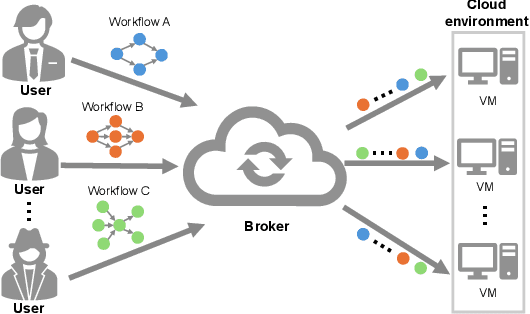


The Cost-aware Dynamic Multi-Workflow Scheduling (CDMWS) in the cloud is a kind of cloud workflow management problem, which aims to assign virtual machine (VM) instances to execute tasks in workflows so as to minimize the total costs, including both the penalties for violating Service Level Agreement (SLA) and the VM rental fees. Powered by deep neural networks, Reinforcement Learning (RL) methods can construct effective scheduling policies for solving CDMWS problems. Traditional policy networks in RL often use basic feedforward architectures to separately determine the suitability of assigning any VM instances, without considering all VMs simultaneously to learn their global information. This paper proposes a novel self-attention policy network for cloud workflow scheduling (SPN-CWS) that captures global information from all VMs. We also develop an Evolution Strategy-based RL (ERL) system to train SPN-CWS reliably and effectively. The trained SPN-CWS can effectively process all candidate VM instances simultaneously to identify the most suitable VM instance to execute every workflow task. Comprehensive experiments show that our method can noticeably outperform several state-of-the-art algorithms on multiple benchmark CDMWS problems.