 Add to Chrome
 Add to Firefox
 Add to Edge
Geometry-Calibrated Closed-Form Shrinkage for SAR Despeckling
Aug 15, 2026
Synthetic aperture radar (SAR) despeckling is an inverse-recovery problem in which multiplicative non-Gaussian noise must be suppressed without erasing scattering structures. We revisit a nonlocal sparse estimator that applies a log--Yeo--Johnson transformation, stacks similar patches into groups, codes each group on its own left singular basis, and shrinks the resulting coefficients. Three quantities usually treated as tunable are shown to be fixed by this construction. First, the group dictionary is orthonormal, so the weighted Lasso admits an exact coefficient-wise soft-threshold solution: the iterative inner solver is unnecessary, and the two apparent weighting matrices are the numerator and denominator of a single threshold field rather than independent modules. Second, because the dictionary is estimated from the noisy group itself, its retained subspace absorbs speckle in proportion to the group aspect ratio $γ=p^2/K$; a random-matrix argument converts the corresponding regularization constant into a geometry-calibrated correction and collapses patch size, group size, and shrinkage scale into one analytically determined degree of freedom. Third, singular projection makes the coefficient noise nearly Gaussian at every tested look number, which locates the point at which an exact speckle likelihood ceases to be informative. The resulting estimator is deterministic, training-free, and applies one set of analytically determined settings to every image and sensor. It ranks first in 18 of 24 PSNR/SSIM comparisons against twelve published methods on three synthetic benchmarks, and attains the lowest mean deviation of the ratio image from the theoretical speckle model over six real-SAR configurations from five sensors. Code is available \href{https://github.com/Teriri1999/Geometry-Calibrated-Closed-Form-Shrinkage-for-SAR-Despeckling}{here}.

$γ$-Bridge: A Look-Parametric Diffusion Bridge
Jul 21, 2026Multiplicative Gamma noise is a signal-dependent degradation in coherent imaging; synthetic aperture radar (SAR) despeckling is its most prominent real-world instance. Existing diffusion denoisers parameterize their forward process by abstract signal-to-noise schedules rather than by the physical look number $L$, so different deployment scenarios typically require separately trained models, and transfer from synthetic Gamma training to real SAR remains challenging without clean ground truth. We introduce $γ$-Bridge, a look-parametric bridge whose schedule $L(t)$ connects the noisy observation at $L_{obs}$ to the clean limit through exact multiplicative Gamma marginals. Its closed-form Gamma--Lévy reverse posterior admits both stochastic and deterministic processes, while observation conditioning and a two-step consistency loss stabilize multi-step inference in the low-SNR single-look regime. Because bridge time directly represents $L$, one conditioned network can smart-start from any admissible input look and stop at a target look number. These two orthogonal controls enable zero-shot restoration over the full admissible grid after training only at $L_{obs} = 1$ on natural images with synthetic Gamma corruption. Combined with a homogeneous-patch look estimator, $γ$-Bridge processes data from six spaceborne and airborne SAR sensors without sensor-specific fine-tuning, achieving leading results on standard synthetic benchmarks while providing physically interpretable input and output controls absent from prior denoisers. Codes are released \href{https://github.com/Teriri1999/GammaBridge}{here}.
GeoHeight-Bench: Towards Height-Aware Multimodal Reasoning in Remote Sensing
Mar 26, 2026Current Large Multimodal Models (LMMs) in Earth Observation typically neglect the critical "vertical" dimension, limiting their reasoning capabilities in complex remote sensing geometries and disaster scenarios where physical spatial structures often outweigh planar visual textures. To bridge this gap, we introduce a comprehensive evaluation framework dedicated to height-aware remote sensing understanding. First, to overcome the severe scarcity of annotated data, we develop a scalable, VLM-driven data generation pipeline utilizing systematic prompt engineering and metadata extraction. This pipeline constructs two complementary benchmarks: GeoHeight-Bench for relative height analysis, and a more challenging GeoHeight-Bench+ for holistic, terrain-aware reasoning. Furthermore, to validate the necessity of height perception, we propose GeoHeightChat, the first height-aware remote sensing LMM baseline. Serving as a strong proof of concept, our baseline demonstrates that synergizing visual semantics with implicitly injected height geometric features effectively mitigates the "vertical blind spot", successfully unlocking a new paradigm of interactive height reasoning in existing optical models.
Perturbation on Feature Coalition: Towards Interpretable Deep Neural Networks
Aug 23, 2024The inherent "black box" nature of deep neural networks (DNNs) compromises their transparency and reliability. Recently, explainable AI (XAI) has garnered increasing attention from researchers. Several perturbation-based interpretations have emerged. However, these methods often fail to adequately consider feature dependencies. To solve this problem, we introduce a perturbation-based interpretation guided by feature coalitions, which leverages deep information of network to extract correlated features. Then, we proposed a carefully-designed consistency loss to guide network interpretation. Both quantitative and qualitative experiments are conducted to validate the effectiveness of our proposed method. Code is available at github.com/Teriri1999/Perturebation-on-Feature-Coalition.
Multi-task SAR Image Processing via GAN-based Unsupervised Manipulation
Aug 02, 2024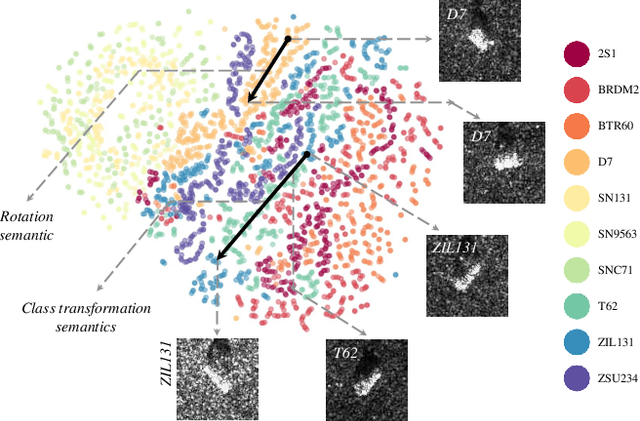
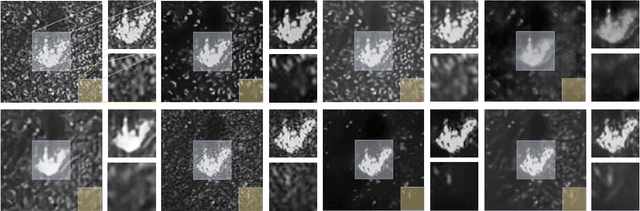
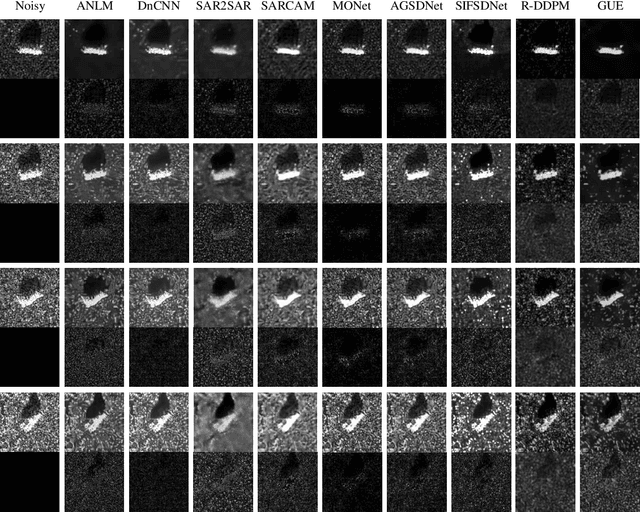
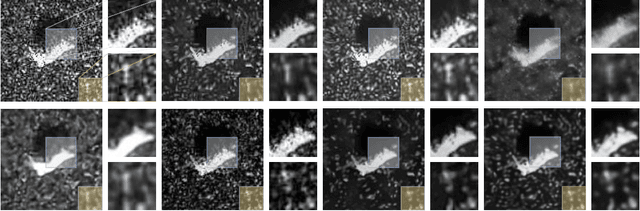
Generative Adversarial Networks (GANs) have shown tremendous potential in synthesizing a large number of realistic SAR images by learning patterns in the data distribution. Some GANs can achieve image editing by introducing latent codes, demonstrating significant promise in SAR image processing. Compared to traditional SAR image processing methods, editing based on GAN latent space control is entirely unsupervised, allowing image processing to be conducted without any labeled data. Additionally, the information extracted from the data is more interpretable. This paper proposes a novel SAR image processing framework called GAN-based Unsupervised Editing (GUE), aiming to address the following two issues: (1) disentangling semantic directions in the GAN latent space and finding meaningful directions; (2) establishing a comprehensive SAR image processing framework while achieving multiple image processing functions. In the implementation of GUE, we decompose the entangled semantic directions in the GAN latent space by training a carefully designed network. Moreover, we can accomplish multiple SAR image processing tasks (including despeckling, localization, auxiliary identification, and rotation editing) in a single training process without any form of supervision. Extensive experiments validate the effectiveness of the proposed method.
SAR Despeckling via Regional Denoising Diffusion Probabilistic Model
Jan 06, 2024Speckle noise poses a significant challenge in maintaining the quality of synthetic aperture radar (SAR) images, so SAR despeckling techniques have drawn increasing attention. Despite the tremendous advancements of deep learning in fixed-scale SAR image despeckling, these methods still struggle to deal with large-scale SAR images. To address this problem, this paper introduces a novel despeckling approach termed Region Denoising Diffusion Probabilistic Model (R-DDPM) based on generative models. R-DDPM enables versatile despeckling of SAR images across various scales, accomplished within a single training session. Moreover, The artifacts in the fused SAR images can be avoided effectively with the utilization of region-guided inverse sampling. Experiments of our proposed R-DDPM on Sentinel-1 data demonstrates superior performance to existing methods.
Manifold-based Shapley for SAR Recognization Network Explanation
Jan 06, 2024


Explainable artificial intelligence (XAI) holds immense significance in enhancing the deep neural network's transparency and credibility, particularly in some risky and high-cost scenarios, like synthetic aperture radar (SAR). Shapley is a game-based explanation technique with robust mathematical foundations. However, Shapley assumes that model's features are independent, rendering Shapley explanation invalid for high dimensional models. This study introduces a manifold-based Shapley method by projecting high-dimensional features into low-dimensional manifold features and subsequently obtaining Fusion-Shap, which aims at (1) addressing the issue of erroneous explanations encountered by traditional Shap; (2) resolving the challenge of interpretability that traditional Shap faces in complex scenarios.