 Add to Chrome
 Add to Firefox
 Add to Edge
Human-in-the-Loop Multi-Agent Ventilator Decision Support with Contextual Bandit Preference Learning
May 22, 2026
Ventilator decision support requires sequential decisions that track evolving physiology and disease trajectories while respecting safety boundaries and clinician specific tuning styles. Rule based approaches rarely generalize personalization, and end to end reinforcement learning or single large language model systems remain difficult to control and audit. We propose the Ventilator Decision Support System (VDSS), a human in the loop multi agent framework that coordinates modular decision components through contract driven structured interfaces and produces traceable evidence for review. VDSS performs online preference adaptation with a contextual bandit, updating clinician specific preferences from the final accepted decision at each adjustment cycle and using them to guide subsequent recommendations. Structured rejection feedback triggers targeted replanning to reduce unproductive iterations and improve interaction stability. Retrospective ICU trajectory replay with expert review indicates higher recommendation acceptability and fewer interaction rounds to reach an acceptable plan, supporting clinically deployable human AI collaboration.

FairGSE: Fairness-Aware Graph Neural Network without High False Positive Rates
Nov 15, 2025Graph neural networks (GNNs) have emerged as the mainstream paradigm for graph representation learning due to their effective message aggregation. However, this advantage also amplifies biases inherent in graph topology, raising fairness concerns. Existing fairness-aware GNNs provide satisfactory performance on fairness metrics such as Statistical Parity and Equal Opportunity while maintaining acceptable accuracy trade-offs. Unfortunately, we observe that this pursuit of fairness metrics neglects the GNN's ability to predict negative labels, which renders their predictions with extremely high False Positive Rates (FPR), resulting in negative effects in high-risk scenarios. To this end, we advocate that classification performance should be carefully calibrated while improving fairness, rather than simply constraining accuracy loss. Furthermore, we propose Fair GNN via Structural Entropy (\textbf{FairGSE}), a novel framework that maximizes two-dimensional structural entropy (2D-SE) to improve fairness without neglecting false positives. Experiments on several real-world datasets show FairGSE reduces FPR by 39\% vs. state-of-the-art fairness-aware GNNs, with comparable fairness improvement.
Towards Fair Graph Neural Networks via Graph Counterfactual without Sensitive Attributes
Dec 13, 2024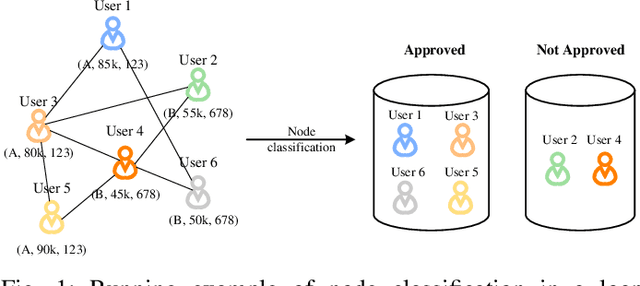
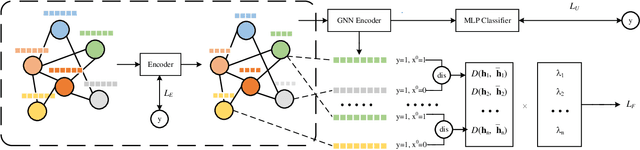
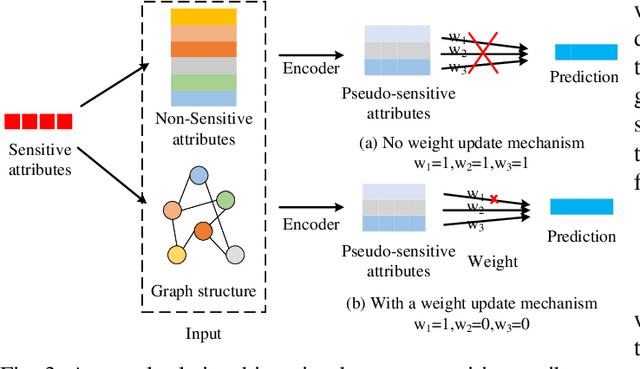
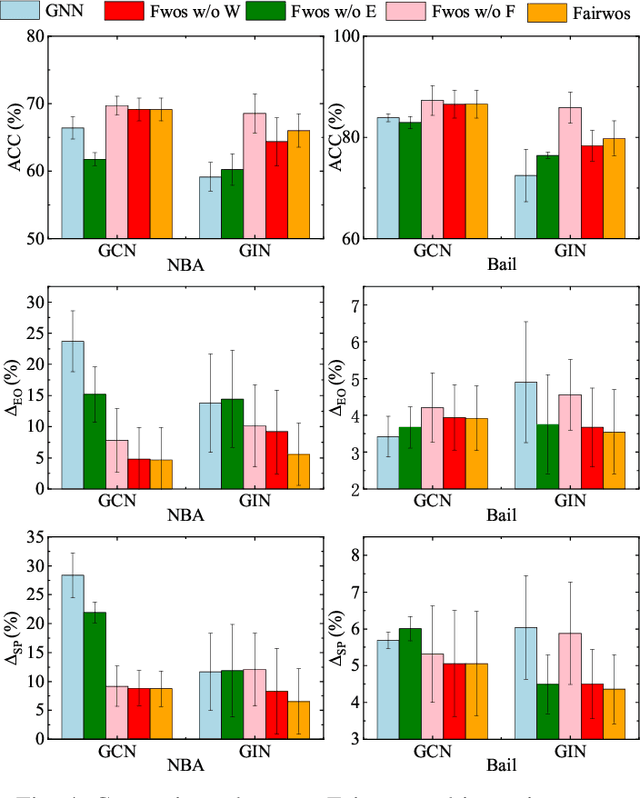
Graph-structured data is ubiquitous in today's connected world, driving extensive research in graph analysis. Graph Neural Networks (GNNs) have shown great success in this field, leading to growing interest in developing fair GNNs for critical applications. However, most existing fair GNNs focus on statistical fairness notions, which may be insufficient when dealing with statistical anomalies. Hence, motivated by causal theory, there has been growing attention to mitigating root causes of unfairness utilizing graph counterfactuals. Unfortunately, existing methods for generating graph counterfactuals invariably require the sensitive attribute. Nevertheless, in many real-world applications, it is usually infeasible to obtain sensitive attributes due to privacy or legal issues, which challenge existing methods. In this paper, we propose a framework named Fairwos (improving Fairness without sensitive attributes). In particular, we first propose a mechanism to generate pseudo-sensitive attributes to remedy the problem of missing sensitive attributes, and then design a strategy for finding graph counterfactuals from the real dataset. To train fair GNNs, we propose a method to ensure that the embeddings from the original data are consistent with those from the graph counterfactuals, and dynamically adjust the weight of each pseudo-sensitive attribute to balance its contribution to fairness and utility. Furthermore, we theoretically demonstrate that minimizing the relation between these pseudo-sensitive attributes and the prediction can enable the fairness of GNNs. Experimental results on six real-world datasets show that our approach outperforms state-of-the-art methods in balancing utility and fairness.