 Add to Chrome
 Add to Firefox
 Add to Edge
Improving Region Representation Learning from Urban Imagery with Noisy Long-Caption Supervision
Nov 10, 2025
Region representation learning plays a pivotal role in urban computing by extracting meaningful features from unlabeled urban data. Analogous to how perceived facial age reflects an individual's health, the visual appearance of a city serves as its ``portrait", encapsulating latent socio-economic and environmental characteristics. Recent studies have explored leveraging Large Language Models (LLMs) to incorporate textual knowledge into imagery-based urban region representation learning. However, two major challenges remain: i)~difficulty in aligning fine-grained visual features with long captions, and ii) suboptimal knowledge incorporation due to noise in LLM-generated captions. To address these issues, we propose a novel pre-training framework called UrbanLN that improves Urban region representation learning through Long-text awareness and Noise suppression. Specifically, we introduce an information-preserved stretching interpolation strategy that aligns long captions with fine-grained visual semantics in complex urban scenes. To effectively mine knowledge from LLM-generated captions and filter out noise, we propose a dual-level optimization strategy. At the data level, a multi-model collaboration pipeline automatically generates diverse and reliable captions without human intervention. At the model level, we employ a momentum-based self-distillation mechanism to generate stable pseudo-targets, facilitating robust cross-modal learning under noisy conditions. Extensive experiments across four real-world cities and various downstream tasks demonstrate the superior performance of our UrbanLN.

TREC: APT Tactic / Technique Recognition via Few-Shot Provenance Subgraph Learning
Feb 23, 2024
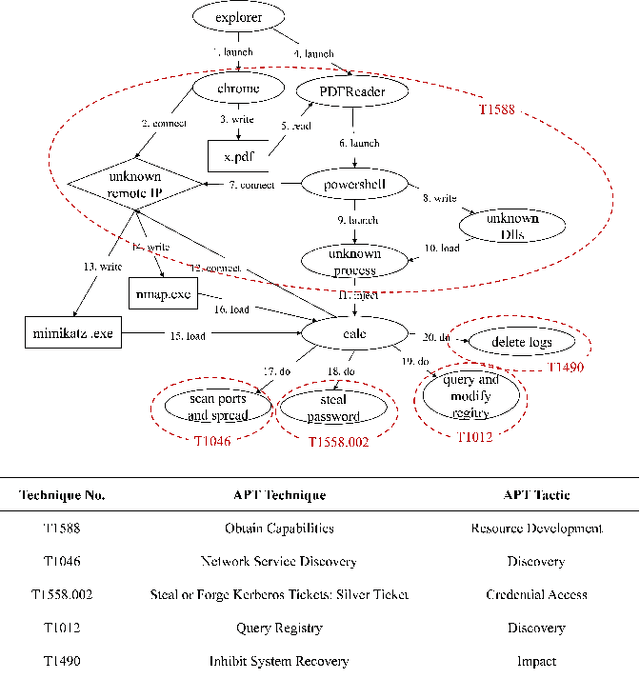
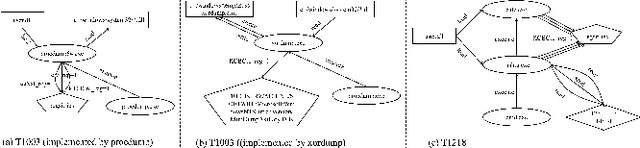

APT (Advanced Persistent Threat) with the characteristics of persistence, stealth, and diversity is one of the greatest threats against cyber-infrastructure. As a countermeasure, existing studies leverage provenance graphs to capture the complex relations between system entities in a host for effective APT detection. In addition to detecting single attack events as most existing work does, understanding the tactics / techniques (e.g., Kill-Chain, ATT&CK) applied to organize and accomplish the APT attack campaign is more important for security operations. Existing studies try to manually design a set of rules to map low-level system events to high-level APT tactics / techniques. However, the rule based methods are coarse-grained and lack generalization ability, thus they can only recognize APT tactics and cannot identify fine-grained APT techniques and mutant APT attacks. In this paper, we propose TREC, the first attempt to recognize APT tactics / techniques from provenance graphs by exploiting deep learning techniques. To address the "needle in a haystack" problem, TREC segments small and compact subgraphs covering individual APT technique instances from a large provenance graph based on a malicious node detection model and a subgraph sampling algorithm. To address the "training sample scarcity" problem, TREC trains the APT tactic / technique recognition model in a few-shot learning manner by adopting a Siamese neural network. We evaluate TREC based on a customized dataset collected and made public by our team. The experiment results show that TREC significantly outperforms state-of-the-art systems in APT tactic recognition and TREC can also effectively identify APT techniques.