 Add to Chrome
 Add to Firefox
 Add to Edge
DataFlex: A Unified Framework for Data-Centric Dynamic Training of Large Language Models
Mar 27, 2026
Data-centric training has emerged as a promising direction for improving large language models (LLMs) by optimizing not only model parameters but also the selection, composition, and weighting of training data during optimization. However, existing approaches to data selection, data mixture optimization, and data reweighting are often developed in isolated codebases with inconsistent interfaces, hindering reproducibility, fair comparison, and practical integration. In this paper, we present DataFlex, a unified data-centric dynamic training framework built upon LLaMA-Factory. DataFlex supports three major paradigms of dynamic data optimization: sample selection, domain mixture adjustment, and sample reweighting, while remaining fully compatible with the original training workflow. It provides extensible trainer abstractions and modular components, enabling a drop-in replacement for standard LLM training, and unifies key model-dependent operations such as embedding extraction, inference, and gradient computation, with support for large-scale settings including DeepSpeed ZeRO-3. We conduct comprehensive experiments across multiple data-centric methods. Dynamic data selection consistently outperforms static full-data training on MMLU across both Mistral-7B and Llama-3.2-3B. For data mixture, DoReMi and ODM improve both MMLU accuracy and corpus-level perplexity over default proportions when pretraining Qwen2.5-1.5B on SlimPajama at 6B and 30B token scales. DataFlex also achieves consistent runtime improvements over original implementations. These results demonstrate that DataFlex provides an effective, efficient, and reproducible infrastructure for data-centric dynamic training of LLMs.

SciAgent: A Unified Multi-Agent System for Generalistic Scientific Reasoning
Nov 17, 2025Recent advances in large language models have enabled AI systems to achieve expert-level performance on domain-specific scientific tasks, yet these systems remain narrow and handcrafted. We introduce SciAgent, a unified multi-agent system designed for generalistic scientific reasoning-the ability to adapt reasoning strategies across disciplines and difficulty levels. SciAgent organizes problem solving as a hierarchical process: a Coordinator Agent interprets each problem's domain and complexity, dynamically orchestrating specialized Worker Systems, each composed of interacting reasoning Sub-agents for symbolic deduction, conceptual modeling, numerical computation, and verification. These agents collaboratively assemble and refine reasoning pipelines tailored to each task. Across mathematics and physics Olympiads (IMO, IMC, IPhO, CPhO), SciAgent consistently attains or surpasses human gold-medalist performance, demonstrating both domain generality and reasoning adaptability. Additionally, SciAgent has been tested on the International Chemistry Olympiad (IChO) and selected problems from the Humanity's Last Exam (HLE) benchmark, further confirming the system's ability to generalize across diverse scientific domains. This work establishes SciAgent as a concrete step toward generalistic scientific intelligence-AI systems capable of coherent, cross-disciplinary reasoning at expert levels.
MorphoBench: A Benchmark with Difficulty Adaptive to Model Reasoning
Oct 16, 2025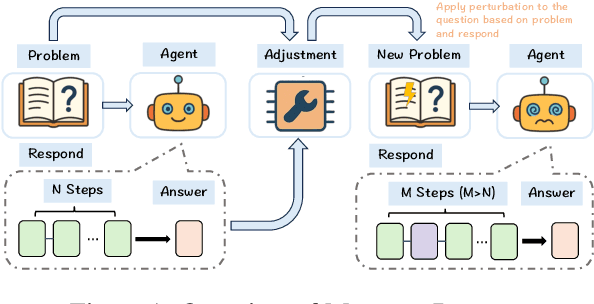

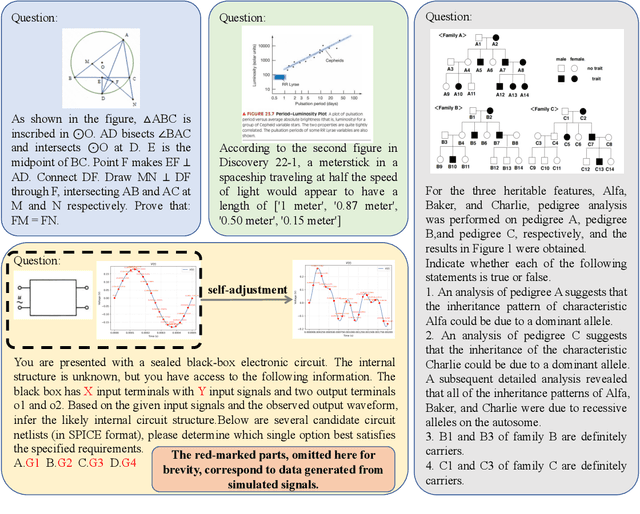
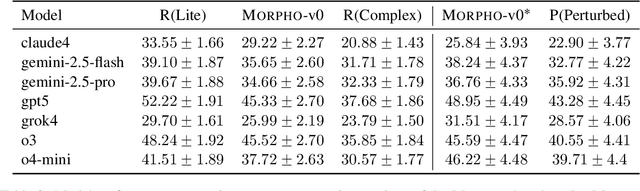
With the advancement of powerful large-scale reasoning models, effectively evaluating the reasoning capabilities of these models has become increasingly important. However, existing benchmarks designed to assess the reasoning abilities of large models tend to be limited in scope and lack the flexibility to adapt their difficulty according to the evolving reasoning capacities of the models. To address this, we propose MorphoBench, a benchmark that incorporates multidisciplinary questions to evaluate the reasoning capabilities of large models and can adjust and update question difficulty based on the reasoning abilities of advanced models. Specifically, we curate the benchmark by selecting and collecting complex reasoning questions from existing benchmarks and sources such as Olympiad-level competitions. Additionally, MorphoBench adaptively modifies the analytical challenge of questions by leveraging key statements generated during the model's reasoning process. Furthermore, it includes questions generated using simulation software, enabling dynamic adjustment of benchmark difficulty with minimal resource consumption. We have gathered over 1,300 test questions and iteratively adjusted the difficulty of MorphoBench based on the reasoning capabilities of models such as o3 and GPT-5. MorphoBench enhances the comprehensiveness and validity of model reasoning evaluation, providing reliable guidance for improving both the reasoning abilities and scientific robustness of large models. The code has been released in https://github.com/OpenDCAI/MorphoBench.