 Add to Chrome
 Add to Firefox
 Add to Edge
How Creative Are Large Language Models in Generating Molecules?
Apr 20, 2026
Molecule generation requires satisfying multiple chemical and biological constraints while searching a large and structured chemical space. This makes it a non-binary problem, where effective models must identify non-obvious solutions under constraints while maintaining exploration to improve success by escaping local optima. From this perspective, creativity is a functional requirement in molecular generation rather than an aesthetic notion. Large language models (LLMs) can generate molecular representations directly from natural language prompts, but it remains unclear what type of creativity they exhibit in this setting and how it should be evaluated. In this work, we study the creative behavior of LLMs in molecular generation through a systematic empirical evaluation across physicochemical, ADMET, and biological activity tasks. We characterize creativity along two complementary dimensions, convergent creativity and divergent creativity, and analyze how different factors shape these behaviors. Our results indicate that LLMs exhibit distinct patterns of creative behavior in molecule generation, such as an increase in constraint satisfaction when additional constraints are imposed. Overall, our work is the first to reframe the abilities required for molecule generation as creativity, providing a systematic understanding of creativity in LLM-based molecular generation and clarifying the appropriate use of LLMs in molecular discovery pipelines.

AdaptMol: Adaptive Fusion from Sequence String to Topological Structure for Few-shot Drug Discovery
May 17, 2025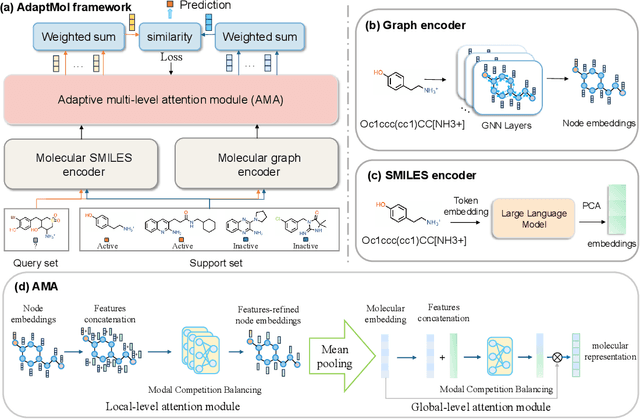
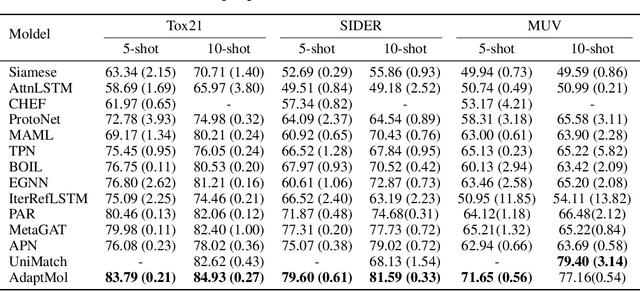
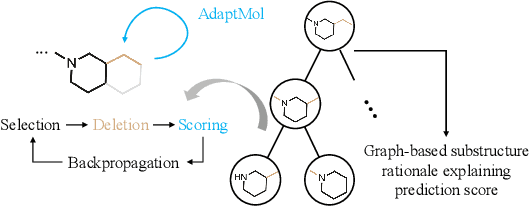
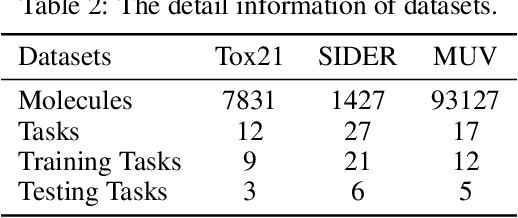
Accurate molecular property prediction (MPP) is a critical step in modern drug development. However, the scarcity of experimental validation data poses a significant challenge to AI-driven research paradigms. Under few-shot learning scenarios, the quality of molecular representations directly dictates the theoretical upper limit of model performance. We present AdaptMol, a prototypical network integrating Adaptive multimodal fusion for Molecular representation. This framework employs a dual-level attention mechanism to dynamically integrate global and local molecular features derived from two modalities: SMILES sequences and molecular graphs. (1) At the local level, structural features such as atomic interactions and substructures are extracted from molecular graphs, emphasizing fine-grained topological information; (2) At the global level, the SMILES sequence provides a holistic representation of the molecule. To validate the necessity of multimodal adaptive fusion, we propose an interpretable approach based on identifying molecular active substructures to demonstrate that multimodal adaptive fusion can efficiently represent molecules. Extensive experiments on three commonly used benchmarks under 5-shot and 10-shot settings demonstrate that AdaptMol achieves state-of-the-art performance in most cases. The rationale-extracted method guides the fusion of two modalities and highlights the importance of both modalities.