 Add to Chrome
 Add to Firefox
 Add to Edge
Characterization, Analytical Planning, and Hybrid Force Control for the Inspire RH56DFX Hand
Mar 09, 2026
Commercially accessible dexterous robot hands are increasingly prevalent, but many remain difficult to use as scientific instruments. For example, the Inspire RH56DFX hand exposes only uncalibrated proprioceptive information and shows unreliable contact behavior at high speed (up to 1618% force limit overshoot). Furthermore, its underactuated, coupled finger linkages make antipodal grasps non-trivial. We contribute three improvements to the Inspire RH56DFX to transform it from a black-box device to a research tool: (1) hardware characterization (force calibration, latency, and overshoot), (2) a sim2real validated MuJoCo model for analytical width-to-grasp planning, and (3) a hybrid, closed-loop speed-force grasp controller. We validate these components on peg-in-hole insertion, achieving 65% success and outperforming a wrist-force-only baseline of 10% and on 300 grasps across 15 physically diverse objects, achieving 87% success and outperforming plan-free grasps and learned grasps. Our approach is modular, designed for compatibility with external object detectors and vision-language models for width & force estimation and high-level planning, and provides an interpretable and immediately deployable interface for dexterous manipulation with the Inspire RH56DFX hand, open-sourced at this website https://correlllab.github.io/rh56dfx.html.

CLIP-based Camera-Agnostic Feature Learning for Intra-camera Person Re-Identification
Sep 29, 2024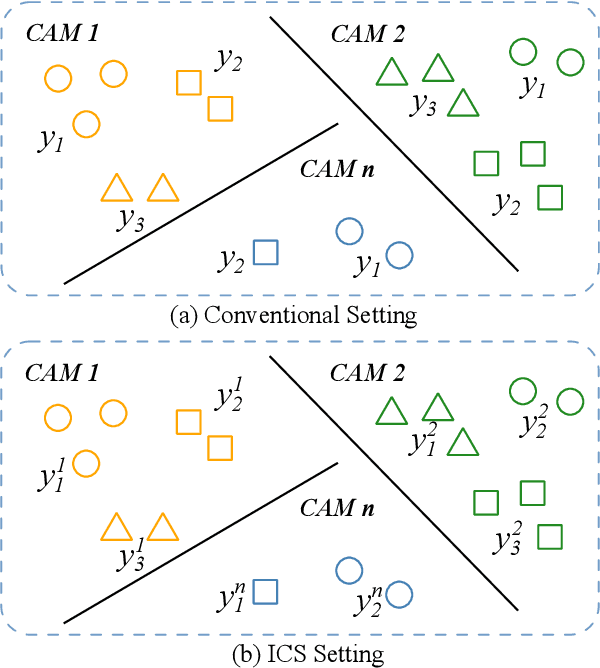
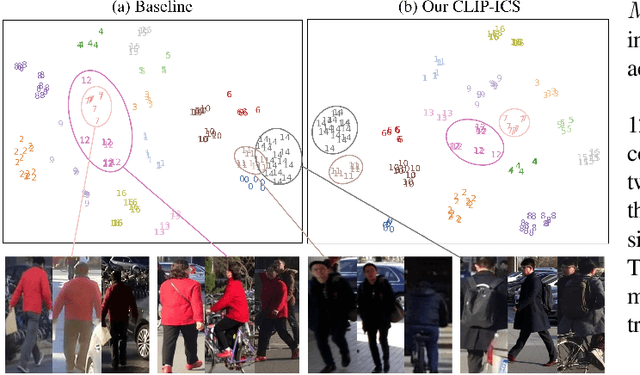
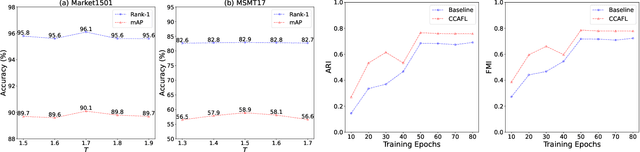
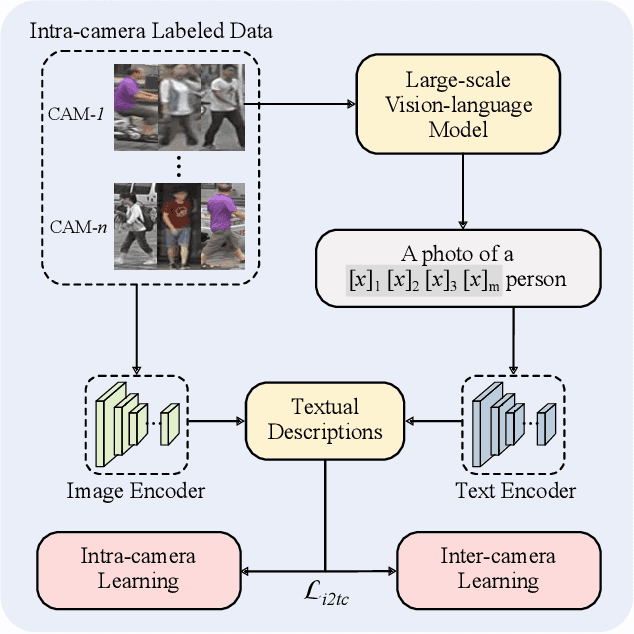
Contrastive Language-Image Pre-Training (CLIP) model excels in traditional person re-identification (ReID) tasks due to its inherent advantage in generating textual descriptions for pedestrian images. However, applying CLIP directly to intra-camera supervised person re-identification (ICS ReID) presents challenges. ICS ReID requires independent identity labeling within each camera, without associations across cameras. This limits the effectiveness of text-based enhancements. To address this, we propose a novel framework called CLIP-based Camera-Agnostic Feature Learning (CCAFL) for ICS ReID. Accordingly, two custom modules are designed to guide the model to actively learn camera-agnostic pedestrian features: Intra-Camera Discriminative Learning (ICDL) and Inter-Camera Adversarial Learning (ICAL). Specifically, we first establish learnable textual prompts for intra-camera pedestrian images to obtain crucial semantic supervision signals for subsequent intra- and inter-camera learning. Then, we design ICDL to increase inter-class variation by considering the hard positive and hard negative samples within each camera, thereby learning intra-camera finer-grained pedestrian features. Additionally, we propose ICAL to reduce inter-camera pedestrian feature discrepancies by penalizing the model's ability to predict the camera from which a pedestrian image originates, thus enhancing the model's capability to recognize pedestrians from different viewpoints. Extensive experiments on popular ReID datasets demonstrate the effectiveness of our approach. Especially, on the challenging MSMT17 dataset, we arrive at 58.9\% in terms of mAP accuracy, surpassing state-of-the-art methods by 7.6\%. Code will be available at: https://github.com/Trangle12/CCAFL.