 Add to Chrome
 Add to Firefox
 Add to Edge
HiST: A Hierarchical Sparse Transformer for Cross-Modal Spatial Transcriptomics Modeling
Jun 12, 2026
Spatial transcriptomics (ST) links gene expression with tissue morphology but remains expensive and low-throughput, motivating surrogates that infer expression from routine histology. Whole-slide H&E-to-ST inference pairs a gigapixel image with gene measurements at a sparse, irregular set of locations, making multiscale modeling challenging without incurring dense-grid overhead or quadratic token mixing. We propose HiST, a hierarchical sparse transformer that treats measured locations as a lattice-indexed sparse field and builds a dyadic encoder--decoder directly on the active tissue footprint. HiST combines sparse window attention for local geometric correspondence with resolution-changing operators for rapid multiscale context integration. For a fixed window size, the dominant runtime and memory scale with the number of observed locations rather than the dense slide area. To mitigate slide-specific acquisition variation, HiST adds a bottlenecked global conditioning pathway via a \emph{slide calibration token} that summarizes slide-level context and conditions local representations. On a multi-organ benchmark spanning diverse tissues and acquisition sources, HiST improves predictive performance over recent baselines while reducing runtime and peak memory.

Generative Simulation for Policy Learning in Physical Human-Robot Interaction
Apr 09, 2026Developing autonomous physical human-robot interaction (pHRI) systems is limited by the scarcity of large-scale training data to learn robust robot behaviors for real-world applications. In this paper, we introduce a zero-shot "text2sim2real" generative simulation framework that automatically synthesizes diverse pHRI scenarios from high-level natural-language prompts. Leveraging Large Language Models (LLMs) and Vision-Language Models (VLMs), our pipeline procedurally generates soft-body human models, scene layouts, and robot motion trajectories for assistive tasks. We utilize this framework to autonomously collect large-scale synthetic demonstration datasets and then train vision-based imitation learning policies operating on segmented point clouds. We evaluate our approach through a user study on two physically assistive tasks: scratching and bathing. Our learned policies successfully achieve zero-shot sim-to-real transfer, attaining success rates exceeding 80% and demonstrating resilience to unscripted human motion. Overall, we introduce the first generative simulation pipeline for pHRI applications, automating simulation environment synthesis, data collection, and policy learning. Additional information may be found on our project website: https://rchi-lab.github.io/gen_phri/
Exploiting Label-Independent Regularization from Spatial Dependencies for Whole Slide Image Analysis
Feb 23, 2026Whole slide images, with their gigapixel-scale panoramas of tissue samples, are pivotal for precise disease diagnosis. However, their analysis is hindered by immense data size and scarce annotations. Existing MIL methods face challenges due to the fundamental imbalance where a single bag-level label must guide the learning of numerous patch-level features. This sparse supervision makes it difficult to reliably identify discriminative patches during training, leading to unstable optimization and suboptimal solutions. We propose a spatially regularized MIL framework that leverages inherent spatial relationships among patch features as label-independent regularization signals. Our approach learns a shared representation space by jointly optimizing feature-induced spatial reconstruction and label-guided classification objectives, enforcing consistency between intrinsic structural patterns and supervisory signals. Experimental results on multiple public datasets demonstrate significant improvements over state-of-the-art methods, offering a promising direction.
Assessing and Mitigating Medical Knowledge Drift and Conflicts in Large Language Models
May 12, 2025Large Language Models (LLMs) have great potential in the field of health care, yet they face great challenges in adapting to rapidly evolving medical knowledge. This can lead to outdated or contradictory treatment suggestions. This study investigated how LLMs respond to evolving clinical guidelines, focusing on concept drift and internal inconsistencies. We developed the DriftMedQA benchmark to simulate guideline evolution and assessed the temporal reliability of various LLMs. Our evaluation of seven state-of-the-art models across 4,290 scenarios demonstrated difficulties in rejecting outdated recommendations and frequently endorsing conflicting guidance. Additionally, we explored two mitigation strategies: Retrieval-Augmented Generation and preference fine-tuning via Direct Preference Optimization. While each method improved model performance, their combination led to the most consistent and reliable results. These findings underscore the need to improve LLM robustness to temporal shifts to ensure more dependable applications in clinical practice.
Memory-Efficient Sparse Pyramid Attention Networks for Whole Slide Image Analysis
Jun 13, 2024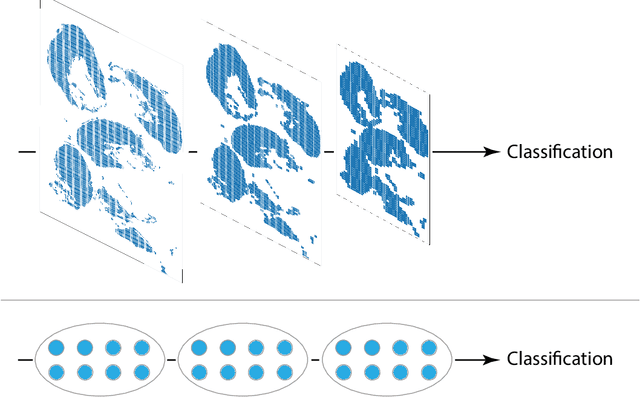
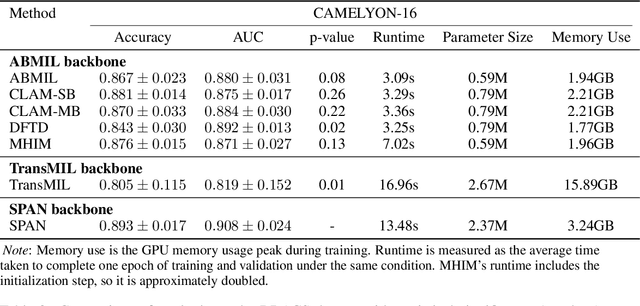
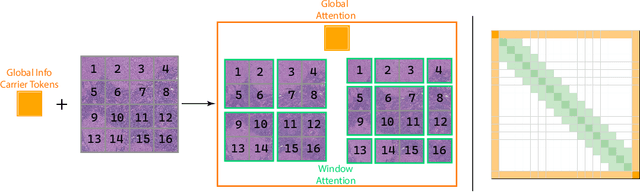
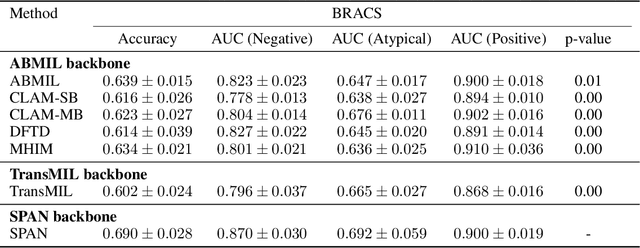
Whole Slide Images (WSIs) are crucial for modern pathological diagnosis, yet their gigapixel-scale resolutions and sparse informative regions pose significant computational challenges. Traditional dense attention mechanisms, widely used in computer vision and natural language processing, are impractical for WSI analysis due to the substantial data scale and the redundant processing of uninformative areas. To address these challenges, we propose Memory-Efficient Sparse Pyramid Attention Networks with Shifted Windows (SPAN), drawing inspiration from state-of-the-art sparse attention techniques in other domains. SPAN introduces a sparse pyramid attention architecture that hierarchically focuses on informative regions within the WSI, aiming to reduce memory overhead while preserving critical features. Additionally, the incorporation of shifted windows enables the model to capture long-range contextual dependencies essential for accurate classification. We evaluated SPAN on multiple public WSI datasets, observing its competitive performance. Unlike existing methods that often struggle to model spatial and contextual information due to memory constraints, our approach enables the accurate modeling of these crucial features. Our study also highlights the importance of key design elements in attention mechanisms, such as the shifted-window scheme and the hierarchical structure, which contribute substantially to the effectiveness of SPAN in WSI analysis. The potential of SPAN for memory-efficient and effective analysis of WSI data is thus demonstrated, and the code will be made publicly available following the publication of this work.